From Dysbiosis to Metabolic Vulnerability: Rethinking the Gut-Brain Connection in Depression
 The Gut-Brain Connection Is More Complicated Than We Thought
Over the past decade, the gut microbiome has become one of the most intriguing areas of research on depression.
Studies have repeatedly asked whether people with major depressive disorder (MDD) have a different collection of intestinal microorganisms than people without depression. Researchers have examined microbial diversity, the relative abundance of particular bacteria, and broad patterns commonly described as “dysbiosis.”
But there is a fundamental problem: findings across studies have often been inconsistent.
In a new article published in Molecular Psychiatry, my colleagues and I argue that this inconsistency may reflect a problem with the question itself.
Rather than asking primarily “Which bacteria are present?”, perhaps we should be asking:
“What are those microorganisms doing to the metabolism of the person in whom they live?”
That shift—from microbial composition to metabolic function—could have important implications for understanding depression and ultimately for developing more precise treatments.
What Is Dysbiosis?
The term dysbiosis generally refers to alterations in the composition of the microbial community. In depression research, studies have reported findings such as:
- Reduced microbial diversity
- Changes in particular bacterial genera
- Alterations in the relative proportions of microbial populations
- Reductions in bacteria capable of producing short-chain fatty acids
These findings are scientifically interesting, but dysbiosis itself is descriptive rather than mechanistic.
Knowing that the microbiome looks different does not necessarily tell us how that difference could contribute to depression. The microbiome communicates with the brain through a complex network involving neural, immune, endocrine, barrier, and metabolic pathways.
The biological effect may therefore depend less on the identity of a particular microorganism and more on the biochemical signals produced by the microbial ecosystem—and on how the individual patient responds to those signals.
The Same Microbiome May Not Mean the Same Thing in Every Person
One reason microbiome studies are difficult to interpret is that microbial composition does not uniquely determine metabolic function.
Different microorganisms can sometimes perform similar biological functions. Conversely, the same microbial community can behave differently depending on:
- Diet
- Available nutrients
- Intestinal transit time
- Inflammation
- Medications
- Lifestyle
- Host genetics and physiology
As a result, two individuals with different microbiomes could potentially generate similar metabolic outputs, while two people with apparently similar microbial profiles might experience very different biological effects.
This may help explain why attempts to identify a universal “depression microbiome” have produced inconsistent results.
From Dysbiosis to Metabolic Vulnerability
The central concept we propose is metabolic vulnerability.
Instead of viewing dysbiosis itself as the mechanism causing depression, we suggest thinking of microbial disturbances as potential upstream regulators of the host’s metabolic state.
In other words:
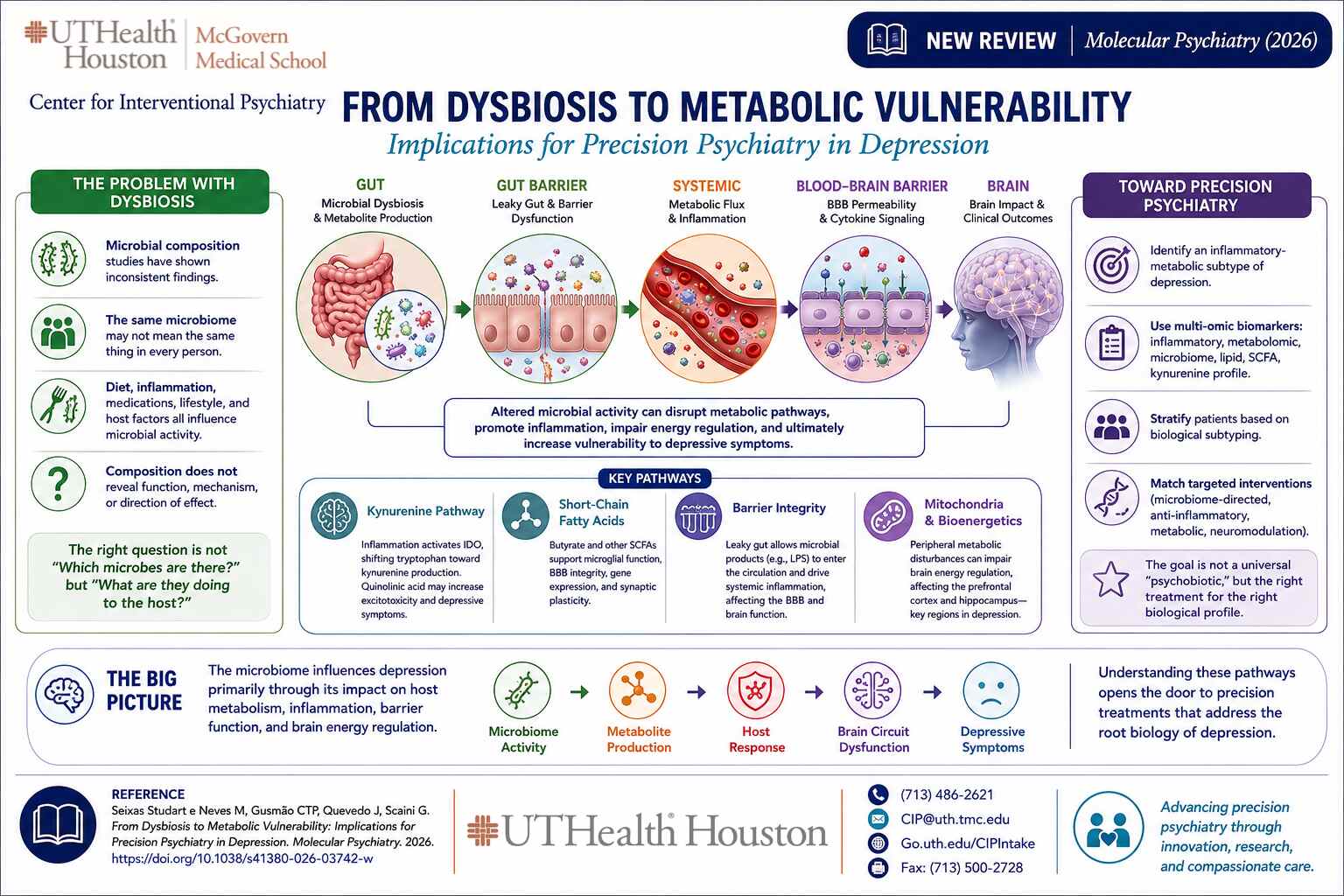
Microbiome → Metabolites → Host biology → Brain function → Depressive symptoms
This distinction is important.
The biologically relevant question may not be whether a patient possesses a particular bacterial species. It may be whether microbial activity alters inflammatory tone, mitochondrial function, energy metabolism, barrier integrity, or neuroplasticity in a person who is biologically vulnerable to those changes.
How Could the Gut Influence the Brain?
Several pathways illustrate how this model could operate.
- The Kynurenine Pathway
Tryptophan is an amino acid involved in several important metabolic pathways.
During inflammation, activation of the enzyme indoleamine 2,3-dioxygenase can shift tryptophan metabolism toward kynurenine and downstream metabolites.
One of these metabolites, quinolinic acid, interacts with NMDA receptors and has been associated with excitotoxicity and depressive symptoms.
Microbial activity may influence this pathway directly through tryptophan metabolism and indirectly by influencing inflammation.
- Short-Chain Fatty Acids
Gut bacteria produce metabolites known as short-chain fatty acids (SCFAs).
One of the best studied is butyrate, which may influence:
- Microglial activity
- Blood-brain barrier integrity
- Gene expression
- Histone deacetylase activity
- Neuroplasticity
This provides a compelling example of how microbial activity could affect brain biology without requiring a particular microorganism to be directly responsible for depression.
- The Gut and Blood-Brain Barriers
The intestinal barrier normally regulates which substances move from the gut into the circulation.
When barrier integrity is compromised—a phenomenon sometimes referred to as “leaky gut”—microbial products such as lipopolysaccharide may enter the circulation and promote systemic inflammation.
Changes in blood-brain barrier permeability may then influence how peripheral inflammatory and metabolic signals reach the central nervous system.
- Mitochondria and Brain Energy
This may be one of the most important pieces of the puzzle.
Depression is increasingly associated with abnormalities involving:
- Mitochondrial function
- Cellular energy regulation
- Synaptic plasticity
- Neuroimmune interactions
All of these processes require substantial amounts of energy.
Peripheral metabolic disturbances generated through the gut-immune-metabolic system could therefore alter the bioenergetic capacity of neural circuits.
Brain regions with particularly high metabolic demands—including the prefrontal cortex and hippocampus—may be especially vulnerable. Impaired energy regulation in these regions could affect cognition, mood regulation, and synaptic plasticity.
From the Gut to the Symptoms of Depression
The figure in our publication illustrates this proposed biological cascade.
It begins with microbial dysbiosis and altered metabolite production, progresses through impaired gut barrier function and changes in systemic metabolic signaling, and ultimately reaches the brain via blood-brain barrier dysfunction, inflammatory signaling, and altered energy regulation.
The downstream consequences may include reduced BDNF, impaired neurogenesis, mitochondrial stress, and ultimately depressive phenotypes.
This framework provides an important conceptual bridge between microbiome research and the neurobiology of depression.
Toward an “Inflammatory-Metabolic” Subtype of Depression
Perhaps the most clinically important implication is the possibility of identifying a subgroup of patients characterized by an inflammatory-metabolic phenotype.
Potential markers could include:
- Increased inflammatory biomarkers
- Altered kynurenine-to-tryptophan ratios
- Abnormal short-chain fatty acid profiles
- Disturbances in lipid metabolism
- Evidence of impaired metabolic flexibility
If such biological subtypes can be reliably identified, the implications for treatment could be substantial.
Instead of testing microbiome-targeted interventions in every patient with depression, future trials could identify the patients whose depression actually involves this biological pathway.
That is the essence of precision psychiatry.
Why “Probiotics for Depression” May Be Too Simple
The enthusiasm surrounding the microbiome has understandably generated interest in probiotics, prebiotics, dietary interventions, and other microbiota-directed treatments.
But if the model proposed in our article is correct, simply modifying microbial composition may not be sufficient.
A microbiome intervention could have very different effects depending on a patient’s:
- Baseline inflammatory state
- Metabolic phenotype
- Mitochondrial function
- Diet
- Intestinal and blood-brain barrier integrity
- Existing microbial ecosystem
This may help explain why microbiome-targeted interventions have not produced uniform clinical effects.
The future may therefore lie not in a universal “psychobiotic” but in matching microbiome-directed treatments to biologically defined patient subgroups.
A New Role for Metabolomics
How can we move from theory to precision treatment?
One particularly promising tool is metabolomics—the large-scale measurement of small molecules produced by cellular and biochemical processes.
Unlike taxonomic microbiome analysis, which primarily tells us who is there, metabolomics may help us understand what is happening biologically.
Combining microbiome sequencing with metabolomics, inflammatory biomarkers, and measures of host physiology could allow researchers to trace pathways such as:
Microbe → Metabolite → Symptom
The authors argue that future studies should integrate taxonomic and functional profiling with metabolomic data across diverse populations while carefully accounting for potential confounding factors.
Why This Matters for Precision Psychiatry
Depression is not a single biological disease.
Two patients can meet identical diagnostic criteria for major depressive disorder while having very different underlying biological disturbances.
One patient’s illness may be dominated by reward-circuit dysfunction. Another may have prominent neuroinflammation. Another may have altered stress physiology, impaired neuroplasticity, or metabolic dysfunction.
The microbiome may contribute differently to each of these biological states.
The goal of precision psychiatry is therefore not simply to discover whether “the microbiome causes depression.”
The more useful questions may be:
In which patients does microbiome activity meaningfully alter host metabolism?
Which metabolic pathways are affected?
How do those pathways influence brain circuits and symptoms?
And can identifying those pathways help us select a more effective treatment?
These are much more difficult questions—but they are also much closer to what ultimately matters for patients.
The UTHealth Houston Perspective
At the Center for Interventional Psychiatry at UTHealth Houston, our research increasingly focuses on understanding the biological heterogeneity underlying depression and treatment resistance.
This publication, developed by investigators from our Center, reflects that broader mission. Rather than treating depression as a uniform disorder, we seek to understand the molecular, metabolic, inflammatory, and circuit-level mechanisms that may define clinically meaningful subgroups of patients.
The ultimate goal is not simply to identify another biomarker.
It is to translate biological information into better treatment decisions.
The progression from dysbiosis → metabolic vulnerability → biological subtyping → stratified intervention provides an important framework for moving microbiome research toward that goal.
The article’s central message is therefore both simple and consequential:
The future of microbiome research in depression may depend less on identifying which microbes are present and more on understanding what those microbes are doing to the individual patient.
That shift could help move the field from association toward mechanism—and ultimately from mechanism toward precision psychiatry.
Reference
Seixas Studart e Neves M, Gusmão CTP, Quevedo J, Scaini G. From Dysbiosis to Metabolic Vulnerability: Implications for Precision Psychiatry in Depression. Molecular Psychiatry. 2026. doi:10.1038/s41380-026-03742-w.
Contact
Center for Interventional Psychiatry
John S. Dunn Behavioral Sciences Center
UTHealth Houston
Request for Second Opinion: Go.uth.edu/CIPIntake
Phone: (713) 486-2621
Fax: (713) 500-2728
Email: [email protected]
Website: Go.uth.edu/CIP
Disclaimer
This article is intended for educational and informational purposes only and should not be considered medical advice or a substitute for consultation with a qualified healthcare professional.
This content was developed with the assistance of artificial intelligence (AI) as a scientific writing support tool. It was reviewed, substantially edited, and approved by Joao L. de Quevedo, MD, PhD, Executive Director of the Center for Interventional Psychiatry at UTHealth Houston and a co-author of the publication discussed in this article. Every effort has been made to ensure the accuracy, scientific balance, and clinical relevance of the information presented; however, readers should consult the original publication and current clinical guidelines when making patient-care decisions.
The opinions expressed in this article are intended to promote scientific education and discussion.
© Center for Interventional Psychiatry, John S. Dunn Behavioral Sciences Center, UTHealth Houston.