SAINT® TMS for Bipolar Depression: Can Personalized, Accelerated Neuromodulation Change the Brain and Depression?
 Bipolar Depression Remains a Major Therapeutic Challenge
When people think about bipolar disorder, mania often receives much of the attention. Yet for many patients, depression represents the dominant burden of the illness.
People with bipolar disorder spend substantially more time experiencing depressive symptoms than manic or hypomanic symptoms, and these depressive episodes can profoundly affect relationships, employment, quality of life, and overall functioning. Even with currently available medications, treatment resistance remains a significant clinical problem.
This raises an important question:
Could the personalized, accelerated brain-stimulation approaches being developed for treatment-resistant major depression also help patients with bipolar depression?
A new pilot study published in the Journal of Mood & Anxiety Disorders provides intriguing preliminary evidence that the answer may eventually be yes.
Researchers evaluated Stanford Accelerated Intelligent Neuromodulation Therapy (SAINT) in patients with bipolar I depression—not only examining changes in depressive symptoms, but also using functional MRI to investigate how treatment may alter the brain networks involved in mood regulation.
What Is SAINT?
SAINT is an accelerated and personalized form of intermittent theta-burst stimulation (iTBS).
Traditional repetitive transcranial magnetic stimulation (TMS) uses magnetic pulses delivered noninvasively through the scalp to modulate brain circuits involved in depression.
SAINT builds on this approach in two particularly important ways.
First, treatment is accelerated, with multiple stimulation sessions delivered each day rather than one treatment per day over several weeks.
Second, the stimulation target is personalized using functional MRI.
Rather than relying solely on anatomical location, investigators identify a specific region within the left dorsolateral prefrontal cortex (DLPFC) based on its functional relationship with another important mood-regulation region: the subgenual anterior cingulate cortex (sgACC).
This represents a broader transition occurring within interventional psychiatry:
from treating a diagnosis to targeting the neural circuit underlying the illness.
Testing SAINT in Bipolar I Depression
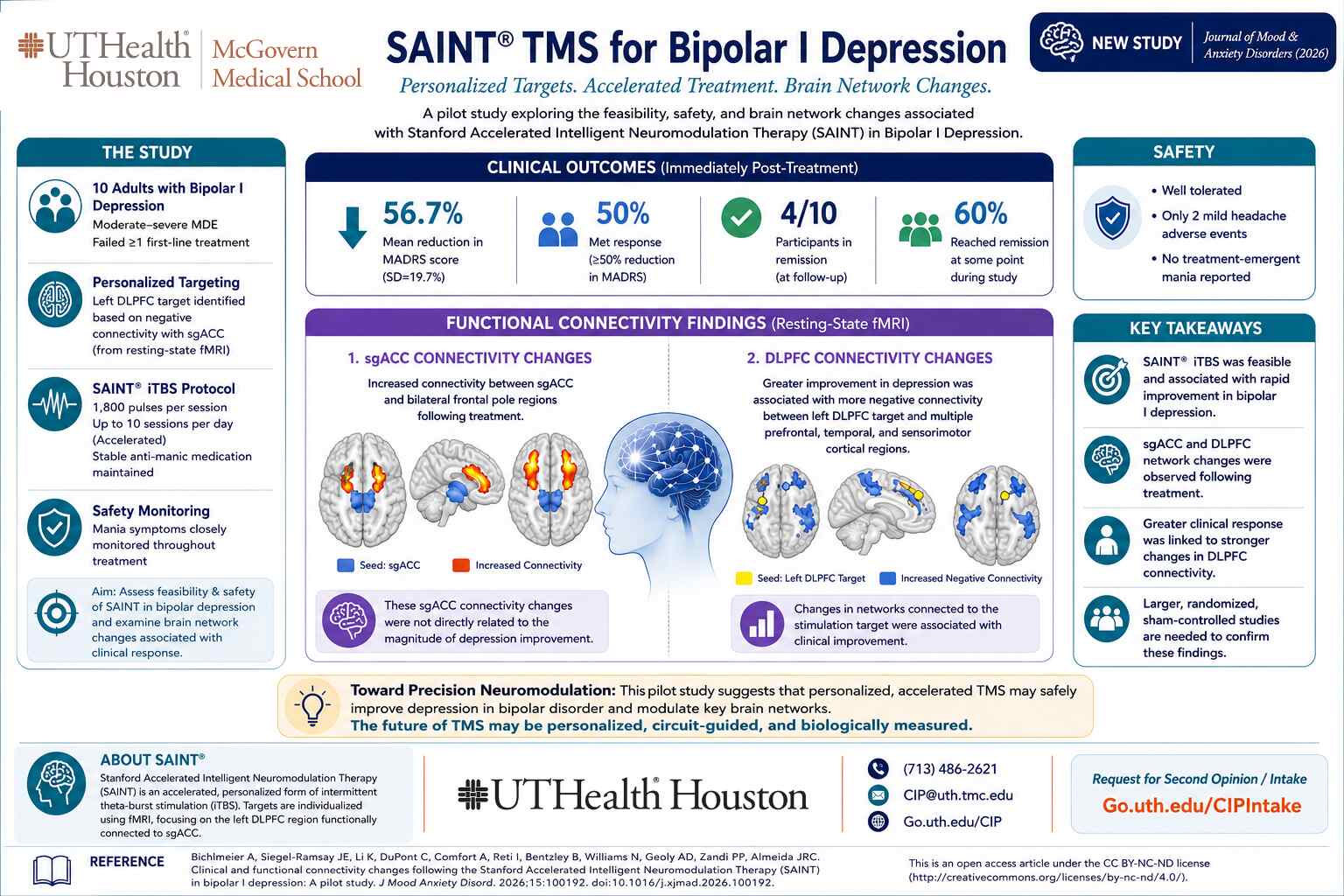
The study included 10 adults with bipolar I disorder experiencing a moderate-to-severe depressive episode.
All participants had failed at least one adequate first-line treatment during the current depressive episode. Importantly, they remained on a stable anti-manic medication regimen throughout the study.
Each participant underwent structural and resting-state functional MRI.
Investigators then identified an individualized left DLPFC stimulation target based on its negative functional connectivity with the sgACC. Participants received an accelerated iTBS protocol of 1,800 pulses per session, up to 10 sessions per day. Treatment was stopped if a participant reached remission or demonstrated concerning increases in manic symptoms.
This last feature is particularly important in bipolar disorder.
Any antidepressant intervention raises concern about potentially precipitating mania or hypomania. The investigators therefore repeatedly monitored manic symptoms throughout treatment rather than focusing exclusively on improvement in depression.
Depression Improved Rapidly
The clinical findings were encouraging.
Immediately following treatment, depressive symptoms measured with the Montgomery-Åsberg Depression Rating Scale (MADRS) had decreased by an average of:
56.7%
The change from baseline was statistically significant.
At immediate follow-up:
50% of participants met criteria for clinical response, defined as at least a 50% reduction in depressive symptoms.
4 of the 10 participants were already in remission.
Across the study, 60% reached remission at some point.
These results are noteworthy—but they need to be interpreted appropriately.
This was not a randomized clinical trial designed to establish efficacy. It was a small, open-label pilot study.
The findings should therefore be viewed as an important signal deserving further investigation, rather than evidence that SAINT has been established as a treatment for bipolar depression.
What Happened in the Brain?
Perhaps the most interesting aspect of this study is that investigators did not stop at asking:
“Did patients feel better?”
They also asked:
“Did the brain circuits involved in depression change?”
Participants underwent resting-state functional MRI before and after treatment.
The investigators focused particularly on two regions central to the SAINT model:
the individualized left DLPFC stimulation target and the sgACC.
The results provide an early glimpse into how accelerated personalized neuromodulation might influence brain networks in bipolar depression.
Finding #1: SAINT Altered sgACC Connectivity
Following treatment, researchers observed increased functional connectivity between the sgACC and bilateral frontal pole regions.
The sgACC is particularly important because abnormalities involving this region have repeatedly been implicated in depression and mood regulation.
The paper’s brain map on page 5 illustrates these bilateral frontal regions in red/orange and the sgACC seed in blue, providing a visual representation of the network changes observed following treatment.
Interestingly, these particular sgACC changes were not directly correlated with the magnitude of improvement in depression.
That distinction matters.
A treatment can change a brain network without that particular change necessarily explaining why an individual patient improved.
Finding #2: Clinical Improvement Was Associated With DLPFC Network Changes
The more intriguing finding emerged when investigators examined the individualized DLPFC stimulation target.
Greater improvement in depressive symptoms was associated with more negative connectivity between the individualized left DLPFC target and several prefrontal, temporal, and sensorimotor cortical regions.
In other words, the magnitude of changes within networks connected to the actual stimulation target was associated with the magnitude of clinical improvement.
This raises an exciting possibility:
Changes in functional connectivity may eventually become a biological marker of how an individual patient’s brain responds to TMS.
The authors appropriately emphasize that the sample is far too small to establish such a biomarker. But the concept points toward an important future direction for precision neuromodulation.
From Personalized Targeting to Personalized Treatment
The implications extend beyond SAINT itself.
Traditional psychiatric treatment is largely based on symptoms and diagnoses.
A patient has bipolar depression, for example, and treatment is selected from interventions shown to work for groups of patients with bipolar depression.
Precision psychiatry seeks to move one step further.
Imagine a future in which clinicians could use:
clinical phenotype → neuroimaging → circuit identification → personalized stimulation → biological measurement of target engagement
to determine not only where to stimulate, but also whether the treatment actually modified the intended neural circuit.
That is a fundamentally different model of psychiatric treatment.
SAINT represents one of the clearest examples of this transition already occurring in clinical neuromodulation.
What About Mania?
Safety deserves particular attention when discussing treatments for bipolar depression.
In this study, participants were maintained on stable anti-manic treatment and manic symptoms were repeatedly assessed during the accelerated stimulation protocol.
The treatment was generally well tolerated. The investigators reported only two mild headache adverse events and, importantly, no treatment-emergent mania.
That finding is reassuring, but the study is much too small to establish the risk of treatment-emergent mania.
Larger controlled studies will be essential.
The authors specifically recommend incorporating systematic mania assessments into future accelerated TMS studies involving bipolar depression.
Important Limitations
Several substantial limitations should balance the enthusiasm generated by these findings.
This was an open-label study of only 10 participants, and the analyses were exploratory. There was no sham-treatment group, meaning improvement cannot definitively be attributed to SAINT itself.
The small and relatively homogeneous sample also limits generalizability and statistical power, particularly for neuroimaging analyses.
Finally, the imaging assessment examined relatively short-term changes. We do not yet know whether the observed brain-network changes persist over months or whether they predict durable clinical outcomes.
The next critical step is therefore clear:
Larger, randomized, sham-controlled trials are needed.
The UTHealth Houston Perspective
At the Center for Interventional Psychiatry at UTHealth Houston, SAINT TMS is part of our expanding continuum of advanced treatments for difficult-to-treat depression.
This study is especially interesting because it illustrates where interventional psychiatry is heading.
The future is unlikely to consist simply of developing stronger antidepressants or delivering more stimulation.
Instead, we are increasingly asking:
Which brain circuit is dysfunctional?
Where should we stimulate that circuit?
Can imaging personalize the target?
Can we demonstrate that treatment changed the intended network?
And can those biological changes predict who will get better?
These questions represent the transition from conventional neuromodulation toward precision neuromodulation.
For patients with bipolar depression—an illness for which effective treatment can remain extraordinarily challenging—the possibility that accelerated, individualized brain stimulation could eventually provide another therapeutic option is exciting.
But this study should be understood for what it is: an encouraging first step, not a definitive answer.
The investigators themselves describe these findings as preliminary and emphasize the need for replication in larger randomized, sham-controlled studies.
If those studies confirm the clinical and neurobiological findings, the implications could extend well beyond bipolar depression.
We may be moving toward an era in which TMS is no longer simply a treatment delivered to a standard location on the brain.
Instead, it may increasingly become a personalized intervention designed around the functional architecture of each patient’s brain.
That may ultimately be one of the most important promises of modern interventional psychiatry.
Reference
Bichlmeier A, Siegel-Ramsay JE, Li K, et al. Clinical and functional connectivity changes following the Stanford Accelerated Intelligent Neuromodulation Therapy (SAINT) in bipolar I depression: A pilot study. Journal of Mood & Anxiety Disorders. 2026;15:100192. doi:10.1016/j.xjmad.2026.100192.
Contact
Center for Interventional Psychiatry
John S. Dunn Behavioral Sciences Center
UTHealth Houston
Request for Second Opinion: Go.uth.edu/CIPIntake
Phone: (713) 486-2621
Fax: (713) 500-2728
Email: [email protected]
Website: Go.uth.edu/CIP
Disclaimer
This article is intended for educational and informational purposes only and should not be considered medical advice or a substitute for consultation with a qualified healthcare professional.
SAINT is FDA-cleared for major depressive disorder and is not currently established or FDA-cleared specifically as a treatment for bipolar depression. The study discussed here was a small, open-label pilot investigation, and its findings should not be interpreted as establishing the efficacy or safety of SAINT for bipolar depression.
This content was developed with the assistance of artificial intelligence (AI) as a scientific writing support tool. It was reviewed, edited, and approved by João L. de Quevedo, MD, PhD, Executive Director of the Center for Interventional Psychiatry at UTHealth Houston. The scientific findings and numerical results presented above were derived from the publication discussed in this article.
© Center for Interventional Psychiatry, John S. Dunn Behavioral Sciences Center, UTHealth Houston.