Depression and Epilepsy: Why the Brain Does Not Respect the Boundary Between Psychiatry and Neurology
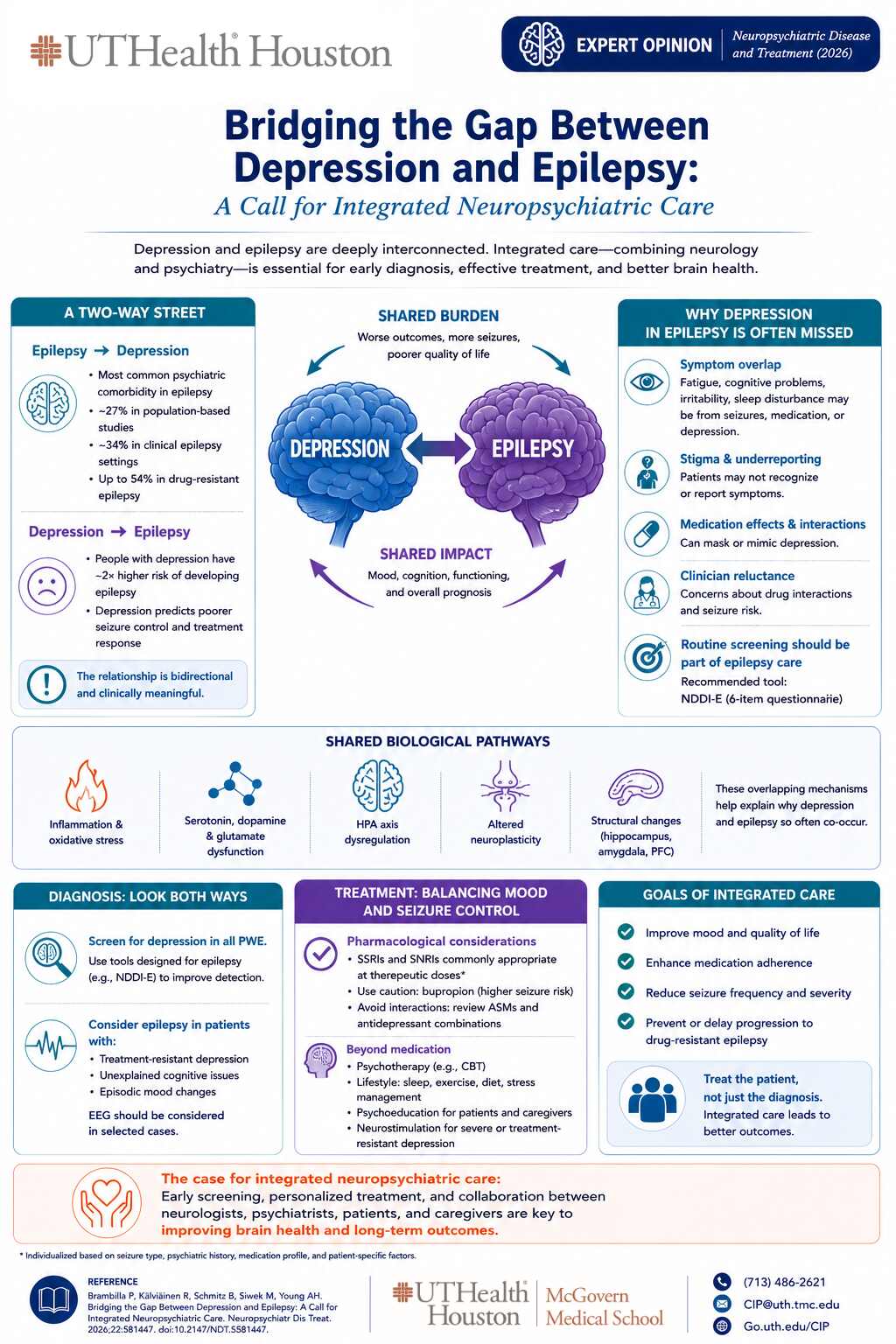
Depression and epilepsy have traditionally been treated as conditions belonging to different areas of medicine. Epilepsy is managed primarily within neurology, while depression is generally considered the domain of psychiatry.
Biology, however, does not follow the organizational boundaries of medical specialties.
A recently published expert opinion in Neuropsychiatric Disease and Treatment argues that depression and epilepsy are deeply interconnected conditions that require a more integrated neuropsychiatric approach to diagnosis and treatment. The article emerged from a multidisciplinary panel of psychiatrists and epileptologists and highlights an important concept for modern brain health: when neurological and psychiatric disorders share biological mechanisms and influence one another clinically, treating them independently may leave important aspects of the illness unaddressed.
The Relationship Goes in Both Directions
Depression is the most common psychiatric comorbidity among people with epilepsy. But the relationship is not simply that living with a chronic neurological illness makes someone more likely to become depressed.
Evidence increasingly points toward a bidirectional relationship.
People with epilepsy have a substantially greater risk of psychiatric comorbidity, with major depressive disorder being particularly common. Conversely, people with depression appear to have an increased subsequent risk of developing epilepsy.
The numbers illustrate the magnitude of the problem.
The paper reports pooled depression prevalence estimates of approximately 27% in population-based samples and 34% in clinical epilepsy settings. In some studies of patients with uncontrolled epilepsy, prevalence has reached 54%. Depressive symptoms have also been associated with a greater likelihood of subsequently developing drug-resistant epilepsy.
This suggests something more complex than simple psychological distress secondary to having seizures.
Depression may influence epilepsy—and epilepsy may influence depression.
Two Disorders, Shared Brain Biology
One of the most compelling aspects of the article is its discussion of the biological mechanisms shared by depression and epilepsy.
The authors identify several overlapping pathways:
- Neuroinflammation and oxidative stress
- Serotonin, dopamine, and glutamate dysfunction
- Hypothalamic-pituitary-adrenal (HPA) axis dysregulation
- Altered neuroplasticity
- Structural changes involving the hippocampus, amygdala, and prefrontal cortex
These mechanisms provide a biological framework for understanding why the two conditions may cluster together.
For example, inflammatory cytokines implicated in depression can also contribute to neuronal hyperexcitability and seizure propagation. Glutamate dysfunction is relevant to both excitotoxicity in epilepsy and synaptic dysfunction in depression. Chronic stress and HPA-axis hyperactivity may simultaneously influence mood regulation and seizure susceptibility.
Similarly, both conditions have been associated with impaired neuroplasticity and changes involving the hippocampus.
Rather than thinking of depression and epilepsy as completely separate diseases that occasionally happen to coexist, it may therefore be more useful in some patients to consider them as different clinical manifestations emerging from partially overlapping brain-network and molecular abnormalities.
Depression in Epilepsy Is Easy to Miss
Despite its frequency and clinical importance, depression remains underdiagnosed in people with epilepsy.
One reason is symptom overlap.
Fatigue, cognitive difficulties, irritability, impaired functioning, and sleep disturbance can result from epilepsy itself, antiseizure medications, depression—or some combination of all three.
Depressive symptoms may also have different temporal relationships with seizures. The paper describes interictal depression, occurring between seizures and often resembling major depressive disorder, as well as postictal depression, which may develop in the hours or days following a seizure.
Other barriers include patients attributing their symptoms entirely to epilepsy, stigma surrounding psychiatric diagnoses, medication effects, and clinicians’ concerns about interactions between antidepressants and antiseizure medications.
The result can be clinically significant underrecognition.
And that matters because untreated depression is not merely a quality-of-life problem in epilepsy.
Depression May Make Epilepsy Harder to Treat
The relationship between mood and seizure control appears to be clinically meaningful.
Depression in people with epilepsy has been associated with poorer medication adherence, more frequent seizures, breakthrough seizures, and a greater likelihood of progressing toward drug-resistant epilepsy.
The relationship can then become self-reinforcing:
Seizures → functional impairment and stress → depression → poorer adherence, sleep and stress regulation → greater seizure vulnerability
At the same time, uncontrolled epilepsy itself can contribute to depression through loss of independence, social isolation, unpredictability, chronic stress, and potentially shared biological mechanisms.
Drug-resistant epilepsy is particularly important. The article notes depression prevalence estimates of approximately 30–50% in this population.
This creates a strong argument for treating depression as an integral part of epilepsy management rather than as a secondary problem to be addressed only after seizure control has been achieved.
Screening should Become Routine
If depression is common, clinically consequential, and frequently missed, screening becomes essential.
The authors highlight the Neurological Disorders Depression Inventory for Epilepsy (NDDI-E) as the most widely recommended screening instrument specifically designed for this population.
It contains only six items and was developed to reduce confounding by factors such as adverse effects of antiseizure medications and cognitive impairment.
The practical message is straightforward:
Depression screening should be part of routine epilepsy care.
Identifying depression earlier may improve psychiatric outcomes, adherence, quality of life, and potentially overall epilepsy management.
But the diagnostic challenge can also work in the opposite direction.
Should We Sometimes Think About Epilepsy in Patients With Depression?
One of the more provocative points in the article is that epilepsy can itself be underrecognized among people presenting primarily with depression.
This is particularly relevant for focal or nonconvulsive seizures, where manifestations may be subtle.
The authors suggest that an electroencephalogram (EEG) should be considered in selected patients with treatment-resistant depression, unexplained cognitive dysfunction, or episodic mood changes.
This does not mean that every patient with treatment-resistant depression requires an EEG.
Rather, it reinforces the importance of careful neurological assessment when the clinical presentation contains features suggesting that something beyond a primary mood disorder may be occurring.
It is another example of why the traditional separation between psychiatric and neurological assessment can sometimes be limiting.
Treating Depression Without Losing Sight of Seizures
Treatment requires balancing two objectives:
improving mood while maintaining—or ideally improving—seizure control.
Some antiseizure medications can adversely affect mood, while others have mood-stabilizing properties. Similarly, antidepressant selection requires consideration of seizure risk and potential drug-drug interactions.
The expert panel considered SSRIs and SNRIs commonly appropriate first-line antidepressant options at therapeutic doses for people with epilepsy, while noting the higher seizure risk associated with agents such as bupropion. The article also emphasizes that treatment decisions must be individualized according to seizure type, psychiatric history, medication interactions, and patient-specific risk factors.
The larger lesson is more important than any individual medication:
Treat the patient—not depression and epilepsy as isolated diagnoses.
Beyond Medication: Where Interventional Psychiatry Fits
The article also emphasizes that integrated treatment should extend beyond pharmacotherapy.
Psychotherapy—particularly cognitive behavioral therapy—psychoeducation, sleep, exercise, diet, and other lifestyle interventions can all contribute to comprehensive management.
For patients with severe or treatment-resistant depression, the authors also discuss neurostimulation. Importantly, several neuromodulation approaches span the interface between psychiatry and neurology, including vagus nerve stimulation, deep brain stimulation, focal cortical stimulation, and transcranial magnetic stimulation.
This overlap is especially relevant to interventional psychiatry.
The brain circuits responsible for mood, cognition, behavior, and seizure susceptibility do not exist independently. Modern neuromodulation increasingly allows us to think about these disorders at the level of circuits and networks rather than traditional specialty boundaries.
From Multidisciplinary Care to Integrated Neuropsychiatry
Perhaps the most important recommendation from this publication is organizational rather than pharmacological.
The authors call for closer collaboration among neurologists, psychiatrists, psychologists, primary care clinicians, patients, and caregivers.
Neurologists should routinely consider depression.
Psychiatrists should understand epilepsy and seizure risk.
Medication selection should account for both neurological and psychiatric consequences.
Patients and families should receive education about both conditions early rather than being left to navigate two disconnected systems of care.
The article ultimately proposes an integrated care package combining pharmacological treatment, psychotherapy, lifestyle interventions, early screening, patient education, and individualized treatment planning.
This is a model that could extend far beyond epilepsy.
The UTHealth Houston Perspective
At the Center for Interventional Psychiatry at UTHealth Houston, this publication reinforces an idea that is increasingly central to our field:
The future of psychiatry is also neuroscience.
The historical separation between psychiatry and neurology has been useful in organizing clinical expertise, but it should not constrain our understanding of brain disorders.
Depression can involve abnormalities in inflammation, stress physiology, neurotransmission, neuroplasticity, metabolism, and neural circuits. Many of those same biological systems are relevant to neurological disorders.
Epilepsy provides a particularly powerful example.
When depression develops in someone with epilepsy, we should not automatically assume that it is simply an understandable psychological reaction to chronic illness. Nor should we assume that improving seizure control will necessarily resolve the depression.
Both conditions deserve recognition and treatment.
For patients with difficult-to-treat depression, this perspective is particularly important. A comprehensive evaluation should remain open to neurological, psychiatric, medical, pharmacological, and circuit-level contributors to persistent symptoms.
The central message of this new publication can therefore be summarized:
Depression and epilepsy should not be treated as strangers sharing the same brain.
Recognizing their bidirectional relationship—and building clinical systems that integrate neurological and psychiatric expertise—may allow us to diagnose earlier, treat more intelligently, and ultimately improve both brain health and quality of life.
Reference
Brambilla P, Kälviäinen R, Schmitz B, Siwek M, Young AH. Bridging the Gap Between Depression and Epilepsy: A Call for Integrated Neuropsychiatric Care. Neuropsychiatric Disease and Treatment. 2026;22. Published August 4, 2026. doi:10.2147/NDT.S581447.
Contact
Center for Interventional Psychiatry
John S. Dunn Behavioral Sciences Center
UTHealth Houston
Request for Second Opinion: Go.uth.edu/CIPIntake
Phone: (713) 486-2621
Fax: (713) 500-2728
Email: [email protected]
Website: Go.uth.edu/CIP
Disclaimer
This article is intended for educational and informational purposes only and should not be considered medical advice or a substitute for individualized evaluation and treatment by qualified healthcare professionals. Treatment decisions for patients with epilepsy and depression require careful consideration of seizure type, psychiatric symptoms, medications, potential drug interactions, and individual clinical circumstances.
This content was developed with the assistance of artificial intelligence (AI) as a scientific writing support tool. It was reviewed, edited, and approved by João L. de Quevedo, MD, PhD, Executive Director of the Center for Interventional Psychiatry at UTHealth Houston. The scientific discussion presented here is based on the publication cited above.
The publication discussed is an expert opinion article arising from a multidisciplinary advisory meeting, rather than a randomized clinical trial. The expert meeting was sponsored by Angelini Pharma S.p.A., which also funded medical-writing support; the publication states that this support did not affect its content.
© Center for Interventional Psychiatry, John S. Dunn Behavioral Sciences Center, UTHealth Houston.