Treat to Sedation: Making ECT Accessible for Patients With Autism, Intellectual Disability, and Hyperactive Catatonia
 When the Treatment Is Effective, but Getting to Treatment Is the Challenge
Electroconvulsive therapy (ECT) can be a critical treatment for severe catatonia. But in some patients, one of the greatest challenges is not deciding whether to use ECT; it is safely completing the steps required to deliver it.
This is particularly relevant for autistic individuals with intellectual disability and hyperactive catatonia, in whom aggression, severe self-injury, negativism, sensory sensitivities, and behavioral dysregulation may make something as seemingly routine as placing an intravenous (IV) catheter extraordinarily difficult.
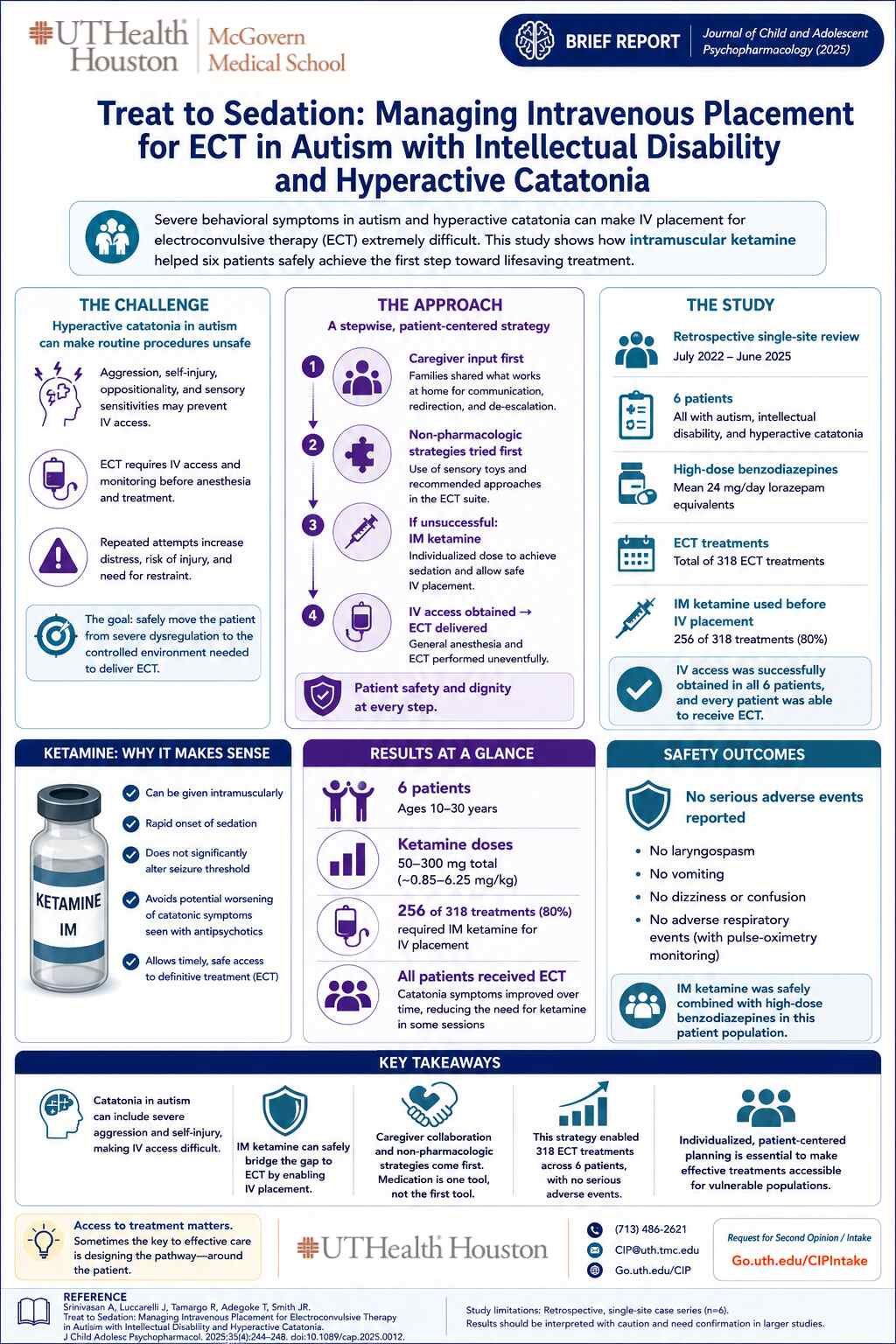
A 2025 brief report published in the Journal of Child and Adolescent Psychopharmacology addresses this very practical clinical problem. Srinivasan and colleagues describe six patients with autism, intellectual disability, and hyperactive catatonia who received intramuscular (IM) ketamine to facilitate IV placement before ECT, despite already receiving high-dose benzodiazepines for catatonia.
The report is small and retrospective, but it raises a larger issue that deserves attention across interventional psychiatry:
An effective treatment has little value if the patient cannot safely access it.
Catatonia in Autism Can Look Different
Catatonia is a severe neuropsychiatric syndrome involving abnormalities of movement, behavior, and mood. Its manifestations can include classic features such as immobility, posturing, negativism, and catalepsy.
In autistic individuals—particularly those with intellectual disability—the clinical presentation may also prominently involve aggression, self-injury, oppositional behavior, regression, and hyperactivity.
These presentations can be especially difficult because some behavioral changes may initially be attributed to autism or intellectual disability rather than recognized as a superimposed catatonic syndrome.
Once catatonia is identified, treatment becomes urgent. The condition is associated with substantial morbidity and can become life-threatening. Benzodiazepines are generally first-line pharmacologic treatment, and some patients require high doses. ECT is an established treatment when catatonia is severe, persistent, or inadequately responsive to medication.
For some patients with autism and hyperactive catatonia, however, delivering ECT creates another problem.
Why IV Access Matters in ECT
Modern ECT is performed under general anesthesia with muscle relaxation.
That means IV access is necessary to administer anesthetic and neuromuscular-blocking medications and safely conduct the procedure. Monitoring equipment must also be placed before treatment.
For most patients, these steps are straightforward.
For someone experiencing severe hyperactive catatonia, aggression, recurrent self-injury, communication difficulties, or extreme sensory sensitivity, they may not be.
Trying repeatedly to place an IV in a severely distressed or behaviorally dysregulated patient can increase fear, agitation, risk of injury, and the potential need for physical restraint.
The challenge therefore becomes:
How can we safely move a patient from severe behavioral dysregulation to the controlled environment necessary to administer ECT?
Why Ketamine?
Ketamine has several properties that make it particularly interesting in this setting.
It can be administered intramuscularly, acts rapidly, and can provide sedation sufficient to facilitate procedures in patients with severe agitation.
There is another important consideration specific to ECT: medications used before treatment can affect the seizure that ECT is designed to produce.
The authors note that ketamine does not significantly alter seizure threshold. In contrast, benzodiazepines commonly used for preprocedural anxiety or sedation can influence seizure threshold and potentially require adjustments to ECT technique. Antipsychotics may present a different concern in catatonia because of the potential for worsening catatonic symptoms in some circumstances.
Ketamine therefore offered the team a practical strategy: provide rapid IM sedation, obtain IV access, and then proceed with ECT.
What Did the Study Do?
The investigators conducted a single-site retrospective analysis of six patients treated between July 2022 and June 2025.
All six had:
- Autism
- Intellectual disability
- Hyperactive catatonia
- Behavioral symptoms that interfered with safe IV placement
- Treatment with ECT
- A need for IM ketamine to facilitate IV access
The patients ranged in age from 10 to 30 years. All demonstrated significant aggression toward caregivers, and four of the six exhibited severe and potentially dangerous self-injurious behavior.
They were also receiving substantial doses of benzodiazepines for catatonia.
The average daily benzodiazepine exposure was equivalent to approximately:
24 mg of lorazepam per day
That is clinically important because combining sedating medications naturally raises concerns about excessive sedation and respiratory compromise.
Medication Was Not the First Step
One aspect of the report deserves particular emphasis.
The clinical team did not simply proceed directly to pharmacologic restraint.
Before IM ketamine was considered, families and guardians were involved in planning. The team reviewed the patient’s individual patterns of aggression and self-injury and asked families about strategies that worked at home for:
- Behavioral redirection
- Communication
- De-escalation
Sensory toys were also available in the ECT suite, and family-recommended strategies were attempted first.
Only when those approaches proved unsuccessful was IM ketamine used to facilitate IV placement.
This is an important clinical principle.
Patient-centered procedural care begins with understanding the individual—not with the medication.
For patients with autism and intellectual disability, families and caregivers may possess critical knowledge about communication, triggers, sensory needs, and effective de-escalation strategies.
What Happened?
The practical outcome was striking:
IV access was successfully obtained in all six patients, and all received ECT.
Initial ketamine doses were individualized according to clinical response. Across the cases, total doses ranged from 50 to 300 mg, corresponding to approximately 0.85 to 6.25 mg/kg.
Collectively, the six patients underwent:
318 ECT procedures
IM ketamine was required before:
256 procedures—approximately 80% of treatments.
As catatonic hyperactivity improved over the course of ECT, ketamine was not always necessary for subsequent IV placement.
That observation is clinically interesting. The procedural strategy helped patients access ECT, while improvement in the underlying catatonia could eventually make it less necessary.
What About Safety?
The combination of ketamine with high-dose benzodiazepines understandably raises safety concerns.
In this small case series, however, the investigators reported no serious adverse events associated with the strategy. They specifically reported no laryngospasm, vomiting, dizziness, or confusion, and no adverse respiratory symptoms were observed on pulse oximetry monitoring.
The authors also reported that agitation was successfully managed without worsening catatonic symptoms.
These findings are reassuring.
They are not, however, sufficient to establish the safety of this approach broadly.
Six patients constitute a very small sample, and the study was retrospective. Rare but clinically important adverse events could easily be missed in a series of this size. The authors appropriately emphasize the need for careful interpretation and additional research.
More Than an Anesthesia Problem
Perhaps the most important lesson from this publication extends beyond ketamine.
When caring for patients with severe neuropsychiatric illness, we often focus on the efficacy of the definitive treatment:
Does ECT work for catatonia?
But there is another equally important question:
Can we create a safe pathway that allows this particular patient to receive ECT?
For patients with autism, intellectual disability, sensory sensitivities, communication differences, aggression, or self-injurious behavior, the standard procedural pathway may not work.
That does not necessarily mean the treatment is impossible.
It may mean the pathway to the treatment needs to be redesigned around the patient.
A Broader Principle for Interventional Psychiatry
This concept has relevance across interventional psychiatry.
ECT, TMS, ketamine, esketamine, and other advanced treatments all involve more than selecting the appropriate intervention. They require patients to navigate environments, procedures, monitoring, equipment, schedules, and repeated encounters with healthcare teams.
For many patients, those logistical and behavioral requirements are manageable.
For others—particularly individuals with neurodevelopmental disorders—they can become genuine barriers to care.
An individualized approach may therefore require modifications involving:
caregiver participation → sensory accommodation → behavioral strategies → individualized pharmacologic support → procedural adaptation
The goal is not simply to complete a procedure.
It is to make evidence-based treatment accessible while preserving the patient’s safety, dignity, and respect.
The UTHealth Houston Perspective
At the Center for Interventional Psychiatry at UTHealth Houston, we view this report as an excellent example of an often-overlooked dimension of interventional psychiatry: treatment accessibility is itself a clinical problem that sometimes requires innovation.
ECT remains one of our most important treatments for catatonia. Yet the patients who need it most may sometimes be those for whom conventional treatment pathways are the most difficult.
This is particularly true when catatonia occurs in the context of autism and intellectual disability.
The report by Srinivasan and colleagues should not be interpreted as establishing a universal ketamine protocol for IV placement. The evidence consists of only six patients from a single center, and dosing was individualized according to clinical circumstances.
Instead, its value lies in demonstrating what can happen when a clinical team identifies the actual barrier preventing treatment and systematically develops a way around it.
In this case:
The problem was not whether ECT could treat catatonia.
The problem was getting safely to ECT.
IM ketamine provided a bridge between those two points for these six patients.
That distinction captures something fundamental about personalized interventional psychiatry.
Sometimes precision care means identifying the right biological target.
Sometimes it means selecting the right treatment.
And sometimes it means redesigning the treatment pathway so that a vulnerable patient can safely receive the therapy they need.
Reference
Srinivasan A, Luccarelli J, Tamargo R, Adegoke T, Smith JR. Treat to Sedation: Managing Intravenous Placement for Electroconvulsive Therapy in Autism with Intellectual Disability and Hyperactive Catatonia. Journal of Child and Adolescent Psychopharmacology. 2025;35(4):244–248. doi:10.1089/cap.2025.0012.
Contact
Center for Interventional Psychiatry
John S. Dunn Behavioral Sciences Center at UTHealth Houston
Request for Second Opinion: Go.uth.edu/CIPIntake
Phone: (713) 486-2621
Fax: (713) 500-2728
Email: [email protected]
Website: Go.uth.edu/CIP
Disclaimer
This article is intended for educational and informational purposes only and should not be considered medical advice or a substitute for individualized evaluation and treatment by qualified healthcare professionals.
The study discussed is a single-site retrospective case series involving six patients and should not be interpreted as establishing IM ketamine as a standardized protocol for obtaining IV access before ECT. Decisions involving ketamine, sedation, anesthesia, ECT, catatonia, autism, and intellectual disability require individualized assessment, appropriate monitoring, and experienced multidisciplinary clinical teams. The authors of the publication themselves emphasize the small sample size, retrospective design, and need for further research.
This content was developed with the assistance of artificial intelligence (AI) as a scientific writing support tool. It was reviewed, edited, and approved by João L. de Quevedo, MD, PhD, Executive Director of the Center for Interventional Psychiatry at UTHealth Houston. The scientific discussion and numerical findings presented above are based on the publication cited in this article.
© Center for Interventional Psychiatry, John S. Dunn Behavioral Sciences Center at UTHealth Houston.