When a Young Person With Down Syndrome Suddenly Changes: Recognizing Regression, Catatonia, and the Potential Role of ECT
 For families of people with Down syndrome, a sudden loss of previously acquired abilities can be frightening and confusing.
A young person who had been socially engaged and relatively independent may begin withdrawing from family and school. Speech may diminish. Activities once performed independently may disappear. Sleep can deteriorate. Unusual movements or prolonged postures may emerge. In some cases, the person may become nearly mute or appear “frozen.”
These changes should not automatically be attributed to Down syndrome itself.
They may represent a rare but increasingly recognized condition known as Down syndrome regression disorder (DSRD)—a syndrome characterized by subacute cognitive decline, loss of previously acquired developmental skills, and prominent neuropsychiatric symptoms, particularly catatonia.
A case report published in Frontiers in Psychiatry provides an important illustration of both the complexity and the treatability of this condition. Over two years, clinicians followed a young woman with DSRD who received both immunomodulatory treatment and electroconvulsive therapy (ECT). Her response raises an important question:
When catatonia is a major feature of regression in Down syndrome, should ECT be considered earlier?
What Is Down Syndrome Regression Disorder?
DSRD is an unusual syndrome most often recognized in adolescents and young adults with Down syndrome.
Unlike the lifelong developmental differences associated with Down syndrome, DSRD involves a change from the individual’s previous level of functioning.
The publication describes its core features as subacute cognitive decline, developmental regression, and neuropsychiatric symptoms, with catatonia being particularly important.
A person may lose skills that had previously been well established. Communication can deteriorate. Social engagement may disappear. Self-care may decline. Sleep can become severely disrupted.
Catatonic symptoms can include:
- Mutism
- Negativism
- Unusual or sustained posturing
- Stereotyped movements
- Periods of immobility or “freezing”
- Alternation between reduced movement and hyperactivity
Recognizing these changes as a new clinical syndrome rather than simply part of Down syndrome is essential.
Unfortunately, DSRD remains poorly understood. Much of the existing evidence comes from case reports and retrospective case series rather than large prospective clinical trials.
Is DSRD an Immune Disorder, a Neuropsychiatric Disorder—or Both?
One of the most intriguing aspects of DSRD is uncertainty about its underlying biology.
Some evidence suggests an immunological contribution. People with DSRD appear to have higher rates of autoimmune conditions than other people with Down syndrome, and some patients have improved following immunomodulatory treatments such as intravenous immunoglobulin (IVIG).
At the same time, other patients improve with treatments traditionally considered psychiatric, including benzodiazepines and ECT.
This creates an important clinical dilemma.
If DSRD reflects immune-mediated neuroinflammation in some patients but predominantly neuropsychiatric mechanisms in others, there may not be a single treatment that works for everyone.
The case described in this publication illustrates precisely that complexity.
A Young Woman Begins to Lose Her Abilities
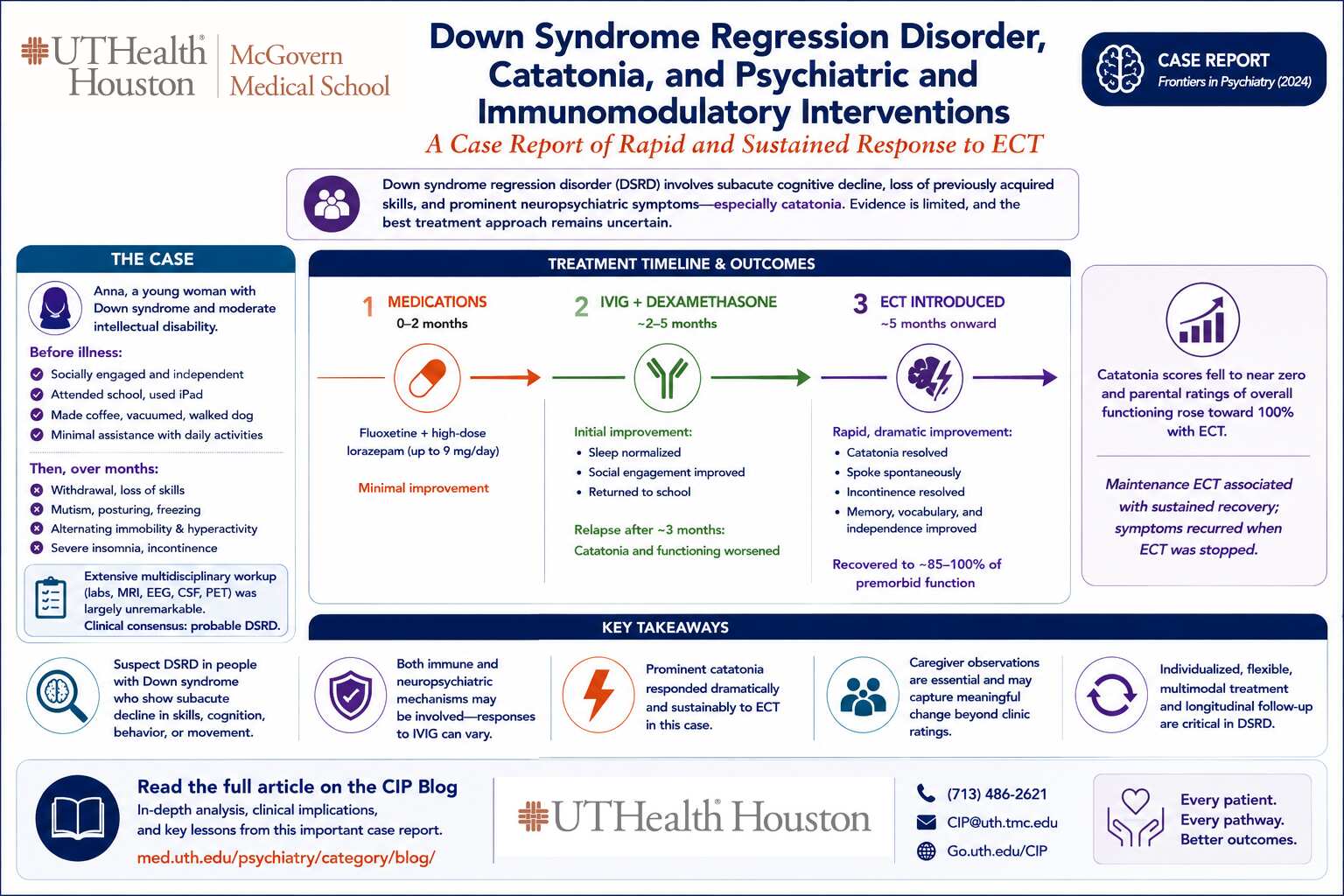
The authors describe a woman in her late teens, given the pseudonym Anna, who had Down syndrome and moderate intellectual disability.
Before becoming ill, she lived with her parents, attended supported education, and performed many everyday activities with minimal assistance. She walked her dog, vacuumed, prepared herself for school, used an iPad, made coffee independently, and baked with supervision.
Then something changed.
Over several months, Anna became increasingly socially withdrawn. She stopped engaging with support workers and teachers and lost interest in activities she had previously enjoyed.
Her cognition deteriorated.
Her self-care declined.
She developed severe insomnia.
Eventually, she began displaying striking behavioral and motor abnormalities. She would hold unusual postures for prolonged periods, become mute, fail to respond to questions, and alternate between immobility and hyperactivity.
Her parents sought opinions from multiple medical specialists before eventually reaching a neuropsychiatric service.
The multidisciplinary clinical consensus was that she met criteria for probable DSRD.
The Diagnostic Workup Was Extensive—and Largely Normal
One of the important lessons from this case is that serious neuropsychiatric illness does not necessarily produce an obvious abnormality on conventional testing.
Anna underwent an extensive evaluation.
Her laboratory studies showed thyroglobulin antibodies, although thyroid function remained normal. Testing for several neuronal and autoimmune antibodies was negative. Cerebrospinal fluid studies were largely unremarkable.
Her EEG was normal.
Brain MRI was normal.
Even positron emission tomography did not reveal an explanation for her deterioration.
Clinicians also considered alternative psychiatric diagnoses, including schizophrenia and severe depression with psychotic features.
But the relatively acute onset, substantial cognitive decline, developmental regression, and prominent catatonia made DSRD more consistent with the overall presentation.
This illustrates why DSRD often requires collaboration across psychiatry, neurology, immunology, and intellectual disability medicine.
First Treatments Produced Limited Improvement
Treatment began with the antidepressant fluoxetine and high-dose lorazepam, a benzodiazepine commonly used to treat catatonia.
Lorazepam was increased to as much as 9 mg per day, but after two months there was negligible improvement.
The clinical team then considered two very different approaches:
ECT and immunomodulatory treatment.
After discussion of the evidence, risks, and potential adverse effects, Anna’s parents expressed a strong preference to begin with immunomodulatory treatment.
She therefore began IVIG every four weeks, accompanied by dexamethasone.
Initially, there appeared to be improvement.
Her insomnia resolved. Social engagement and cognitive skills gradually improved, and she was able to return to school. Her parents estimated progressive recovery toward her previous level of functioning.
But the improvement did not last.
Catatonia Returned
Approximately three months after beginning IVIG, Anna’s catatonia worsened again.
Her overall functioning subsequently declined. Her parents reported increasing self-talking as well as new urinary and fecal incontinence despite her previously being toilet trained.
At that point, the clinical team proceeded with ECT.
Even getting to ECT was difficult.
The authors describe significant logistical obstacles resulting from the absence of established clinical pathways for people with intellectual disability and from Anna’s transition between pediatric and adult services. She ultimately had to be admitted to a neurology ward rather than an adult psychiatric ward, and legal authorization for ECT was required under local law.
These details may appear administrative, but they reveal something important:
For people with intellectual disabilities and complex neuropsychiatric disorders, access to the right treatment can itself become a major clinical challenge.
Then ECT Was Introduced
ECT was initially administered three times per week using right unilateral electrode placement.
The clinicians deliberately chose unilateral treatment because of its lower risk of cognitive adverse effects—an especially important consideration in a patient who already had an intellectual disability and significant cognitive regression.
What happened next was striking.
The authors describe Anna’s improvement as dramatic.
Her catatonic symptoms, which had persisted for approximately a year, rapidly subsided.
She became more socially interactive.
For the first time, she began speaking spontaneously with clinicians.
Her self-talking resolved.
Her incontinence disappeared.
Her vocabulary, memory, and ability to participate in everyday activities improved substantially. Her parents estimated that she had recovered to approximately 85% of her premorbid level of functioning.
After 12 treatments, ECT transitioned into a maintenance schedule with progressively longer intervals between treatments.
Within another three months, her parents considered her to have returned to baseline.
The Figure Tells the Story
One of the most compelling parts of the publication is Figure 1 on page 4.
The investigators tracked two measures over time: clinician-rated catatonia using the Bush-Francis Catatonia Rating Scale and Anna’s mother’s assessment of her overall functioning relative to her premorbid baseline.
During the period dominated by IVIG and other medications, the trajectory fluctuated.
Then ECT was introduced.
The graph shows a striking temporal relationship: catatonia scores rapidly fell toward zero while parental ratings of functioning climbed toward 100%.
Because this is a single case, that graph cannot prove causality.
But visually and clinically, the temporal association is difficult to ignore.
What Happened When ECT Was Stopped?
The longer follow-up adds another important dimension.
After the first year, ECT was discontinued for four months while IVIG continued. Anna gradually developed brief episodes of freezing, muteness, and aggression.
A second course of 12 ECT treatments was introduced, and these episodes ceased.
IVIG was eventually discontinued because there was inadequate evidence of a clear, sustained response.
Across the longitudinal observation, the authors therefore found a small and fluctuating response to IVIG that was not sustained, compared with a rapid response to ECT that produced sustained resolution of symptoms during maintenance treatment.
That distinction is the central clinical observation of this report.
Does This Mean ECT Should Be the First Treatment for DSRD?
No.
A case report involving one patient cannot determine the optimal treatment strategy for an entire disorder.
DSRD appears heterogeneous, and immune mechanisms may be important in some patients. The authors specifically caution that Anna’s uncertain response to IVIG does not exclude an immunological contribution to her illness. They also note that ECT itself may have immunomodulatory properties.
There are still major unanswered questions:
Which patients are most likely to respond to immunotherapy?
Which are most likely to respond to ECT?
Are there biomarkers that can help distinguish these groups?
Should treatments sometimes be combined?
How long should maintenance ECT continue after recovery?
These questions require prospective, multicenter studies.
But this case does suggest something clinically important:
When prominent catatonia accompanies DSRD, ECT deserves serious—and potentially earlier—consideration.
That is also the conclusion emphasized by the authors.
Measuring Recovery Requires More Than One Perspective
There is another important lesson in this paper.
The clinicians measured catatonia using a standardized clinical scale. Anna’s mother rated her overall functioning separately.
Those measurements generally moved in the same direction—but not always.
At certain points, the family perceived improvements in everyday functioning even while clinician-rated catatonia was worsening.
Neither perspective was necessarily wrong.
They were measuring different dimensions of recovery.
A clinician observes a patient during a limited encounter.
A caregiver sees communication, independence, sleep, social interaction, self-care, and behavior across days and weeks.
For people with intellectual disabilities who may have difficulty describing their internal experiences, caregiver observations can therefore provide indispensable clinical information.
The authors argue for multimodal assessment that incorporates multiple indicators rather than relying on a single measure.
The Family’s Perspective May Be the Most Important Part of the Paper
The publication includes an unusually powerful account written by Anna’s mother.
She describes watching her previously independent and engaged daughter become withdrawn, mute, combative, severely sleep-deprived, and intermittently “frozen.”
She also describes searching for answers while encountering clinicians unfamiliar with the syndrome and having Anna’s deterioration dismissed as simply part of Down syndrome.
The transition from pediatric to adult healthcare created another major barrier, just as the family had begun to find clinicians who understood the condition.
Eventually, an interdisciplinary team recognized the problem and worked collaboratively with the family. Anna’s mother describes the outcome: her daughter was back—happy, engaged, and thriving.
Her experience captures one of the most important messages of this publication:
Regression should never automatically be dismissed as “just Down syndrome.”
A major change from an individual’s established baseline deserves careful investigation.
The UTHealth Houston Perspective
At the Center for Interventional Psychiatry at UTHealth Houston, this case resonates strongly with our understanding of catatonia.
Catatonia is not synonymous with schizophrenia. It is not exclusively psychiatric. And it is not restricted to people without neurodevelopmental disorders.
It is a neuropsychiatric syndrome that can occur across a wide range of psychiatric, neurological, medical, and developmental conditions.
Most importantly, catatonia is treatable.
For individuals with Down syndrome who experience an unexplained and relatively rapid deterioration in speech, cognition, movement, behavior, independence, or social engagement, recognizing catatonia may fundamentally change the treatment pathway.
The case also illustrates why modern interventional psychiatry increasingly requires collaboration beyond traditional specialty boundaries.
The patient’s care involved neuropsychiatry, neurology, clinical immunology, and intellectual disability psychiatry.
That multidisciplinary approach matters because the underlying biology of DSRD remains uncertain. Immunological and neuropsychiatric mechanisms may overlap, and different patients may ultimately require different treatment strategies.
But diagnostic uncertainty should not become therapeutic paralysis.
When a patient has severe catatonia and established treatments have not produced adequate improvement, ECT should remain firmly within the clinical conversation.
For Anna, it was associated with a remarkable restoration of function.
For the field, her case is a reminder that the sudden loss of abilities in a person with Down syndrome should prompt us to ask not only what has changed—but whether what has changed is treatable.
Reference
Connors MH, Sachdev PS, Colebatch JG, Taylor MS, Trollor J, Mohan A. Case report: Down syndrome regression disorder, catatonia, and psychiatric and immunomodulatory interventions. Frontiers in Psychiatry. 2024;15:1416736. doi:10.3389/fpsyt.2024.1416736.
Contact
Center for Interventional Psychiatry
John S. Dunn Behavioral Sciences Center at UTHealth Houston
Request for Second Opinion: Go.uth.edu/CIPIntake
Phone: (713) 486-2621
Fax: (713) 500-2728
Email: [email protected]
Website: Go.uth.edu/CIP (external link)
Disclaimer
This article is intended for educational and informational purposes only and should not be considered medical advice or a substitute for consultation with a qualified healthcare professional.
Down syndrome regression disorder is uncommon, diagnostically complex, and incompletely understood. The publication discussed here is a single-patient case report, and the patient’s response should not be interpreted as establishing the comparative efficacy of ECT, IVIG, or other treatments for DSRD. Evaluation and treatment require individualized clinical assessment and may involve specialists in psychiatry, neurology, immunology, intellectual disability medicine, and other disciplines.
This content was developed with the assistance of artificial intelligence (AI) as a scientific writing support tool. It was reviewed, substantially edited, and approved by João L. de Quevedo, MD, PhD. Every effort has been made to ensure the accuracy, scientific balance, and clinical relevance of the information presented; however, readers should consult the original publication and current clinical guidelines when making patient-care decisions.
The authors of the original publication reported no financial support for the research, authorship, or publication and no commercial or financial conflicts of interest.
© Center for Interventional Psychiatry, John S. Dunn Behavioral Sciences Center at UTHealth Houston.