Treating Bipolar Disorder Across the Lifespan: What Does the Best Available Evidence Tell Us?
 Bipolar disorder presents clinicians with an unusual treatment challenge: the same diagnosis can require fundamentally different treatment strategies at different moments in a patient’s life.
A medication that is effective during acute mania may not be the best treatment for bipolar depression. A therapy that relieves an acute episode may not prevent the next one. Treatments also differ substantially in weight gain, sedation, metabolic effects, movement symptoms, and other adverse effects that matter enormously to individual patients.
And the evidence itself can be difficult to navigate.
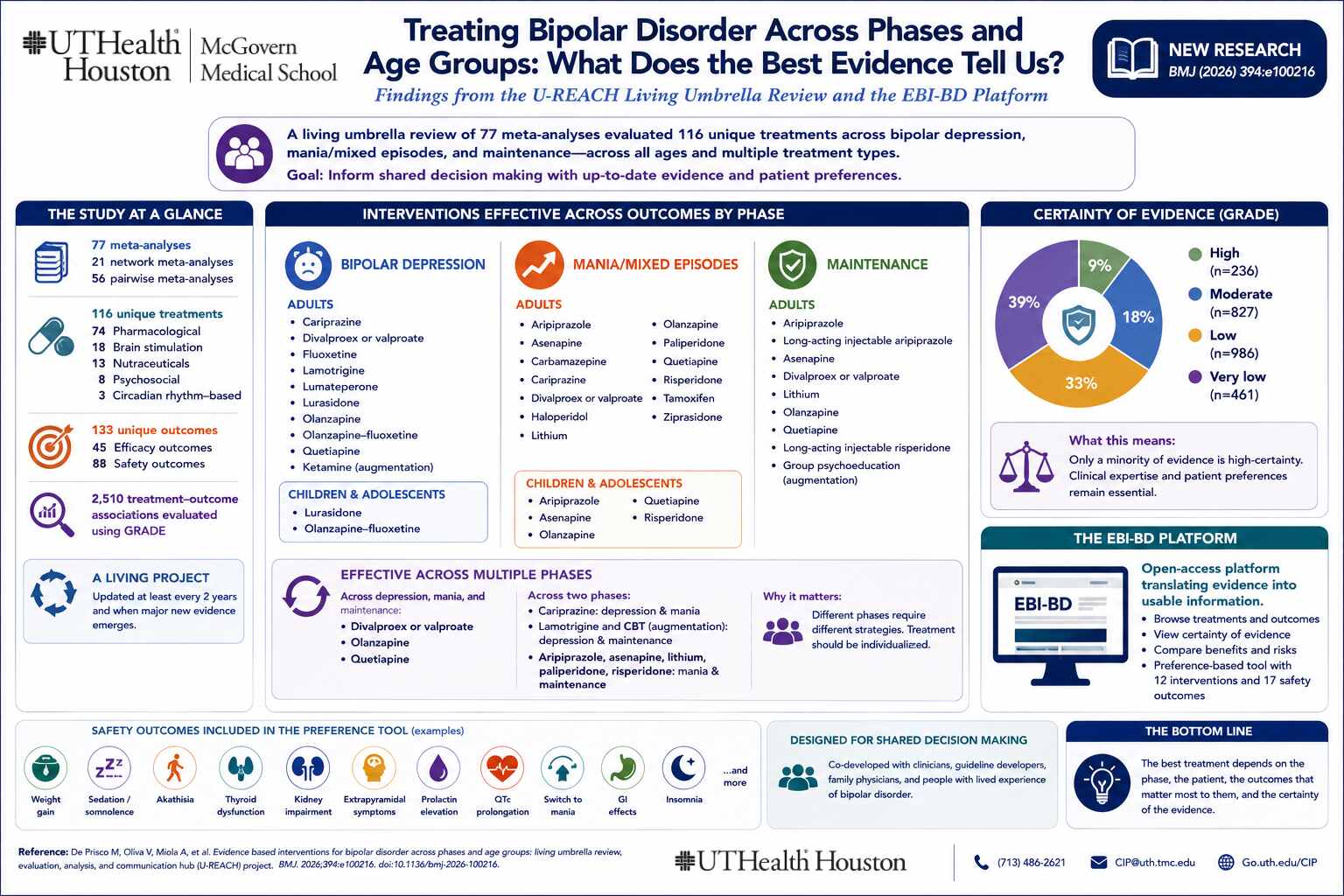
A major new study published in The BMJ attempts to address this problem on an unprecedented scale. Researchers conducted a living umbrella review of treatments for bipolar disorder, bringing together meta-analytic evidence across bipolar depression, mania or mixed episodes, and maintenance treatment—and across pharmacological, psychological, brain stimulation, nutraceutical, and circadian interventions.
The result is more than another systematic review.
The investigators also created an evolving digital resource called Evidence-Based Interventions for Bipolar Disorder (EBI-BD), designed to translate a remarkably complex evidence base into information clinicians and patients can use to make treatment decisions.
The study raises an important question for modern psychiatry:
Can we move from asking, “What is the best treatment for bipolar disorder?” to asking, “What is the best treatment for this patient, during this phase of illness, given the outcomes that matter most to them?”
Why Bipolar Disorder Requires a Different Way of Thinking About Treatment
Bipolar disorder is not a single clinical state.
A person may experience episodes of depression, mania, hypomania, mixed symptoms, and periods of relative stability. Treatment therefore has several distinct objectives:
- Relieve acute depressive symptoms
- Control mania or mixed episodes
- Achieve remission
- Prevent future depressive episodes
- Prevent future manic episodes
- Preserve functioning and quality of life
- Minimize adverse effects
- Maintain long-term treatment adherence
This complexity helps explain why simply asking whether a treatment “works for bipolar disorder” is not sufficient.
The study also emphasizes the broader clinical burden. Bipolar disorder affects an estimated 39.5 million people worldwide, and affected individuals experience substantial medical comorbidity, increased suicide risk, and markedly reduced life expectancy. The authors cite an estimated 12.47 years of potential life lost compared with the general population.
Treatment adherence presents another major challenge. Nearly half of individuals with bipolar disorder may not adhere to prescribed treatment, with perceived lack of efficacy, tolerability problems, and insufficient involvement in treatment decisions among the contributing factors.
This is precisely where shared decision-making becomes important.
A Study of Studies: What Is a Living Umbrella Review?
Instead of examining individual clinical trials, the investigators went several levels higher in the evidence hierarchy.
They identified systematic reviews containing either network meta-analyses or pairwise meta-analyses of randomized controlled trials.
The search covered pharmacological treatments but went considerably beyond medications. Eligible interventions included:
- Pharmacological treatments
- Brain stimulation
- Psychosocial interventions
- Nutraceuticals
- Circadian rhythm-based treatments
The investigators considered monotherapy, augmentation, and combination treatment across acute bipolar depression, mania or mixed episodes, and maintenance treatment.
And importantly, this is a living review.
Rather than remaining a static snapshot of evidence available at publication, the project is intended to be updated at least every two years, with additional updates when major changes in the literature warrant them.
That approach makes considerable sense in a field where new therapies and new evidence continue to emerge.
How Much Evidence Did the Researchers Examine?
The scale of the project is remarkable.
From 4,863 initial records, the researchers ultimately included 77 meta-analyses—21 network meta-analyses and 56 pairwise meta-analyses.
Together, these represented:
116 unique treatments
including:
- 74 pharmacological interventions
- 18 brain stimulation treatments
- 13 nutraceuticals
- 8 psychosocial interventions
- 3 circadian rhythm-based interventions
The investigators examined 133 outcomes—45 related to efficacy and 88 to safety—yielding 2,510 associations for formal evaluation.
But perhaps the most important aspect of the study was not simply counting studies or treatments.
The researchers asked:
How certain are we that these treatment effects are real?
Not All Evidence Is Equally Strong
The investigators evaluated the certainty of each body of evidence using the GRADE framework, which considers factors such as risk of bias, inconsistency, indirectness, imprecision, and publication bias.
Among the 2,510 evaluated associations:
- 236 were supported by high-certainty evidence
- 827 by moderate-certainty evidence
- 986 by low-certainty evidence
- 461 by very-low-certainty evidence
That finding deserves attention.
The psychiatric literature contains an enormous amount of information. But more information does not necessarily mean more certainty.
In fact, only a minority of the evaluated associations achieved high-certainty evidence.
For clinicians, this reinforces an important principle: the existence of a positive study—or even a positive meta-analysis—does not constitute robust evidence that a treatment should be preferred for a particular patient.
What Works for Bipolar Depression?
Bipolar depression remains one of the most difficult phases of bipolar disorder to treat.
For adults, the investigators identified several interventions supported across multiple efficacy outcomes. These included:
Cariprazine, divalproex or valproate, fluoxetine, lamotrigine, lumateperone, lurasidone, olanzapine, olanzapine-fluoxetine combination, quetiapine, and augmentation with ketamine.
For children and adolescents, the evidence was much narrower: lurasidone and olanzapine-fluoxetine combination emerged as interventions effective across outcomes.
This difference highlights a persistent problem in psychiatry: the evidence base for younger patients remains substantially smaller than that for adults.
Ketamine Appears in the Evidence—but Context Matters
For those of us working in interventional psychiatry, one finding is particularly noteworthy.
Ketamine augmentation was among the interventions that demonstrated efficacy across multiple outcomes for adult bipolar depression.
This reinforces the growing role of glutamatergic treatments in difficult-to-treat mood disorders.
However, the finding should not be interpreted as meaning that ketamine is universally appropriate for bipolar depression or that it should replace established mood-stabilizing treatments.
The study’s purpose is not to produce a simplistic ranking.
Rather, it shows where evidence exists, how strong that evidence is, and how different efficacy and safety outcomes should inform individualized decisions.
What Works for Mania?
The evidence landscape changes substantially when the clinical problem shifts from depression to mania.
For adults with mania or mixed episodes, interventions effective across multiple outcomes included:
Aripiprazole, asenapine, carbamazepine, cariprazine, divalproex or valproate, haloperidol, lithium, olanzapine, paliperidone, quetiapine, risperidone, tamoxifen, and ziprasidone.
For children and adolescents, the corresponding treatments were:
Aripiprazole, asenapine, olanzapine, quetiapine, and risperidone.
Again, the lesson is not that all these treatments are equivalent.
They differ considerably in adverse effects, pharmacology, patient acceptability, route of administration, previous response, and suitability for long-term treatment.
Maintenance Treatment Is a Different Question
Once an acute episode has resolved, the clinical objective changes.
Now the question becomes:
How do we keep the patient well?
Among adults, treatments supported across multiple maintenance outcomes included aripiprazole, long-acting injectable aripiprazole, asenapine, divalproex or valproate, lithium, olanzapine, quetiapine, long-acting injectable risperidone, and group psychoeducation as an augmentation strategy.
The inclusion of group psychoeducation is particularly important.
Modern treatment of bipolar disorder should not be reduced to pharmacology. Teaching patients to understand their illness, recognize early warning signs, improve adherence, manage sleep and behavioral rhythms, and actively participate in their treatment can be an important component of long-term care.
Which Treatments Have Evidence Across Different Phases?
Perhaps one of the most clinically interesting analyses examined treatments that demonstrated efficacy across more than one phase of bipolar disorder.
Three interventions had evidence spanning depression, mania, and maintenance:
Divalproex or valproate
Olanzapine
Quetiapine
Other treatments demonstrated efficacy across two phases.
Cariprazine crossed bipolar depression and mania.
Lamotrigine and augmentation with cognitive behavioral therapy crossed depression and maintenance.
Aripiprazole, asenapine, lithium, paliperidone, and risperidone had evidence across mania and maintenance.
This does not mean that treatments with evidence across more phases are automatically “better.”
A treatment may be particularly valuable for one phase while having little role in another. And the optimal choice still depends on the patient’s history, the polarity of previous episodes, comorbidities, vulnerability to adverse effects, previous response, and preferences.
What About ECT, TMS, and Other Brain Stimulation Treatments?
The review is particularly relevant to interventional psychiatry because it did not restrict its scope to medications.
It considered 18 brain stimulation interventions, including electroconvulsive therapy (ECT), transcranial magnetic stimulation (TMS), theta burst stimulation, and transcranial direct current stimulation.
However, the evidence base for these interventions was substantially less developed than that for pharmacological interventions.
For example, the review identified network and pairwise meta-analyses examining brain stimulation in bipolar depression, but many underlying reviews were rated as low or critically low methodological quality.
That distinction is crucial.
Absence of high-certainty meta-analytic evidence is not the same as evidence that a treatment does not work.
ECT illustrates this particularly well.
ECT has an established clinical role in severe mood episodes, including severe or treatment-resistant bipolar depression, mania, catatonia, psychosis, and situations requiring rapid clinical improvement. But some of the populations most likely to receive ECT are difficult to study in conventional randomized controlled trials.
Because this umbrella review included meta-analyses of randomized controlled trials, its methodology inherently privileges interventions with large randomized evidence bases.
That should be kept in mind when interpreting what does—and does not—appear among its strongest findings.
An Important Warning About “Evidence Rankings”
One of the most sophisticated aspects of this paper is also one of its most important cautions.
Even when an intervention has a favorable meta-analytic estimate, clinicians should not interpret that number in isolation.
The authors specifically discuss lamotrigine and lithium in maintenance treatment. Previous evidence suggested benefit in preventing depressive episodes, but the certainty of that evidence was rated low because of issues including risk of bias and substantial heterogeneity.
The authors therefore emphasize that clinical decisions should incorporate not only meta-analytic estimates and GRADE ratings but also clinical expertise and real-world evidence.
That is an essential distinction between evidence-based medicine and simply following an evidence ranking.
Evidence informs clinical judgment.
It does not replace it.
From Evidence-Based Medicine to Preference-Based Medicine
Perhaps the most innovative contribution of this project is not the umbrella review itself.
It is what the researchers built from it.
The EBI-BD platform translates evidence into an open-access digital environment where users can explore treatments, outcomes, methodological quality, and the certainty of the evidence.
The researchers then went one step further.
They created a preference-based treatment tool involving 12 commonly used interventions and 17 safety outcomes, including:
- Akathisia
- Sedation
- Somnolence
- Weight gain
- Kidney impairment
- Hypothyroidism
- Extrapyramidal symptoms
- Prolactin elevation
- QTc prolongation
- Switch to mania
- Gastrointestinal effects
- Insomnia and other adverse effects
Instead of assuming every adverse effect matters equally to every patient, users can assign different importance to different outcomes.
An algorithm then generates a treatment ranking based partly on those preferences.
The platform itself was co-designed with clinicians, guideline developers, family physicians, and importantly, people with lived experience of bipolar disorder.
This represents an important conceptual shift:
The treatment with the strongest average efficacy may not be the best treatment for a particular person.
Why Patient Preferences Matter
Imagine two patients with bipolar disorder.
One has obesity, diabetes, and substantial concern about additional weight gain.
Another has previously experienced severe akathisia and considers avoiding it the highest priority.
A third has responded extraordinarily well to lithium in the past and accepts the monitoring required for treatment.
A fourth strongly values avoiding sedation because of professional responsibilities.
The same evidence base can lead to different rational treatment decisions.
That is not a failure of evidence-based medicine.
It is what personalized evidence-based medicine should look like.
The Study Also Reveals How Much We Still Do Not Know
Despite its extraordinary breadth, this publication exposes major gaps in the literature.
Only 8 of the 77 included meta-analyses were rated as high quality using AMSTAR-2; 16 were rated low, and 53 were rated critically low.
The evidence was also heavily weighted toward adults: 66 included meta-analyses reported findings for adult populations, whereas only 4 specifically addressed children and adolescents.
And although randomized controlled trials provide essential evidence about efficacy, they cannot answer every clinical question encountered in real-world practice.
The authors themselves emphasize that EBI-BD should complement—not replace—clinical expertise and other relevant sources of evidence.
The UTHealth Houston Perspective
At the Center for Interventional Psychiatry at UTHealth Houston, this study reinforces an idea that is increasingly central to modern mood-disorder treatment:
We should not think in terms of a treatment hierarchy alone. We should think in terms of a treatment portfolio.
Bipolar disorder is heterogeneous.
The patient experiencing severe bipolar depression today may require a very different intervention from the one needed during mania, maintenance treatment, or a future treatment-resistant episode.
Pharmacotherapy remains foundational. But contemporary care may also incorporate psychotherapy, psychoeducation, circadian and behavioral interventions, and—when clinically appropriate—interventional approaches such as ECT, TMS, or ketamine-based treatment.
The goal should not be to identify one universally superior treatment.
It should be to answer several more clinically meaningful questions:
What phase of bipolar disorder are we treating?
How severe is the illness?
What has the patient previously tried?
What worked before?
What adverse effects pose the greatest risk?
What outcomes matter most to this individual?
And how certain is the evidence supporting the options we are considering?
The EBI-BD project is important because it attempts to place those questions into the same evidence framework.
Looking Ahead: A Living Evidence System for Psychiatry
Traditional clinical guidelines have an unavoidable limitation.
By the time hundreds of studies are reviewed, recommendations are written, consensus is achieved, and guidelines are published, the evidence base may already have changed.
The U-REACH approach offers a different model.
The bipolar disorder review is designed to remain living, with updates at least every two years and potentially sooner when important new evidence emerges.
That concept could ultimately become more important than any individual treatment result in this paper.
Imagine a future psychiatric clinic where the clinician and patient can sit together and access an evidence system that continuously integrates:
clinical trials,
meta-analyses,
real-world outcomes,
biomarkers,
previous treatment response,
medical comorbidities,
adverse-effect vulnerability,
and the patient’s own preferences.
The system would not make the decision.
It would make the evidence easier to understand, enabling patients and clinicians to make better decisions together.
The authors conclude that EBI-BD can support evidence-based personalized treatment decisions and potentially inform future clinical guidelines as the evidence evolves.
That may be the most important message of this publication.
The future of bipolar disorder treatment may not simply involve more therapies. It may involve becoming much better at choosing among them.
Reference
De Prisco M, Oliva V, Miola A, et al. Evidence-based interventions for bipolar disorder across phases and age groups: living umbrella review, evaluation, analysis, and communication hub (U-REACH) project. BMJ. 2026;394:e100216. doi:10.1136/bmj-2026-100216.
Contact
Center for Interventional Psychiatry
John S. Dunn Behavioral Sciences Center at UTHealth Houston
Request for Second Opinion: Go.uth.edu/CIPIntake
Phone: (713) 486-2621
Fax: (713) 500-2728
Email: [email protected]
Website: Go.uth.edu/CIP
Disclaimer
This article is intended for educational and informational purposes only and should not be considered medical advice or a substitute for consultation with a qualified healthcare professional. Treatment of bipolar disorder requires individualized assessment, and treatment selection depends on illness phase, clinical history, medical comorbidities, previous treatment response, safety considerations, patient preferences, and other factors.
The findings discussed here come from an umbrella review of existing network and pairwise meta-analyses of randomized controlled trials. The strength and quantity of evidence differed substantially among interventions, populations, and outcomes; therefore, the absence of moderate- or high-certainty evidence for a treatment should not automatically be interpreted as evidence of ineffectiveness.
This content was developed with the assistance of artificial intelligence (AI) as a scientific writing support tool. It was reviewed, substantially edited, and approved by João L. de Quevedo, MD, PhD. Every effort has been made to ensure the accuracy, scientific balance, and clinical relevance of the information presented; however, readers should consult the original publication and current clinical guidelines when making patient-care decisions.