Psilocybin-Assisted Therapy for Treatment-Resistant Depression: Can It Work in Public Mental Healthcare?
 For years, psychedelic-assisted therapy has generated excitement because of the possibility that a single treatment session might produce meaningful antidepressant effects lasting for weeks or longer.
But an important question remains:
Can psychedelic therapy move beyond highly specialized research environments and eventually become part of routine mental healthcare?
A new randomized controlled trial published in Nature Medicine takes an important step toward answering that question.
Investigators tested psilocybin-assisted therapy for treatment-resistant major depressive disorder within England’s National Health Service (NHS)—a public healthcare system where feasibility, staffing, cost, logistics, and scalability matter just as much as efficacy.
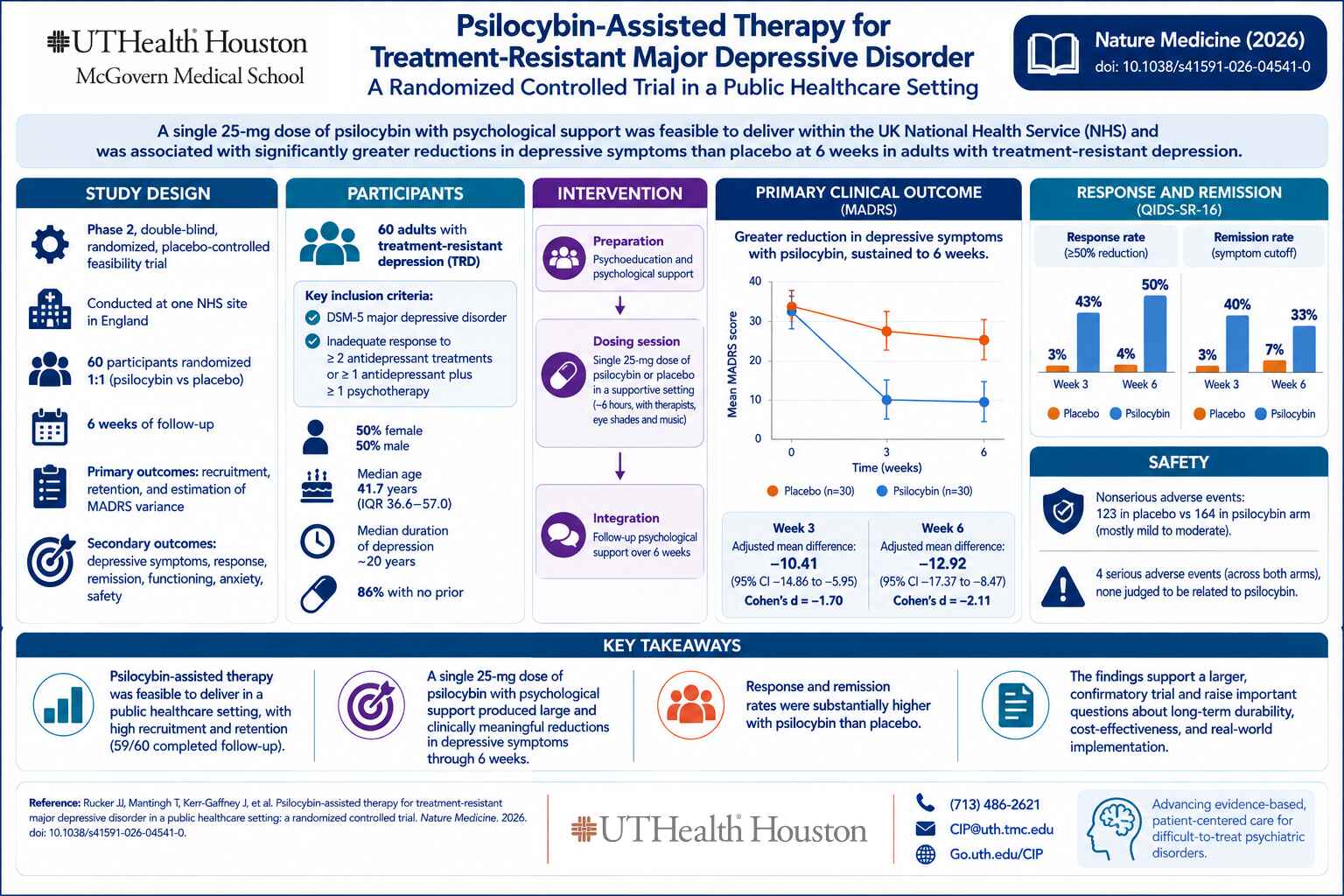
The study found that a single 25-mg dose of psilocybin, delivered with structured psychological support, was feasible to administer and was associated with substantially greater reductions in depressive symptoms than placebo over six weeks.
The results are encouraging.
They are also more complicated than they may first appear.
Treatment-Resistant Depression Still Needs Better Options
Major depressive disorder is among the leading causes of disability worldwide.
For a substantial subgroup of patients, standard treatments do not provide adequate relief. Treatment-resistant depression is commonly defined as failure to respond adequately to at least two antidepressant treatments, and the authors note that it affects approximately one-third of people with major depressive disorder.
Current evidence-based options include:
- Ketamine
- Esketamine
- Electroconvulsive therapy (ECT)
- Repetitive transcranial magnetic stimulation (TMS)
- Adjunctive psychotherapy
These treatments can be highly effective, but access remains uneven.
Psilocybin-assisted therapy is being investigated as a potentially different therapeutic model: instead of daily medication or repeated procedures, a patient receives a limited number of psychedelic dosing sessions embedded within psychological preparation and follow-up.
This trial examined whether that model could be realistically delivered within a public mental health system.
What Exactly Did the Study Test?
The trial was conducted at a single NHS site in England.
Sixty adults with treatment-resistant major depressive disorder were randomized equally to receive either:
25 mg of psilocybin or placebo
Both groups received structured psychological support.
Participants qualified if they had failed at least two adequate antidepressant trials or one antidepressant trial plus one psychotherapy trial. Importantly, the investigators placed no upper limit on the degree of prior treatment resistance, allowing enrollment of some patients with longstanding and difficult-to-treat illness.
The median participant age was about 41 years, half were women, and on average participants had lived with significant depression for approximately 20 years.
Psilocybin Was Not Given as a Stand-Alone Drug
One of the most important points in interpreting psychedelic trials is that researchers are not simply handing patients a capsule and sending them home.
Participants underwent a preparation period during which psychiatric medications were withdrawn, and they received psychoeducation and psychological preparation.
On dosing day, participants received psilocybin or placebo in a quiet treatment room. They were accompanied by a therapist and a chaperone for approximately six hours, with optional eye shades and music.
Afterward, participants returned for follow-up assessments and time-limited integration sessions over six weeks.
The intervention therefore was not simply:
psilocybin
It was more accurately:
psilocybin + preparation + prolonged monitored dosing + psychological support + integration
That distinction matters enormously when considering future implementation.
First Question: Was the Model Feasible?
This was formally a phase 2 feasibility trial.
The primary outcomes were not antidepressant efficacy itself, but recruitment, retention, and the ability to collect reliable outcome data.
By those measures, the study performed very well.
Of the 75 individuals who consented and were screened, 60 were randomized.
All randomized participants attended the dosing visit.
And 59 of 60 participants completed the primary depression measure at every follow-up point through week 6.
That level of retention is particularly important for an intensive intervention requiring preparation, a long dosing day, and repeated follow-up.
The authors concluded that conducting this type of trial within an NHS setting was feasible.
The Antidepressant Signal Was Striking
Although clinical efficacy was a secondary rather than primary objective, the antidepressant findings were substantial.
At week 3, participants receiving psilocybin had an adjusted 10.41-point greater reduction on the Montgomery–Åsberg Depression Rating Scale (MADRS) than those receiving placebo.
The standardized effect size was:
Cohen’s d = −1.70
That represents a very large between-group effect.
And the separation between groups persisted.
At week 6, the adjusted difference had increased to:
−12.92 MADRS points
with a standardized effect size of:
Cohen’s d = −2.11
The forest plot on page 6 shows that the direction of effect favored psilocybin across multiple measures—not only clinician-rated depression, but also self-reported depression, anxiety, functioning, wellbeing, and overall health.
Response and Remission Were Also Encouraging
At week 3:
43% of participants receiving psilocybin met criteria for response, compared with 3% receiving placebo.
40% of participants receiving psilocybin met criteria for remission, again compared with 3% receiving placebo.
At week 6, the response rate in the psilocybin group increased to 50%.
Self-reported measures showed a similar pattern, with 43% meeting the response criteria and 33% meeting the remission criteria at week 6.
For patients who had experienced depression for many years and failed multiple prior treatments, these results are clinically notable.
But there is a major caveat.
The Blinding Problem Cannot Be Ignored.
Psychedelic trials face a unique methodological challenge.
A person receiving a full psychedelic dose will often know—or strongly suspect—that they received the active treatment.
That is exactly what happened here.
Among participants who were asked to guess their treatment allocation:
- 100% of those receiving psilocybin correctly guessed
- 70% of those receiving placebo correctly guessed
The investigators explicitly acknowledge that expectancy effects likely contributed to the observed between-group difference.
This does not mean the antidepressant effect was “just placebo.”
It means that separating the pharmacological effect of psilocybin from expectancy, the subjective psychedelic experience, therapeutic support, and integration is extremely difficult.
And perhaps that separation is not entirely artificial.
Is the Psychedelic Experience Part of the Treatment?
Traditional randomized drug trials assume that the medication can be evaluated largely independently of the treatment context.
Psychedelic-assisted therapy may challenge that assumption.
The authors note that expectancy, subjective psychedelic effects, pharmacology, and psychological integration may work synergistically and may therefore be intrinsic to the therapeutic model itself.
That raises a fascinating question:
Is psilocybin best understood as a drug—or as one component of a complex therapeutic intervention?
If the treatment depends in part on the emotional, perceptual, and psychological experiences produced during the session, then conventional placebo-controlled methodology may imperfectly capture the intervention.
This is one of the central scientific challenges facing psychedelic psychiatry.
Safety: Reassuring, but Still Requires Careful Monitoring
During the randomized phase, investigators recorded:
- 164 nonserious adverse events in the psilocybin group
- 123 nonserious adverse events in the placebo group
Most adverse events were mild or moderate.
Four serious adverse events occurred across the randomized and open-label phases. Importantly, the serious events occurring in participants who had received psilocybin were judged unrelated to the study treatment.
Clinical safety scales evaluating suicidality and mania did not show substantial deterioration over time.
These findings are reassuring.
They should not, however, be interpreted as proving broad safety outside carefully selected and monitored clinical populations.
The trial excluded individuals with conditions such as bipolar disorder, psychotic disorders, recent suicide attempts, substance dependence, and significant medical conditions considered incompatible with psilocybin treatment.
Why the NHS Setting Matters
Perhaps the most distinctive feature of this publication is not the antidepressant response.
It is where the study occurred.
The investigators were trying to understand whether psychedelic-assisted therapy could eventually function within a real public healthcare system.
That requires answering very practical questions:
Can patients be recruited?
Will they complete the treatment?
Can trained staff deliver it reliably?
Can six-hour dosing sessions be integrated into clinical workflows?
Can follow-up and psychological support be provided?
Can this be done safely outside highly specialized psychedelic research centers?
Interestingly, the trial initially took place in a hospital research facility but later moved to a refurbished community mental health setting.
The investigators reported no new logistical or safety concerns after the move, although they appropriately describe this as an informal observation rather than a formal study result.
This may be highly relevant to future implementation.
The Real Scalability Challenge May Not Be the Drug
A 25-mg psilocybin capsule is relatively simple.
The healthcare infrastructure surrounding it is not.
This trial involved:
screening → medication discontinuation → preparation → six-hour monitored dosing → therapist + chaperone → medical oversight → integration → repeated follow-up
That raises questions about staffing, training, facilities, scheduling, reimbursement, and cost-effectiveness.
The authors explicitly state that cost-effectiveness must be established before this model can be realistically evaluated for broader use in public healthcare.
That may ultimately determine whether psychedelic-assisted therapy becomes widely available or remains concentrated in specialized centers.
The Participants Were More “Real World”—But Not Fully Representative
The investigators deliberately used relatively broad inclusion criteria and allowed patients with substantial previous treatment resistance.
This is a strength.
The average participant had experienced depression for approximately two decades, and some had failed many previous interventions.
But generalizability remains limited.
The sample was highly educated, and Black participants were underrepresented relative to recruitment targets. The authors specifically highlight the need to improve representation and cultural competency in future trials.
This is especially important for an intervention whose therapeutic context may interact with culture, expectations, trust, and patient-clinician relationships.
Six Weeks Is Encouraging—but Not Long Enough
Another central question is durability.
The antidepressant effect remained evident through week 6.
But treatment-resistant depression is frequently chronic and recurrent.
We still need to understand:
How many patients remain well at 3 months?
At 6 months?
At 1 year?
Who requires another psilocybin session?
How often?
Could repeated dosing create additional benefits—or additional risks?
The investigators are conducting a two-year follow-up of participants, which should help answer some of these questions.
For now, the correct conclusion is not that a single dose produces permanent remission.
It is that a clinically meaningful antidepressant signal remained present through six weeks in this trial.
What This Study Does—and Does Not—Show
This distinction is critical.
The trial does show that:
- Psilocybin-assisted therapy can be delivered within an NHS public mental health setting.
- Recruitment and retention were excellent.
- A strong antidepressant signal emerged following one 25-mg dose.
- Improvements persisted through six weeks.
- The intervention was generally well tolerated in carefully selected patients.
The study does not yet prove that:
- Psilocybin is definitively effective for TRD in routine practice.
- The very large effect size reflects pharmacology alone.
- One treatment is sufficient long-term.
- The intervention is cost-effective.
- It can be scaled easily across healthcare systems.
- It should replace established treatments such as ECT, TMS, ketamine, or esketamine.
The authors themselves appropriately describe these findings as supporting a larger confirmatory efficacy trial.
The UTHealth Houston Perspective
At the Center for Interventional Psychiatry at UTHealth Houston, this study is particularly relevant because it addresses one of the questions that increasingly defines our field:
How do we translate promising neuroscience into treatment that can actually be delivered to patients?
Interventional psychiatry already manages this challenge every day.
ECT requires anesthesia, specialized facilities, and trained teams.
TMS requires equipment, repeated visits, and precise treatment delivery.
SAINT® requires accelerated scheduling and individualized targeting.
Ketamine and esketamine require monitoring and clinical infrastructure.
Psychedelic-assisted therapy would introduce another distinct model—one that may combine pharmacology, psychotherapy, prolonged observation, and specialized treatment environments.
That is why this study is important.
The major question is no longer simply:
“Can psilocybin reduce depressive symptoms?”
Increasingly, the questions are:
Who should receive it?
How should patients be prepared?
How much psychological support is necessary?
How do we monitor risk?
Where should the treatment occur?
What does long-term care look like afterward?
And can the model be delivered at a cost that healthcare systems can sustain?
Those are implementation questions—and they will ultimately determine whether psychedelic-assisted therapy becomes a meaningful part of psychiatric care.
Looking Ahead
Psychedelic psychiatry is moving into a more mature phase.
The early question was whether these compounds could produce an antidepressant effect.
The next generation of studies must determine:
how durable that effect is,
how much of it depends on the psychedelic experience and psychological support,
how best to identify suitable patients,
how to compare the treatment directly with established interventions,
and
how to build safe and scalable systems of care.
This new Nature Medicine study does not answer all of those questions.
But it demonstrates something important:
Psilocybin-assisted therapy for treatment-resistant depression can be studied—and potentially delivered—within a public mental healthcare system.
The antidepressant signal is compelling.
The implementation challenge is now becoming just as important as the pharmacology.
And that may represent the next major chapter in psychedelic medicine.
Reference
Rucker JJ, Mantingh T, Kerr-Gaffney J, et al. Psilocybin-assisted therapy for treatment-resistant major depressive disorder in a public healthcare setting: a randomized controlled trial. Nature Medicine. 2026. doi:10.1038/s41591-026-04541-0.
Contact
Center for Interventional Psychiatry
John S. Dunn Behavioral Sciences Center at UTHealth Houston
Request for Second Opinion: Go.uth.edu/CIPIntake
Phone: (713) 486-2621
Fax: (713) 500-2728
Email: [email protected]
Website: Go.uth.edu/CIP
Disclaimer
This article is intended for educational and informational purposes only and should not be considered medical advice or a substitute for consultation with a qualified healthcare professional.
Psilocybin-assisted therapy remains investigational and is not FDA-approved for the treatment of major depressive disorder or treatment-resistant depression. The study discussed here was a single-site phase 2 feasibility trial involving 60 participants. Clinical efficacy outcomes were secondary; the follow-up period was six weeks, and functional unblinding likely contributed to the observed between-group differences. Larger confirmatory trials with longer follow-up periods are required before these findings can be established as routine clinical use.
This content was developed with the assistance of artificial intelligence (AI) as a scientific writing support tool. It was reviewed, substantially edited, and approved by João L. de Quevedo, MD, PhD. Every effort has been made to ensure the accuracy, scientific balance, and clinical relevance of the information presented; however, readers should consult the original publication and current clinical guidelines when making patient-care decisions.