From Ions to Mood: What Our Research on the Ouabain Model Reveals About Bipolar Disorder
Bipolar disorder is defined clinically by changes in mood, energy, activity, cognition, and behavior. Yet beneath these recognizable symptoms lies a much more difficult question:
What biological processes cause the brain to shift between different mood states?
This question has been central to my research in bipolar disorder for many years.
In a recently published narrative review in Progress in Neuro-Psychopharmacology & Biological Psychiatry, my colleagues and I revisited one experimental model that has contributed substantially to this line of investigation: the ouabain-induced animal model of bipolar disorder.
Our review integrates recent evidence examining how disruption of sodium-potassium pump activity may influence intracellular signaling, oxidative stress, inflammation, neuroplasticity, neurotransmission, and ultimately mood-related behavior.
The model is particularly intriguing because its effects can evolve over time—from behaviors resembling aspects of mania to behaviors resembling aspects of depression.
That temporal progression gives researchers an unusual experimental opportunity: rather than studying only one mood state, we may be able to investigate some of the biological processes involved in transitions between mood states.
Why Do We Need Animal Models of Bipolar Disorder?
Psychiatric illnesses present a unique challenge for neuroscience.
Researchers cannot experimentally manipulate many potentially important biological pathways in the human brain. Animal models therefore provide an opportunity to investigate mechanisms under controlled conditions and test whether particular biological disturbances produce behavioral and molecular changes relevant to human illness.
But an important distinction must be made:
An animal does not have bipolar disorder in the same sense that a person does.
Instead, researchers ask whether a model reproduces specific features relevant to the illness.
Experimental models are commonly evaluated according to several forms of validity.
Face validity assesses whether the model produces behaviors that resemble relevant clinical features.
Construct validity assesses whether the underlying biological mechanisms are plausibly linked to the human disorder.
Predictive validity assesses whether treatments known to be clinically effective can reverse abnormalities produced by the model.
Animal models should therefore not be viewed as miniature replicas of human psychiatric disorders. They are experimental tools that allow researchers to isolate and investigate components of extraordinarily complex illnesses.
What Is Ouabain?
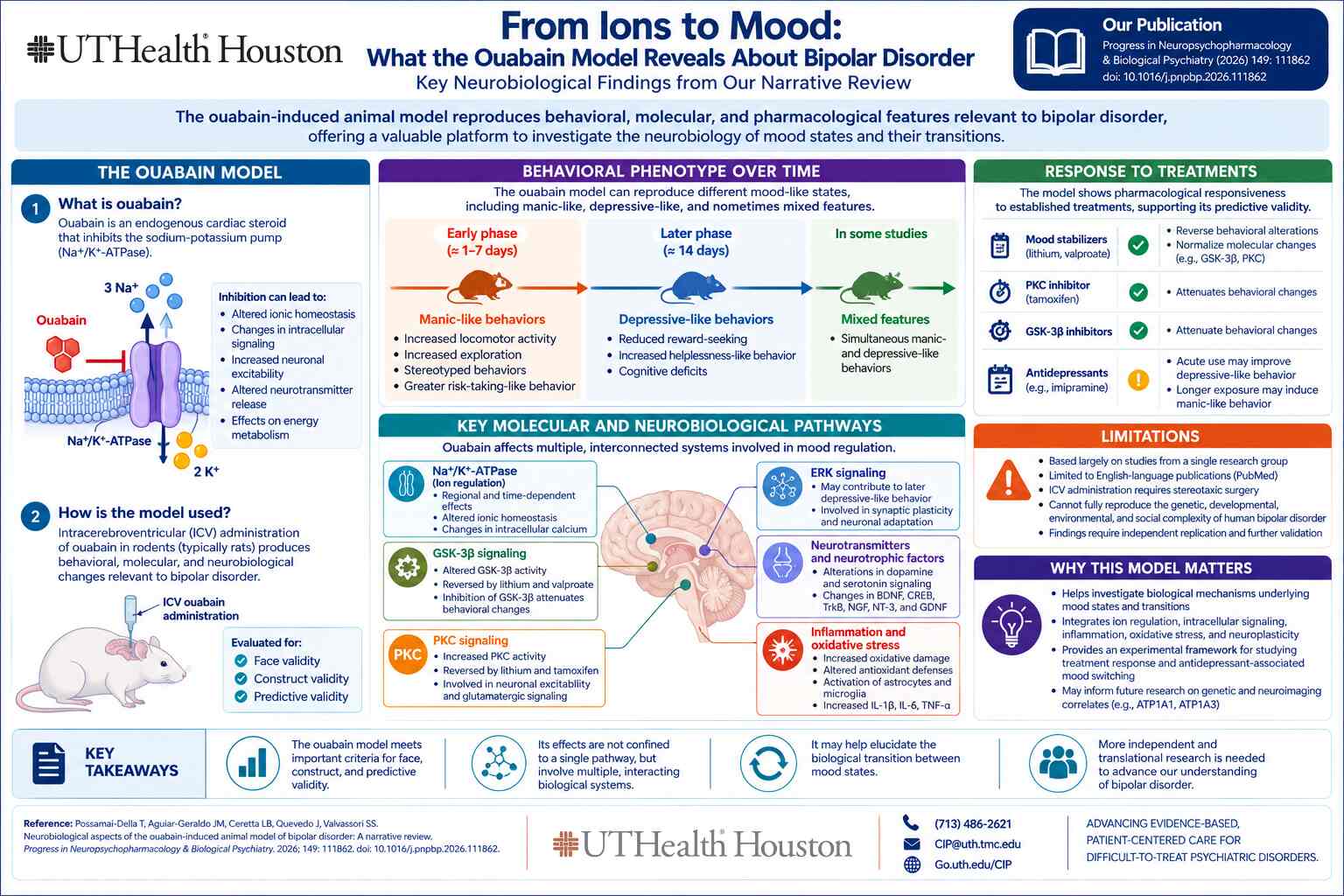
Ouabain is an endogenous cardiac steroid that inhibits an important membrane enzyme called the sodium-potassium pump, or Na+/K+-ATPase.
This pump is fundamental to normal neuronal function.
It helps maintain sodium and potassium gradients across cell membranes, supports electrical excitability, consumes a substantial amount of cellular energy, and participates in intracellular signaling.
When ouabain is administered directly into the brain in experimental animals, Na+/K+-ATPase activity is disrupted.
But the consequences extend far beyond sodium and potassium.
Changes can occur in:
- Intracellular calcium
- Neuronal excitability
- Neurotransmitter release
- Cellular signaling
- Energy regulation
These interconnected effects make the model particularly interesting for studying the biology of bipolar disorder.
One Model, Different Mood-Like States
Perhaps the most intriguing characteristic of the ouabain model is its temporal evolution.
Many experimental models reproduce only one behavioral dimension—for example, hyperactivity or depressive-like behavior.
The ouabain model can produce behavioral changes resembling different poles of bipolar disorder at different times.
Soon after intracerebroventricular administration, animals can develop manic-like behaviors, including increased locomotor and exploratory activity, stereotyped behaviors, and greater risk-taking-like behavior.
At later time points—particularly around 14 days after administration in several experiments—animals can develop depressive-like behaviors, including reduced reward-seeking and increased helplessness-like behavior.
Cognitive abnormalities have also been described.
Some studies have even reported simultaneous manic- and depressive-like features, raising the possibility that the model could help researchers investigate biological processes relevant to mixed states.
This temporal dimension is scientifically important.
Bipolar disorder is fundamentally dynamic. Understanding the disorder may therefore require us to understand not only the biology of mania and depression independently, but also:
What causes the brain to transition from one state to another?
The Sodium-Potassium Pump May Be Only the Beginning
The simplest interpretation of the model might be:
Ouabain → Na+/K+-ATPase inhibition → abnormal neuronal activity → abnormal behavior
Our review suggests that the biology is considerably more complex.
Changes in Na+/K+-ATPase activity vary by brain region and over time. Moreover, ouabain affects multiple intracellular signaling pathways implicated in mood regulation.
The sodium-potassium pump may therefore be more than an ion transporter.
Its disruption may represent an upstream event that influences a broader network of biological systems.
GSK-3: An Important Connection to Mood Stabilization
One of the most interesting connections involves glycogen synthase kinase-3 beta (GSK-3β).
GSK-3 participates in numerous cellular processes relevant to brain function, including:
- Synaptic plasticity
- Gene expression
- Energy metabolism
- Inflammation
- Neurogenesis
- Neuronal survival
It is particularly relevant to bipolar disorder because lithium—one of our most established mood stabilizers—affects GSK-3 signaling.
Across the studies examined in our review, ouabain altered GSK-3β signaling.
Importantly, lithium and valproate can reverse some of the molecular and behavioral abnormalities induced by ouabain, and direct experimental inhibition of GSK-3β has also attenuated these abnormalities in the model.
This does not establish GSK-3 dysfunction as the cause of bipolar disorder.
Instead, it demonstrates why experimental models are useful: they allow investigators to examine relationships among a molecular perturbation, intracellular signaling, behavioral changes, and treatment response within the same experimental system.
PKC and ERK: Expanding the Signaling Network
The biological effects extend further.
Ouabain has also been associated with increased activity of protein kinase C (PKC), another signaling system involved in neuronal excitability, neurotransmitter release, neuroplasticity, oxidative stress, and glutamatergic signaling.
Interestingly, both lithium and the PKC inhibitor tamoxifen have attenuated behavioral alterations produced by ouabain in experimental studies.
The extracellular signal-regulated kinase (ERK) pathway represents another potentially important component.
Our review suggests that distinct signaling pathways may contribute to different phases of the behavioral phenotype.
Ionic dysregulation and signaling involving GSK-3β and PKC may be particularly relevant to manic-like behavior, whereas alterations involving ERK may contribute to depressive-like states emerging later.
These hypotheses remain preliminary.
But they point toward a much richer model:
Bipolar disorder may involve dynamic interactions among multiple signaling networks rather than dysfunction of a single molecular pathway.
Oxidative Stress and Inflammation Enter the Picture
Two biological processes repeatedly implicated in bipolar disorder research are oxidative stress and inflammation.
Both also appear prominently in the ouabain model.
Across multiple studies, ouabain administration has been associated with increased markers of oxidative damage and alterations in antioxidant defenses.
Some increases in antioxidant enzymes may represent compensatory attempts by the brain to restore redox balance rather than evidence that oxidative stress has resolved.
Inflammatory changes appear to have their own temporal pattern.
Experimental studies have identified activation of astrocytes and microglia, followed at later time points by changes in inflammatory mediators including IL-1β, IL-6, and TNF-α.
Notably, some of these inflammatory abnormalities emerge around the same time as depressive-like behavior.
This raises an intriguing possibility.
Mood-state transitions may reflect not a single molecular switch, but an evolving interaction among:
ionic regulation → intracellular signaling → oxidative stress → neuroinflammation → neuroplasticity
The exact relationships among these processes remain to be established, but the model gives researchers a platform for investigating them experimentally.
Neuroplasticity May Connect These Systems
Our review also identified changes in several molecules involved in neuronal growth and plasticity, including:
BDNF, CREB, TrkB, NGF, NT-3, and GDNF.
Alterations in the BDNF/ERK/CREB pathway are particularly noteworthy because these systems help regulate synaptic plasticity and neuronal adaptation.
Ouabain has also been associated with changes in dopamine and serotonin signaling and with molecular pathways involved in cell survival and apoptosis.
Taken together, these findings reinforce an increasingly important concept in modern psychiatry:
Bipolar disorder is unlikely to result from dysfunction in a single neurotransmitter system.
Instead, the illness may arise from disturbances in interacting systems that maintain neuronal stability, cellular energetics, signaling, plasticity, and adaptation.
Why Treatment Response Matters
An experimental model becomes substantially more interesting when established treatments modify its abnormalities.
Lithium and valproate generally improve or attenuate behavioral alterations produced by ouabain.
The effects of antidepressants appear more complicated.
The literature reviewed includes experiments in which acute imipramine improved depressive-like behavior, whereas longer exposure produced manic-like behavior following ouabain administration.
This potentially provides researchers with an experimental framework for investigating mechanisms relevant to antidepressant-associated mood switching.
That is particularly interesting in bipolar disorder, where the biological state of the patient may influence how the brain responds to a pharmacological intervention.
The same model may therefore allow investigators to ask two different questions:
Why do different mood states emerge?
and
Why might the same treatment produce different effects depending on the biological state of the brain?
What Does This Mean for Patients?
It is important to emphasize what this research does not mean.
Ouabain is not being proposed as a treatment for bipolar disorder.
And findings from an animal model cannot be assumed to apply directly to an individual patient.
The value of this work is mechanistic.
Today, psychiatric treatments are still selected largely according to clinical symptoms, previous treatment response, safety considerations, and patient preferences.
A deeper understanding of the biological networks underlying different mood states could eventually contribute to a more biologically informed approach.
Future research may help determine whether particular patients have abnormalities involving:
- Ion regulation
- Intracellular signaling
- Oxidative stress
- Inflammation
- Neuroplasticity
- Cellular energetics
—or combinations of these processes.
If those biological profiles can eventually be linked to treatment response, they could contribute to the development of precision psychiatry.
That remains a future goal rather than a current clinical capability. Still, experimental models such as this one help us formulate and test the biological hypotheses necessary to move in that direction.
Important Limitations
The evidence must be interpreted cautiously.
Our narrative review included 31 primary studies identified through a PubMed search of peer-reviewed literature published from 2014 through 2026.
A substantial proportion of the experimental literature originated from a single research group, emphasizing the importance of independent replication.
The review was also restricted to English-language publications identified through a single database.
There are also limitations inherent to the model itself.
Intracerebroventricular administration requires stereotaxic surgery, and a pharmacological animal model cannot reproduce the genetic, developmental, environmental, psychological, and social complexity of human bipolar disorder.
These limitations are precisely why experimental models should be considered tools for testing hypotheses—not replicas of human disease.
The UTHealth Houston Perspective
This publication reflects a research trajectory that has been important to my work in bipolar disorder: understanding how disturbances at the cellular and molecular level may ultimately translate into changes in mood and behavior.
Our review suggests that the ouabain model is useful precisely because its effects are not confined to a single biological pathway.
A perturbation beginning with Na+/K+-ATPase can influence ionic homeostasis and propagate through signaling systems involving GSK-3β, PKC, and ERK, while interacting with oxidative stress, inflammation, neurotrophic signaling, neurotransmission, and pathways regulating cell survival.
The temporal dimension is particularly compelling.
The available evidence suggests that ionic dysregulation and signaling involving GSK-3β and PKC may contribute to earlier manic-like manifestations. At the same time, ERK-related alterations may participate in the depressive-like phenotype observed later. These hypotheses remain preliminary, but they offer an experimental framework for studying something fundamental to bipolar disorder:
The biological transition between mood states.
At the Center for Interventional Psychiatry at UTHealth Houston, this translational perspective is especially relevant.
Ultimately, our goal is not simply to identify additional molecular abnormalities associated with psychiatric illness. It is to understand how those abnormalities organize into biologically meaningful states—and whether that knowledge can eventually help us identify better therapeutic targets, predict treatment response, and move toward more precise approaches to psychiatric treatment.
Our review concludes that the ouabain model meets important criteria for face, construct, and predictive validity and remains a useful experimental platform for investigating bipolar-disorder biology and potential therapeutic interventions.
At the same time, considerably more independent and translational research is needed.
Looking Ahead
One particularly interesting next step may be to connect these experimental findings more directly to human genetics and neurobiology.
Our review highlights genes encoding Na+/K+-ATPase subunits—including ATP1A1 and ATP1A3—as potential targets for future genetic and neuroimaging research.
Evidence connecting variation in these systems with bipolar disorder could strengthen the translational bridge between experimental models and human disease.
More broadly, our work reinforces the idea that the biology of bipolar disorder may be best understood as a dynamic system.
The question may ultimately be less:
“Which molecule causes bipolar disorder?”
and more:
“How do interacting biological systems lose stability—and what causes the brain to transition from one mood state to another?”
Answering that question could eventually bring us closer to treatments designed not simply to suppress symptoms, but to restore and maintain the biological stability underlying healthy mood regulation.
Reference
Possamai-Della T, Aguiar-Geraldo JM, Ceretta LB, Quevedo J, Valvassori SS. Neurobiological aspects of the ouabain-induced animal model of bipolar disorder: A narrative review. Progress in Neuro-Psychopharmacology & Biological Psychiatry. 2026;149:111862. doi:10.1016/j.pnpbp.2026.111862.
Contact
Center for Interventional Psychiatry
John S. Dunn Behavioral Sciences Center at UTHealth Houston
Request for Second Opinion:
Go.uth.edu/CIPIntake
Phone: (713) 486-2621
Fax: (713) 500-2728
Email: [email protected]
Website: Go.uth.edu/CIP
Disclaimer
This article is intended for educational and informational purposes only and should not be considered medical advice or a substitute for consultation with a qualified healthcare professional.
The research discussed here concerns an experimental animal model of bipolar disorder. Findings from animal models cannot be assumed to translate directly to human bipolar disorder, and ouabain is not being proposed as a treatment for bipolar disorder.
This article discusses a publication for which João L. de Quevedo, MD, PhD, is a co-author.
This content was developed with the assistance of artificial intelligence (AI) as a scientific writing support tool. It was reviewed, substantially edited, and approved by João L. de Quevedo, MD, PhD. Every effort has been made to ensure the accuracy, scientific balance, and clinical relevance of the information presented; however, readers should consult the original publication and current clinical guidelines when making patient-care decisions.