ECT After Temporal Lobectomy: What a Complex Case Teaches Us About Treating Severe Depression
 Electroconvulsive therapy (ECT) is one of the most effective treatments available for severe, treatment-resistant depression, particularly when depression is accompanied by suicidality, psychosis, catatonia, or marked functional decline.
But what happens when a patient who may benefit from ECT also has a complex neurological history?
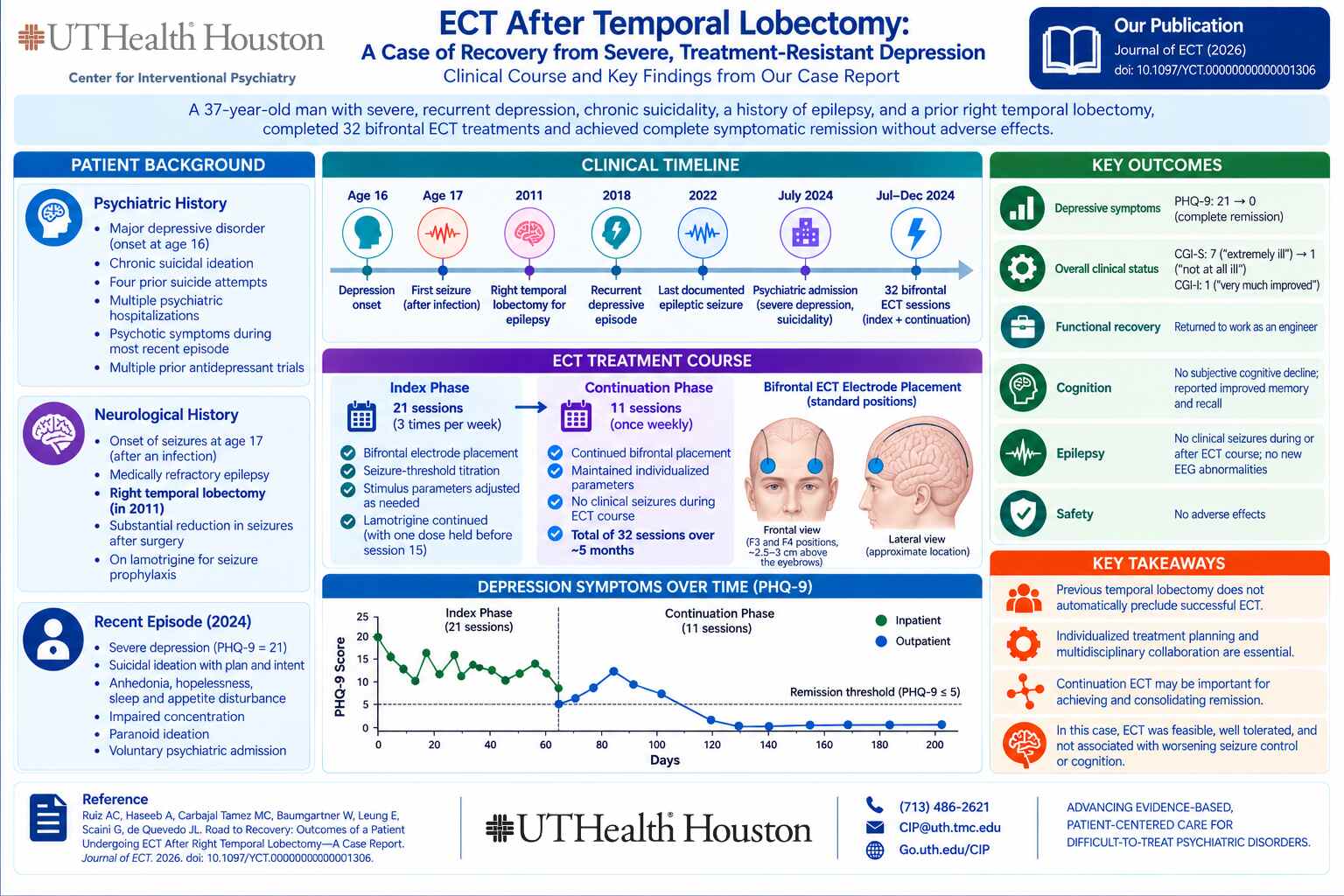
In a new case report published in the Journal of ECT, my colleagues and I describe the treatment of a patient with severe recurrent major depressive disorder, chronic suicidality, a history of medically refractory epilepsy, and a prior right temporal lobectomy. The patient ultimately completed 32 bifrontal ECT treatments over approximately five months and achieved complete symptomatic remission, functional recovery, and no apparent worsening of epilepsy or cognition.
This is a single case and should not be overgeneralized. But it illustrates an important principle in interventional psychiatry:
A complex neurological history does not automatically exclude a patient from ECT. It may instead require more careful evaluation, individualized treatment planning, and close multidisciplinary collaboration.
Why This Case Was Challenging
The patient described in the report was a 37-year-old man with a long history of severe recurrent depression beginning in adolescence.
His psychiatric history included approximately 20 years of major depressive disorder, chronic suicidal ideation, four prior suicide attempts, multiple psychiatric hospitalizations, severe depressive symptoms with functional impairment, psychotic symptoms during the most recent episode, and multiple prior antidepressant trials.
His neurological history added another layer of complexity. He developed epilepsy during adolescence and eventually experienced frequent complex partial seizures despite treatment. In 2011, he underwent a right frontotemporal craniotomy with resection of the right temporal lobe tip for medically refractory epilepsy. His seizure burden improved substantially after surgery, although he later experienced isolated seizures and remained on lamotrigine.
By 2024, however, his depression had become severe again. He voluntarily presented for psychiatric hospitalization because of suicidal ideation with a specific plan and intent. He also described profound hopelessness, loss of pleasure and emotional responsiveness, sleep and appetite disturbance, impaired concentration, and paranoid ideation.
The clinical question was therefore difficult: Could ECT be delivered safely and effectively in a patient with previous epilepsy surgery and altered temporal-lobe anatomy?
ECT and Structural Brain Abnormalities
ECT is often associated in the public imagination with seizure risk, but the relationship between ECT and epilepsy is more nuanced.
ECT intentionally induces a controlled therapeutic seizure under general anesthesia. Epilepsy, by contrast, involves spontaneous pathological seizures.
Patients with epilepsy can receive ECT in selected circumstances, but previous neurosurgery introduces additional considerations. In this case, the patient had undergone a right temporal lobectomy 14 years earlier.
Because of the structural alteration in that region, the treatment team selected a bifrontal electrode configuration rather than placing stimulation directly over the prior resection site.
That decision reflects an important principle of modern ECT: ECT is not a fixed procedure. Electrode placement, stimulus intensity, pulse width, treatment frequency, anesthesia, and medication management can all be individualized.
The Multidisciplinary Evaluation Was Central
Before treatment began, the patient underwent a comprehensive multidisciplinary assessment.
The pre-ECT workup included psychiatric and medical evaluations, serial neurological examinations, laboratory testing, ECG and EEG, review of prior brain MRI, neurology consultation, anesthesiology clearance, and review of anticonvulsant treatment.
Neurology recommended continuing lamotrigine to maintain seizure control. Emergency medication was also available in the event of a prolonged seizure. No contraindication to ECT was identified.
The success of the treatment cannot be attributed simply to “giving ECT.” It depended on coordinated decision-making across psychiatry, neurology, anesthesia, and the ECT treatment team.
Why Bifrontal ECT Was Chosen
Because the patient had undergone a right temporal lobectomy, the team selected bifrontal electrode placement. The goal was to obtain reliable therapeutic seizures while minimizing direct stimulation over the region of prior surgical resection.
Treatment was delivered with a MECTA Sigma device using seizure-threshold titration. The acute—or index—phase consisted of 21 treatments, three times per week. This was followed by 11 continuation treatments, once weekly, for a total of 32 ECT sessions over approximately five months.
Treatment Required Ongoing Adjustment
The ECT course was not technically static.
When one treatment failed to produce an adequate seizure, the pulse width was increased. Later, when seizure quality improved, the team reduced the pulse width again.
The patient’s anticonvulsant regimen also required careful consideration. Lamotrigine can make it more difficult to induce therapeutic seizures during ECT. However, stopping it entirely could have increased the risk of spontaneous epileptic seizures.
The clinical team therefore prioritized neurological stability. Lamotrigine was generally continued at a stable maintenance dose, with only one evening dose withheld before session 15 after seizure duration had shortened.
The detailed treatment timeline in the publication illustrates how stimulus parameters and medication management were adjusted over time rather than following a rigid formula. This is a useful example of what individualized interventional psychiatry looks like in practice.
The Clinical Response Was Remarkable
The patient’s depressive symptoms were monitored with the Patient Health Questionnaire-9 (PHQ-9) before ECT sessions.
At baseline, PHQ-9 was 21, consistent with severe depression. By the end of the 21-session index course, PHQ-9 was 16. He had improved, but had not yet reached remission.
Continuation ECT was therefore particularly important. By session 28, PHQ-9 was 0, and remission was sustained through the remainder of the course.
The graph in the publication is especially informative. It shows that the improvement was neither instantaneous nor perfectly linear. Symptoms fluctuated during the index phase and then declined substantially during continuation treatment, eventually reaching and remaining within the remission range.
Some patients may require a longer ECT course than expected before achieving full remission.
Continuation ECT Was Not an Afterthought
One particularly valuable feature of this case is the distinction between the index phase and continuation phase.
After the planned 21-session index course, the patient had clearly improved but had not yet achieved full remission. Rather than stopping treatment, continuation ECT was used to consolidate the response and reduce relapse risk.
The patient ultimately reached remission during this continuation phase. This illustrates why ECT should often be understood as a course of treatment, rather than as an isolated procedure.
For some patients, index ECT produces response; continuation ECT consolidates recovery; and maintenance strategies may then help protect against relapse.
Improvement Went Beyond a Depression Score
A PHQ-9 score of zero is striking. But numerical improvement in symptoms is not the most important outcome in isolation.
By the end of treatment, the patient denied suicidal ideation, reported feeling substantially better, returned to work as an engineer, reported no subjective cognitive decline, reported improved memory retention and recall, and had no new abnormalities on serial neurological examinations.
His Clinical Global Impression-Severity score improved from 7—“extremely ill”—at the beginning of treatment to “not at all ill” by the final session. His Clinical Global Impression-Improvement rating reached 1—“very much improved.”
Recovery is not merely a lower symptom score. It is also restoration of function, safety, cognition, relationships, independence, and quality of life.
What Happened to His Epilepsy?
This was one of the most important safety questions.
The patient reported no clinical epileptic seizures during or after the ECT course. His seizure frequency did not increase compared with his pre-ECT baseline, and follow-up EEG performed during the course did not demonstrate new abnormalities.
That is reassuring. But it does not mean that ECT after epilepsy surgery has now been established as universally safe.
This is still a case report. The correct interpretation is more limited: in this carefully evaluated and closely monitored patient, ECT was feasible, clinically effective, and not associated with an observed deterioration in seizure control.
What About Memory?
Concerns about memory remain among the most common questions patients and families ask about ECT.
In this case, the patient did not report subjective memory problems. In fact, he described improved memory retention and recall and successfully returned to cognitively demanding work.
This is encouraging but must be interpreted cautiously. No formal neuropsychological testing was performed during or after treatment. Therefore, the case cannot establish that cognition objectively improved or that there were no subtle cognitive effects.
Subjective cognitive recovery is clinically meaningful but not equivalent to formal neuropsychological evidence.
Why This Case Matters
ECT after temporal-lobe surgery has been reported only rarely.
The literature discussed in our case report includes previous patients treated with ECT after epilepsy surgery, including cases involving severe bipolar depression, suicidality, catatonia, and complex postoperative psychiatric symptoms. Outcomes have varied, but several reports describe substantial clinical benefit.
Our case adds to that small body of evidence. It is particularly notable because the patient had severe recurrent major depression, chronic suicidality, a prior temporal lobectomy, remained on anticonvulsant medication, completed an extended ECT course, achieved complete symptomatic remission, returned to cognitively demanding employment, and experienced no apparent increase in spontaneous seizure activity.
Taken together, the case suggests that prior epilepsy surgery should not automatically be considered an absolute barrier to ECT.
What This Case Does—and Does Not—Show
The case shows that ECT can be successfully delivered in at least some patients with a prior temporal lobectomy when treatment is carefully individualized and supported by a multidisciplinary evaluation. It also shows that anticonvulsant treatment need not be routinely discontinued for ECT to be effective, and it demonstrates the potential importance of continuing ECT in achieving full recovery.
The case does not show that ECT is universally safe after temporal lobectomy; that all patients with epilepsy or previous epilepsy surgery should receive the same treatment protocol; that bifrontal placement is necessarily the optimal electrode configuration in every such patient; or that one successful case can establish general efficacy or safety.
The authors explicitly emphasize that a single case cannot answer these questions definitively and that careful individualized planning remains essential.
The UTHealth Houston Perspective
This case reflects an important aspect of what we do at the Center for Interventional Psychiatry at UTHealth Houston.
Patients referred for interventional treatment often do not have simple clinical histories. They may have neurological disease, previous brain surgery, epilepsy, complex medication regimens, medical comorbidities, cognitive concerns, severe suicidality, psychotic symptoms, and multiple previous treatment failures.
The relevant question is therefore rarely: “Does this patient fit a standard ECT pathway?”
A better question is: “Can we design an individualized treatment strategy that appropriately balances psychiatric urgency, neurological risk, seizure quality, cognitive considerations, and long-term recovery?”
In this case, the treatment plan evolved continuously. Electrode placement was selected with the patient’s anatomy in mind. Stimulus parameters were adjusted according to seizure quality. Lamotrigine management was coordinated with neurology. ECT continued beyond the initial phase because the patient was improving but had not yet reached remission.
That is precisely the kind of decision-making that multidisciplinary interventional psychiatry is designed to support.
Looking Ahead
Cases like this raise several questions that deserve more systematic study.
How should ECT electrode placement be selected in patients with previous epilepsy surgery? How should anticonvulsants be managed? Which structural brain abnormalities meaningfully alter treatment risk? Should formal neuropsychological assessment be incorporated more consistently in these complex cases? And how should index, continuation, and maintenance ECT be optimized for patients whose response emerges gradually?
Larger case series, multicenter registries, and prospective observational studies could help answer these questions.
For now, the message from this case is appropriately cautious but clinically important:
Previous temporal lobectomy does not necessarily preclude successful ECT.
With careful multidisciplinary evaluation, individualized treatment parameters, appropriate neurological monitoring, and continued reassessment, ECT may remain an option even in patients with highly complex neuropsychiatric histories.
Reference
Ruiz AC, Haseeb A, Carbajal Tamez MC, Baumgartner W, Leung E, Scaini G, de Quevedo JL. Road to Recovery: Outcomes of a Patient Undergoing ECT After Right Temporal Lobectomy—A Case Report. Journal of ECT. 2026. doi:10.1097/YCT.0000000000001306.
Contact
Center for Interventional Psychiatry
John S. Dunn Behavioral Sciences Center at UTHealth Houston
Request for Second Opinion: Go.uth.edu/CIPIntake
Phone: (713) 486-2621
Fax: (713) 500-2728
Email: [email protected]
Website: Go.uth.edu/CIP
Disclaimer
This article is intended for educational and informational purposes only and should not be considered medical advice or a substitute for consultation with a qualified healthcare professional.
This article discusses a single published case report. The clinical outcome described should not be generalized to all patients with epilepsy, prior epilepsy surgery, structural brain abnormalities, or other neurological conditions. Decisions regarding ECT require individualized assessment of psychiatric indication, neurological status, anesthetic risk, medication management, and cognitive considerations.
This article discusses a publication for which João L. de Quevedo, MD, PhD, is a co-author.
This content was developed with the assistance of artificial intelligence (AI) as a scientific writing support tool. It was reviewed, substantially edited, and approved by João L. de Quevedo, MD, PhD. Every effort has been made to ensure the accuracy, scientific balance, and clinical relevance of the information presented; however, readers should consult the original publication and current clinical guidelines when making patient-care decisions.