What Is Interventional Psychiatry? Defining a Field at a Crossroads
 Psychiatry is changing.
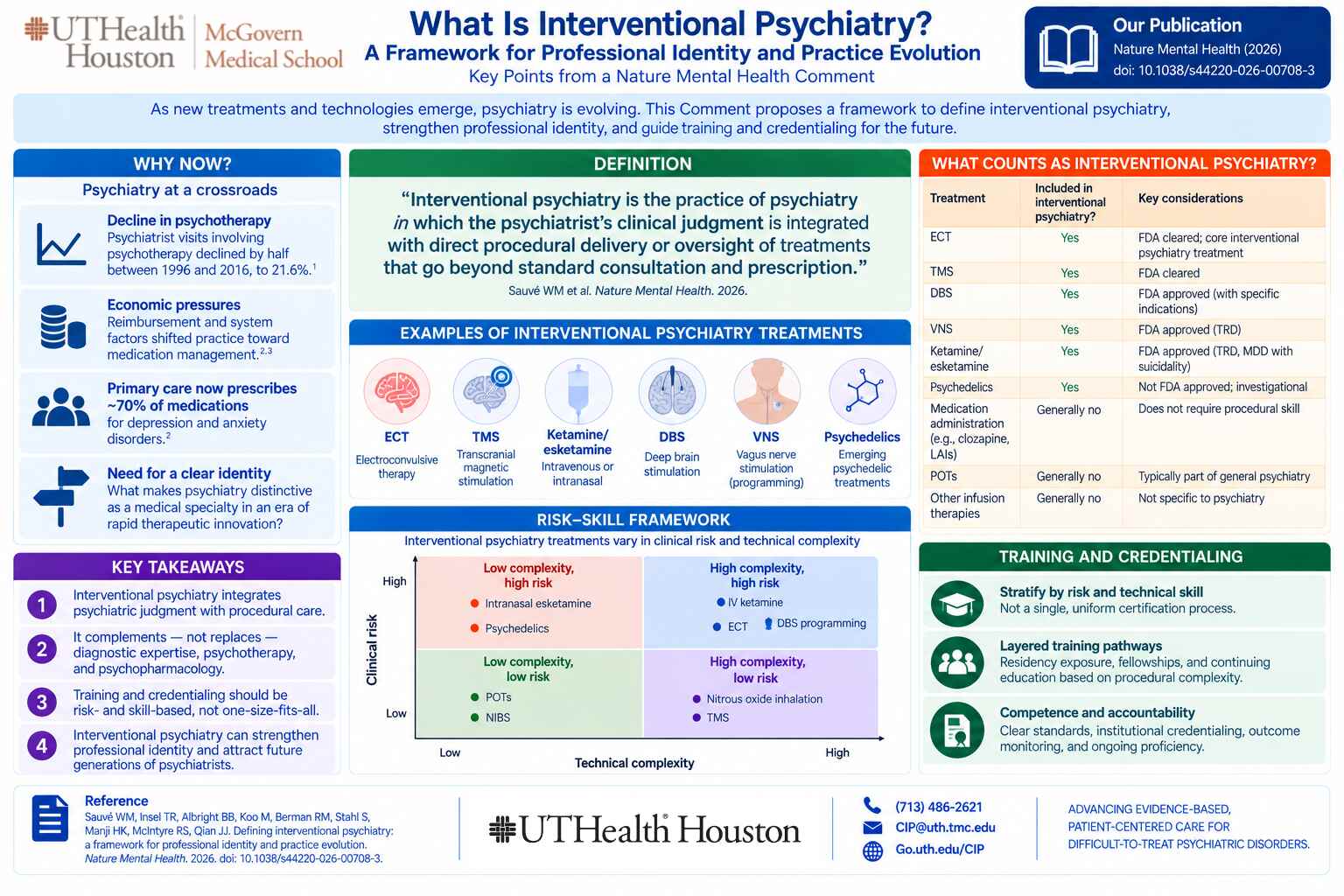
For much of modern psychiatric practice, the psychiatrist’s therapeutic toolkit has been organized around two major domains: psychotherapy and medication. Yet over the past several decades, a growing group of treatments has changed what psychiatrists can directly do for patients. Electroconvulsive therapy (ECT), transcranial magnetic stimulation (TMS), ketamine and esketamine, vagus nerve stimulation (VNS), deep brain stimulation (DBS), and emerging psychedelic treatments increasingly require psychiatrists to move beyond consultation and prescription into procedural care.
A new Comment in Nature Mental Health asks a deceptively simple question: What, exactly, is interventional psychiatry?
The authors argue that the answer should not be a list of technologies. Instead, interventional psychiatry should be understood as a mode of psychiatric practice in which clinical judgment is integrated with direct procedural treatment or oversight.
That distinction matters. It helps define the field, clarifies the psychiatrist’s role, and raises important questions about training, credentialing, safety, access, and the future professional identity of psychiatry.
Psychiatry Is at a Crossroads
The article begins with a broader concern about the evolution of psychiatric practice in the United States.
Psychiatrists have progressively moved away from providing psychotherapy. The authors cite evidence that the proportion of psychiatrist visits involving psychotherapy fell by approximately half between 1996 and 2016, reaching only 21.6% of visits. At the same time, primary care clinicians now prescribe a large proportion of treatments for common conditions such as depression and anxiety.
This creates an important professional question: if psychiatric practice becomes increasingly centered on brief medication-management visits, what distinguishes psychiatry as a medical specialty?
The authors do not argue that procedures should replace psychotherapy, diagnosis, or psychopharmacology. Rather, they suggest that interventional psychiatry offers one path toward expanding what psychiatrists can provide while reconnecting the specialty with hands-on medical care, intensive patient engagement, and specialized clinical expertise.
A Proposed Definition of Interventional Psychiatry
The central contribution of the paper is a proposed definition:
Interventional psychiatry is the practice of psychiatry in which the psychiatrist’s clinical judgment is integrated with direct procedural delivery or oversight, requiring real-time clinical decision-making about a patient undergoing a specialized treatment beyond standard consultation and prescription.
This definition shifts attention away from the technology itself.
A procedure does not become “interventional psychiatry” simply because it involves a device, an infusion, an injection, or a monitored treatment session. The defining feature is the psychiatrist’s clinical responsibility for the treatment.
That responsibility includes selecting appropriate patients, evaluating psychiatric and medical risks, designing the treatment protocol, managing the patient’s psychiatric and physiological state during and after treatment, responding to complications, and integrating the intervention into a longitudinal psychiatric treatment plan.
The psychiatrist may personally perform the procedure or supervise appropriately trained staff. In this framework, what matters is not who physically presses a button, administers a medication, or operates a device. What matters is who holds psychiatric responsibility for the treatment and its integration into the patient’s overall care.
The Procedure Is Not the Specialty
This may be the paper’s most important conceptual point.
A trained technician can technically deliver TMS. Other healthcare professionals can administer Esketamine. An anesthesiologist can administer ketamine. A neurosurgeon implants a VNS or DBS device.
None of those technical acts, by themselves, define interventional psychiatry.
The psychiatrist’s distinctive contribution is the clinical reasoning surrounding the procedure: Why this intervention? Why this patient? Why now? What are the alternatives? How should medications be managed before and during treatment? How should response, adverse effects, suicidality, cognition, mania, psychosis, or other psychiatric changes be monitored? And what comes next?
This distinction is particularly important as psychiatric procedures become increasingly available outside traditional academic medical centers.
Interventional psychiatry should not become a collection of technical services disconnected from comprehensive psychiatric care.
Which Treatments Belong to Interventional Psychiatry?
The authors deliberately define the field broadly, while acknowledging that its boundaries remain contested.
Established examples include ECT and TMS. Intranasal esketamine is included because its administration requires supervised treatment and monitoring. Supervised ketamine treatment generally fits the framework as well.
DBS and VNS illustrate another important distinction. Neurosurgical implantation itself is not psychiatric practice. However, psychiatric patient selection, referral, post-implant assessment, programming, parameter optimization, and longitudinal psychiatric management can fall squarely within interventional psychiatry.
The framework also includes emerging psychedelic treatments, which require supervised treatment sessions and may require physiological monitoring and management of intense psychological experiences.
Other modalities occupy more ambiguous territory. The paper discusses nitrous oxide, focused ultrasound neuromodulation, home-based neuromodulation, medication-assisted treatment, botulinum toxin injections, long-acting injectable medications, digital therapeutics, and stellate ganglion block.
For these boundary cases, context matters. A treatment may qualify as interventional psychiatry when it requires direct psychiatric procedural involvement or oversight, yet may fall outside the field when prescribed for unsupervised use.
This is useful because it prevents the field from being defined by a permanently fixed list of technologies. Technologies will change. The underlying clinical model can remain coherent.
Not Every Procedure Requires the Same Training
A second major contribution of the article is its proposed risk-skill matrix.
Rather than requiring identical training or certification for every interventional treatment, the authors organize procedures according to two dimensions: technical complexity and safety risk.
This produces four broad categories.
Low-complexity, low-risk interventions may require relatively limited formal training. High-complexity, low-risk interventions, such as TMS in the authors’ framework, require demonstrated technical competence because precision affects efficacy even when serious procedural risk is comparatively low.
Low-complexity, high-risk treatments require strong crisis management and emergency preparedness skills. Intranasal esketamine and psychedelic supervision are examples discussed in this category.
High-complexity, high-risk interventions require both advanced technical proficiency and the ability to recognize and manage potentially serious complications. The paper places intravenous ketamine and complex DBS programming in this area, with ECT also positioned on the higher-risk, higher-complexity side of the matrix.
The broader principle is compelling: training requirements should reflect what a procedure actually demands rather than applying a single credentialing model to every intervention.
Competency Over Credentials?
The authors argue against prematurely imposing a uniform national board-certification requirement across all of interventional psychiatry.
Instead, they favor competency-based pathways that may include fellowship training, intensive workshops, mentorship, supervised experience, manufacturer training, and institutional credentialing, depending on the procedure.
Their argument is partly historical. In fields such as interventional cardiology and radiology, procedural practice developed before formal subspecialty certification became established.
The authors suggest that institutional credentialing and privileging can serve as an important accountability mechanism. ECT already requires facility-specific privileges. Hospital-based ketamine and TMS programs commonly require documentation of training and competence. Esketamine operates within a formal Risk Evaluation and Mitigation Strategy framework and may also require institutional approval.
At the same time, the authors acknowledge an important unresolved problem: much interventional psychiatric care occurs in private outpatient settings without the same institutional oversight.
State medical boards, malpractice liability, professional guidelines, manufacturer requirements, payer policies, and professional reputation all provide some accountability, but they do not create a uniform procedure-specific competency standard.
The authors therefore identify quality assurance in noninstitutional settings as an important gap and suggest that voluntary accreditation models may eventually offer one possible solution.
Interventional Psychiatrists Need More Medical Skills—and More Psychological Skills
One of the most interesting arguments in the paper is that interventional psychiatry may require psychiatry to strengthen two sets of skills that modern practice has sometimes allowed to weaken.
The first is acute medical competence.
Procedural psychiatrists may need to recognize hypertensive emergencies, respiratory depression, cardiovascular changes, altered consciousness, and other acute complications. They may need familiarity with intravenous access, sterile technique, physiological monitoring, pre-procedure medical assessment, contraindications, medical devices, and rapid clinical decision-making.
But the second requirement moves in the opposite direction: interventional psychiatry may also demand stronger psychological skills.
Treatments involving dissociation or altered states of consciousness can require rapid rapport building, management of acute fear or psychological distress, trauma-informed procedural care, and sustained interaction with patients. Psychedelic treatment models may add preparation and integration around intense subjective experiences.
The authors therefore argue that the future interventional psychiatrist may need to combine medical, procedural, psychological, and psychiatric competencies rather than becoming merely a technical proceduralist.
Interventional Psychiatry Is Inherently Team-Based
Procedural care also changes how psychiatric services must be organized.
Traditional psychiatric practice is often structured around sequential individual appointments. Interventional programs operate differently.
ECT requires coordination with anesthesia and nursing. DBS and VNS require collaboration with neurosurgery and other specialties. TMS requires trained treatment staff and repeated treatment sessions. Esketamine requires monitored treatment and recovery space. Ketamine programs require physiological monitoring and emergency preparedness. Emerging psychedelic models may require prolonged supervised sessions.
The psychiatrist therefore increasingly functions within a multidisciplinary treatment system rather than as an isolated clinician.
The paper emphasizes an important boundary: the interventional psychiatrist should recognize complications, initiate appropriate responses, and coordinate specialty care, but should not attempt to replace anesthesiologists, emergency physicians, surgeons, or other specialists when their expertise is required.
Procedures Do Not Replace Psychopharmacology
The article also rejects a false choice between interventional treatments and sophisticated medication management.
Patients referred for interventional treatment frequently have some of the most difficult-to-treat psychiatric illnesses. Their care may still require lithium augmentation, clozapine, monoamine oxidase inhibitors, complex medication transitions, management of drug-device interactions, or pharmacotherapy before, during, and after procedural treatment.
The authors therefore describe interventional and pharmacological expertise as complementary.
This is particularly relevant to the emerging concept of difficult-to-treat depression, in which treatment is less about sequentially exhausting one therapy after another and more about rationally combining, sequencing, and maintaining complementary interventions.
An interventional psychiatrist should therefore not simply know how to deliver ECT, TMS, ketamine, or another procedure. The psychiatrist must understand where that intervention belongs within the full treatment strategy.
Training the Next Generation
If interventional psychiatry is becoming a recognizable domain of practice, training will need to evolve.
The authors argue that residency exposure should progress beyond passive observation toward supervised participation in procedural treatments. Residents interested in deeper expertise could pursue dedicated tracks, while specialized interventional psychiatry fellowships could provide concentrated post-residency training.
Established psychiatrists should also have accessible continuing education pathways that recognize prior clinical experience rather than requiring them to restart training from the beginning.
Faculty development matters as well. Procedural skills are difficult to teach without faculty members who actively perform and supervise the interventions themselves.
The paper notes that formal discussions about subspecialty recognition are already underway, including multidisciplinary efforts around brain stimulation and emerging accreditation pathways.
The field is therefore no longer asking only whether interventional psychiatry exists. It is beginning to ask how its practitioners should be trained.
Professional Identity: Why the Definition Matters
The debate ultimately extends beyond procedures.
The authors argue that interventional psychiatry may strengthen psychiatry’s professional identity as a medical specialty by adding a procedural domain that requires distinctive technical and physician-level clinical expertise.
But they also address an important counterargument: psychiatry’s unique contribution has never depended solely on performing procedures. Diagnosis, formulation, longitudinal management, and the integration of biological, psychological, and social information remain fundamental.
The paper agrees with that premise.
In fact, the authors argue that procedural treatments make diagnostic rigor even more important. The consequences of an incorrect diagnosis become more consequential when treatment involves anesthesia, seizure induction, prolonged altered states, invasive devices, or sustained modulation of neural circuits.
The future of interventional psychiatry therefore should not be defined by procedural skill alone.
Both words matter: “interventional” describes the mode of treatment; “psychiatry” describes the clinical expertise that determines how, when, why, and for whom the intervention should be used.
Important Limitations and Areas of Debate
This publication is a Comment proposing a framework, not a clinical guideline, consensus statement, or validated credentialing standard.
The authors appropriately acknowledge several limitations.
First, the framework is primarily focused on the United States, where reimbursement, residency structures, certification, and healthcare organization differ from those in other countries.
Second, the authors themselves are closely involved in interventional psychiatry through clinical practice, research, academia, and, for several authors, industry relationships. They explicitly note that this experience informs their recommendations and reflects a perspective invested in the field’s development.
Third, the boundaries remain contested. Reasonable clinicians may disagree about whether treatments such as long-acting injectable medications, home neuromodulation, digital therapeutics, or other emerging modalities should be classified as interventional psychiatry.
Finally, the proposed risk-stratified training and credentialing models remain conceptual. Whether they can achieve the desired balance between safety, competency, innovation, and access will need to be evaluated empirically.
These caveats are important. Defining a rapidly evolving field requires debate, and this paper should be understood as a substantial contribution to that debate rather than its final word.
The UTHealth Houston Perspective
At the Center for Interventional Psychiatry at UTHealth Houston, this discussion is not abstract.
Our clinical model already brings together many of the elements described in this framework: comprehensive evaluation of treatment-resistant illness; sophisticated psychopharmacology; ECT, TMS, and accelerated neuromodulation approaches; ketamine and esketamine; VNS; multidisciplinary collaboration; longitudinal follow-up; clinical research; and specialized training.
From this perspective, the most useful idea in the Nature Mental Health paper is that interventional psychiatry should not be defined by ownership of a particular device or procedure.
It should be defined by clinical responsibility.
A patient with treatment-resistant depression, bipolar depression, catatonia, severe suicidality, or another difficult-to-treat condition does not need a menu of disconnected procedures. The patient needs a psychiatrist and multidisciplinary team capable of deciding whether an intervention is appropriate, choosing among alternatives, integrating it with medications and psychological care, managing medical and psychiatric risks, evaluating outcomes, and planning what comes next.
This is also why interventional psychiatry should not become synonymous with neuromodulation alone. ECT, TMS, SAINT-type accelerated TMS, ketamine, esketamine, VNS, DBS, and emerging therapeutics differ substantially in mechanism and delivery. What connects them is a model of specialized, procedure-oriented psychiatric care.
For academic centers, there is another responsibility: training.
Residents should understand when to refer patients for interventional treatments even if they never become procedural psychiatrists themselves. Psychiatrists who choose advanced procedural practice require greater competence. Fellowships can provide concentrated expertise for those who will lead programs, teach others, conduct research, and manage the most complex patients.
The goal should not be to separate interventional psychiatry from the rest of psychiatry. It should be to strengthen the full specialty.
Looking Ahead
Interventional psychiatry is likely to continue expanding.
New forms of neuromodulation, rapid-acting pharmacological interventions, implantable devices, focused ultrasound, psychedelic treatments, closed-loop stimulation, and other technologies will continue to challenge existing definitions.
For that reason, defining the field by a fixed list of procedures is unlikely to work.
A more durable definition is one centered on clinical responsibility, specialized procedural care, real-time decision-making, competency appropriate to risk, multidisciplinary collaboration, and integration into longitudinal psychiatric treatment.
The next phase will require more than technological innovation. It will require evidence-based training standards, thoughtful credentialing, quality assurance, equitable access, appropriate reimbursement, and careful protection against the risk that procedural incentives could overwhelm patient-centered clinical judgment.
The central question is therefore not whether psychiatry will acquire more interventions. It already has.
The question is whether the specialty will develop the clinical structures, professional identity, and training systems needed to use those interventions well.
Interventional psychiatry may ultimately be most important not because it adds procedures to psychiatry, but because it expands what psychiatrists can responsibly do for patients with the most difficult-to-treat illnesses.
Reference
Sauvé WM, Insel TR, Albright BB, Koo M, Berman RM, Stahl S, Manji HK, McIntyre RS, Qian JJ. Defining interventional psychiatry: a framework for professional identity and practice evolution. Nature Mental Health. 2026. doi:10.1038/s44220-026-00708-3.
Contact
Center for Interventional Psychiatry
John S. Dunn Behavioral Sciences Center at UTHealth Houston
Request for Second Opinion: https://Go.uth.edu/CIPIntake
Phone: (713) 486-2621
Fax: (713) 500-2728
Email: [email protected]
Website: https://go.uth.edu/CIP
Disclaimer
This article is intended for educational and informational purposes only and should not be considered medical advice or a substitute for consultation with a qualified healthcare professional.
The publication discussed is a Comment proposing a conceptual framework for interventional psychiatry. Its definitions, treatment boundaries, risk-skill framework, and proposed approaches to training and credentialing should not be interpreted as formal clinical guidelines, accreditation requirements, or universally accepted professional standards.
This content was developed with the assistance of artificial intelligence (AI) as a scientific writing support tool. It was reviewed, substantially edited, and approved by João L. de Quevedo, MD, PhD. Every effort has been made to ensure the accuracy, scientific balance, and clinical relevance of the information presented; however, readers should consult the original publication and current clinical guidelines, regulatory requirements, and institutional policies when making patient-care or credentialing decisions.