Can ECT Reduce the Risk of Death in Severe Depression? What the Latest Evidence Shows
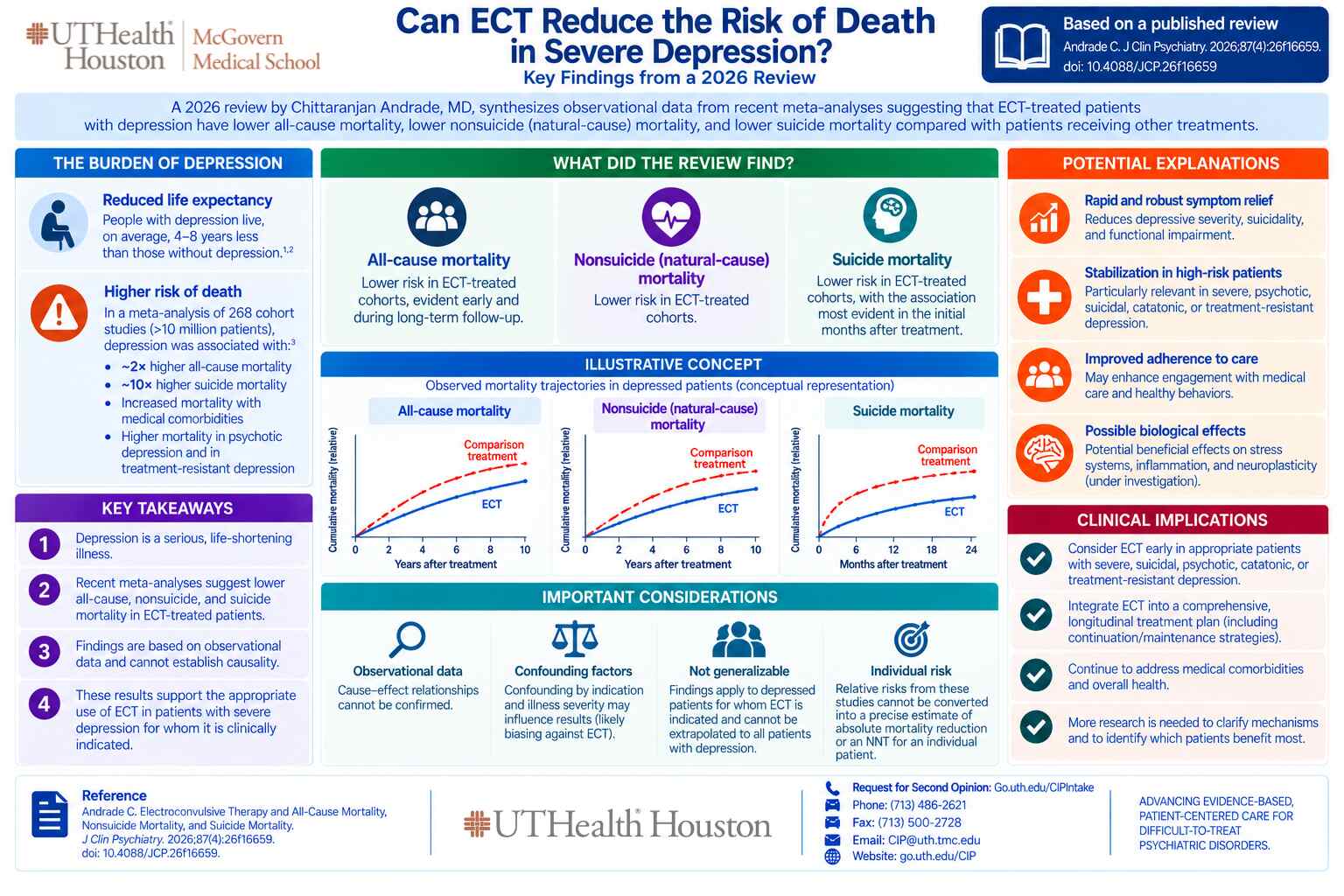 Electroconvulsive therapy (ECT) is best known for something immediate: it can produce rapid and substantial improvement in severe depression, including illness accompanied by suicidality, psychosis, catatonia, or treatment resistance.
But could its benefits extend beyond symptom relief?
A 2026 review by Chittaranjan Andrade in The Journal of Clinical Psychiatry examines an increasingly important question: whether treatment with ECT is associated with lower subsequent mortality among people with depression. Drawing primarily on three meta-analyses published in 2025, the article reviews all-cause mortality, deaths from nonsuicide or natural causes, and suicide mortality after ECT.
The emerging signal is clinically important. Across observational datasets, patients treated with ECT generally had lower all-cause mortality than comparable depressed patients receiving other treatments. Researchers also observed reductions in nonsuicide or natural-cause mortality. Suicide mortality appeared lower, particularly during the first months after treatment.
The key word, however, is “associated.” These data are largely observational. They cannot establish that ECT itself causes people to live longer.
Depression Is Also a Mortality Disorder
The mortality question matters because depression is associated not only with emotional suffering and disability but also with premature death.
The review summarizes a very large meta-analysis of 268 cohort studies including more than 10.8 million people with depression and approximately 2.84 billion controls. Relative to nondepressed or general-population comparison groups, depression was associated with roughly twice the risk of all-cause mortality and nearly ten times the risk of suicide mortality.
Mortality from natural causes was also elevated. Importantly for interventional psychiatry, all-cause mortality was higher in psychotic depression than in nonpsychotic depression and higher in treatment-resistant depression than in depression that was not treatment-resistant.
Population studies cited in the review suggest that people with depression may have a life expectancy approximately 4–8 years shorter than comparison populations.
These observations change the clinical frame. Successfully treating severe depression is not simply about improving a rating-scale score. Depression is associated with suicide, medical comorbidity, impaired self-care, unhealthy behaviors, reduced adherence to medical treatment, and other pathways that may influence survival.
What Did the ECT Studies Find?
Andrade reviews three 2025 meta-analyses whose datasets overlap partially but not completely.
The first, by Chan and colleagues, found that among people with depression, ECT treatment was associated with lower all-cause mortality (relative risk [RR] 0.73), lower natural-cause mortality (RR 0.76), and lower suicide mortality (RR 0.67) compared with depressed patients who did not receive ECT.
These figures correspond to relative associations, not absolute reductions in an individual patient’s risk. They also should not be interpreted as randomized estimates of treatment effect.
Nevertheless, the consistency across different mortality outcomes raises an important question: could effective treatment of severe depression influence outcomes well beyond psychiatric symptoms?
The Largest Meta-Analysis: More Than 1.1 Million Patients
A second meta-analysis, by Rhee and colleagues, included one randomized controlled trial and 16 cohort studies of patients with unipolar depression, bipolar depression, or schizoaffective disorder who received ECT.
The pooled population included 1,182,501 people; 40,867 received ECT, and 1,141,634 received other interventions.
ECT was associated with lower all-cause mortality overall (HR 0.70). The association was strongest early and weakened over time: HR 0.52 at 3 months, 0.64 at 6 months, and 0.72 at 12 months.
For suicide mortality, the pattern was different. Across the overall analysis, ECT was not associated with a statistically significant reduction in suicide mortality. However, at 3 months, ECT was associated with substantially lower suicide mortality (HR 0.53). This association was no longer statistically significant at 6 or 12 months.
This temporal pattern is clinically plausible and important. ECT is often used when rapid improvement is essential, particularly in patients with severe depression and acute suicide risk. The strongest mortality signal for suicide appears during precisely this early period.
A Third Meta-Analysis: All-Cause and Nonsuicide Mortality
A smaller meta-analysis by Naismith and colleagues included only studies reporting all three outcomes of interest: all-cause mortality, nonsuicide mortality, and suicide mortality.
ECT was associated with lower all-cause mortality (RR 0.75) and lower nonsuicide mortality (RR 0.81). In this analysis, suicide mortality was not significantly lower (RR 0.90).
Because this analysis included fewer studies, it should not be viewed in isolation. Taken together, however, the three meta-analyses produce a reasonably consistent overall picture: ECT-treated cohorts appear to experience lower all-cause mortality, and evidence supports lower nonsuicide or natural-cause mortality. The suicide-mortality signal is less uniform and appears strongest in the early months following treatment.
Could the Association Persist for Years?
The review also highlights a population-based cohort study from Wales, primarily designed to examine dementia risk after ECT.
That study reported an additional observation: ECT exposure was associated with lower mortality over approximately 25 years of follow-up (HR 0.81).
A finding across such a long interval is intriguing, but it requires particular caution. Over decades, countless differences in illness course, subsequent treatment, healthcare engagement, physical health, and social circumstances can influence mortality.
It nevertheless reinforces the broader observation that the mortality association seen after ECT is not confined exclusively to the immediate treatment period.
Why Might ECT Be Associated With Lower Mortality?
Several mechanisms could contribute.
The most straightforward concern is suicide. ECT can produce rapid improvement in severe depressive symptoms and suicidal thinking. In patients at high acute suicide risk, this early therapeutic effect could plausibly contribute to the reduction in suicide mortality observed during the first months after treatment.
The explanation for lower nonsuicide and long-term all-cause mortality is more complex.
Depression can interfere with exercise, diet, sleep, medical adherence, attendance at appointments, substance-use control, and management of chronic medical illnesses. If ECT produces rapid and substantial remission in a severely depressed patient, improvement in these behaviors could potentially influence physical-health outcomes.
There may also be effects of what happens after ECT. Patients who receive ECT may subsequently receive continuation or maintenance ECT, which can reduce relapse risk, or they may remain under more intensive psychiatric follow-up.
These are plausible explanations. The available studies do not establish which mechanisms are responsible.
The Central Problem: Observational Evidence Is Not Causal Evidence
Almost all of the evidence reviewed comes from observational studies. Researchers did not randomly assign patients to ECT versus another treatment.
This creates confounding.
One possible bias could favor ECT. Patients generally must be medically suitable for anesthesia. People with medical illness severe enough to preclude anesthesia may be less likely to receive ECT and independently more likely to die. Even when studies statistically adjust for medical comorbidities, they may not adequately capture the severity of those illnesses.
But an important bias can operate in the opposite direction.
ECT is disproportionately used in patients who are more severely ill: those with treatment resistance, psychotic depression, catatonia, severe functional impairment, or high suicide risk. These factors themselves can increase mortality. If they are incompletely measured and adjusted for, ECT-treated patients may start with a worse prognosis than comparison patients.
Andrade therefore notes an interesting tension: some residual confounding could favor ECT, whereas confounding by severity of psychiatric indication could prejudice the results against ECT.
There is also posttreatment bias. Continuation ECT, closer follow-up, and more intensive treatment after an acute ECT course could improve outcomes independently of the acute procedure itself.
For all these reasons, the evidence supports an association, not proof that ECT directly prevents death.
Relative Risk Is Not the Same as Absolute Risk
The reported HRs and RRs are striking, but they do not tell us how many deaths are prevented per 100 or 1,000 patients treated.
The meta-analyses did not provide usable absolute mortality risks for ECT and comparison groups at standardized endpoints. Therefore, the review cannot provide an absolute risk reduction or a number needed to treat to prevent one death.
This distinction is important when communicating results.
An HR of 0.70, for example, should not be translated into a claim that ECT will reduce an individual patient’s probability of death by exactly 30%. Hazard ratios describe relative event rates over time within the studied populations and are influenced by study design, follow-up, baseline risk, and statistical adjustment.
What This Evidence Does—and Does Not—Show
The evidence supports several clinically relevant conclusions.
Across multiple observational datasets, ECT treatment in severe depressive illness is associated with lower all-cause mortality. Evidence also suggests lower natural-cause or nonsuicide mortality. A reduction in suicide mortality is seen most consistently during the early months after ECT.
The evidence does not establish that ECT causes these mortality reductions.
It also does not show that ECT should be given to patients solely to reduce mortality, nor can these findings be extrapolated to every person with depression. The studied populations frequently represent patients with severe, treatment-resistant, psychotic, suicidal, bipolar, or otherwise complex depressive illness—the very populations in whom ECT is most often considered.
Finally, the studies do not provide reliable absolute risk reductions or numbers needed to treat for mortality.
The mortality data should therefore strengthen, rather than replace, the established clinical rationale for ECT when the treatment is otherwise indicated.
The UTHealth Houston Perspective
At the Center for Interventional Psychiatry at UTHealth Houston, these findings reinforce an important principle: severe depression should be treated as a potentially life-threatening medical illness.
ECT is sometimes framed narrowly as a last-resort treatment. That description can obscure its role when waiting through repeated sequential medication trials may itself carry substantial risk.
For patients with severe depression accompanied by suicidality, psychosis, catatonia, profound functional deterioration, or substantial treatment resistance, the clinical question is not simply whether ECT can reduce depressive symptoms. It is whether the overall risk-benefit balance favors a treatment that can produce a rapid and substantial response.
The mortality literature adds a meaningful dimension to that discussion. It suggests that patients who receive ECT do not experience excess long-term mortality compared with similar patients treated without ECT; rather, observational studies repeatedly show the opposite association.
This should not be oversold as proof that ECT prolongs life. But it is clinically reassuring, particularly because ECT recipients are often among the most severely ill patients in psychiatry.
The findings also underscore the importance of what happens after the index ECT course. Acute response is only one phase of treatment. Continuation strategies—including pharmacotherapy, continuation or maintenance ECT when appropriate, psychotherapy, management of medical comorbidities, and close longitudinal follow-up—are essential to preserve recovery and address the longer-term risks associated with severe mood disorders.
Looking Ahead
The next scientific step is not simply to accumulate more retrospective comparisons.
Future research should better characterize baseline illness severity, suicide risk, medical comorbidity severity, treatment resistance, continuation treatment, and healthcare engagement. Standardized reporting of absolute event rates at clinically meaningful time points would make the findings easier to translate into patient-level discussions.
Randomized trials powered for mortality are unlikely to be practical or ethically straightforward in the populations most likely to receive ECT. High-quality causal-inference approaches using large clinical datasets may therefore be especially valuable.
It will also be important to understand why mortality appears lower. Is the association mediated primarily by rapid remission of depression? Reduced suicide risk? Better medical adherence? More intensive follow-up? Continuation treatment? Selection factors? Or several mechanisms acting together?
For now, the evidence supports a careful but important conclusion.
ECT is already one of the most effective treatments available for severe depression. The emerging mortality literature suggests that its benefits may be associated not only with recovery from depressive illness, but also with better survival outcomes in the high-risk populations for whom the treatment is indicated.
That possibility deserves rigorous study—and thoughtful discussion with patients, families, and clinicians.
Reference
Andrade C. Electroconvulsive Therapy and All-Cause Mortality, Nonsuicide Mortality, and Suicide Mortality. Journal of Clinical Psychiatry. 2026;87(4):26f16659. Published online August 31, 2026. doi:10.4088/JCP.26f16659.
Contact
Center for Interventional Psychiatry
UTHealth Houston Behavioral Health Sciences
Request for Second Opinion: https://Go.uth.edu/CIPIntake
Phone: (713) 486-2621
Fax: (713) 500-2728
Email: [email protected]
Website: https://go.uth.edu/CIP
Disclaimer
This article is intended for educational and informational purposes only and should not be considered medical advice or a substitute for consultation with a qualified healthcare professional.
The mortality findings discussed here come primarily from observational studies and meta-analyses of observational data. They show associations and do not establish that ECT reduces mortality. The findings should not be extrapolated to all patients with depression or interpreted as an indication for ECT independent of an individualized clinical assessment.
This content was developed with the assistance of artificial intelligence (AI) as a scientific writing support tool. It was reviewed, substantially edited, and approved by João L. de Quevedo, MD, PhD. We made every effort to ensure the accuracy, scientific balance, and clinical relevance of the information presented; however, readers should consult the original publication and current clinical guidelines when making patient-care decisions.