Treatment-Resistant Depression Is a Dynamic Continuum: Why Timing, Reassessment, and Treatment Sequencing Matter
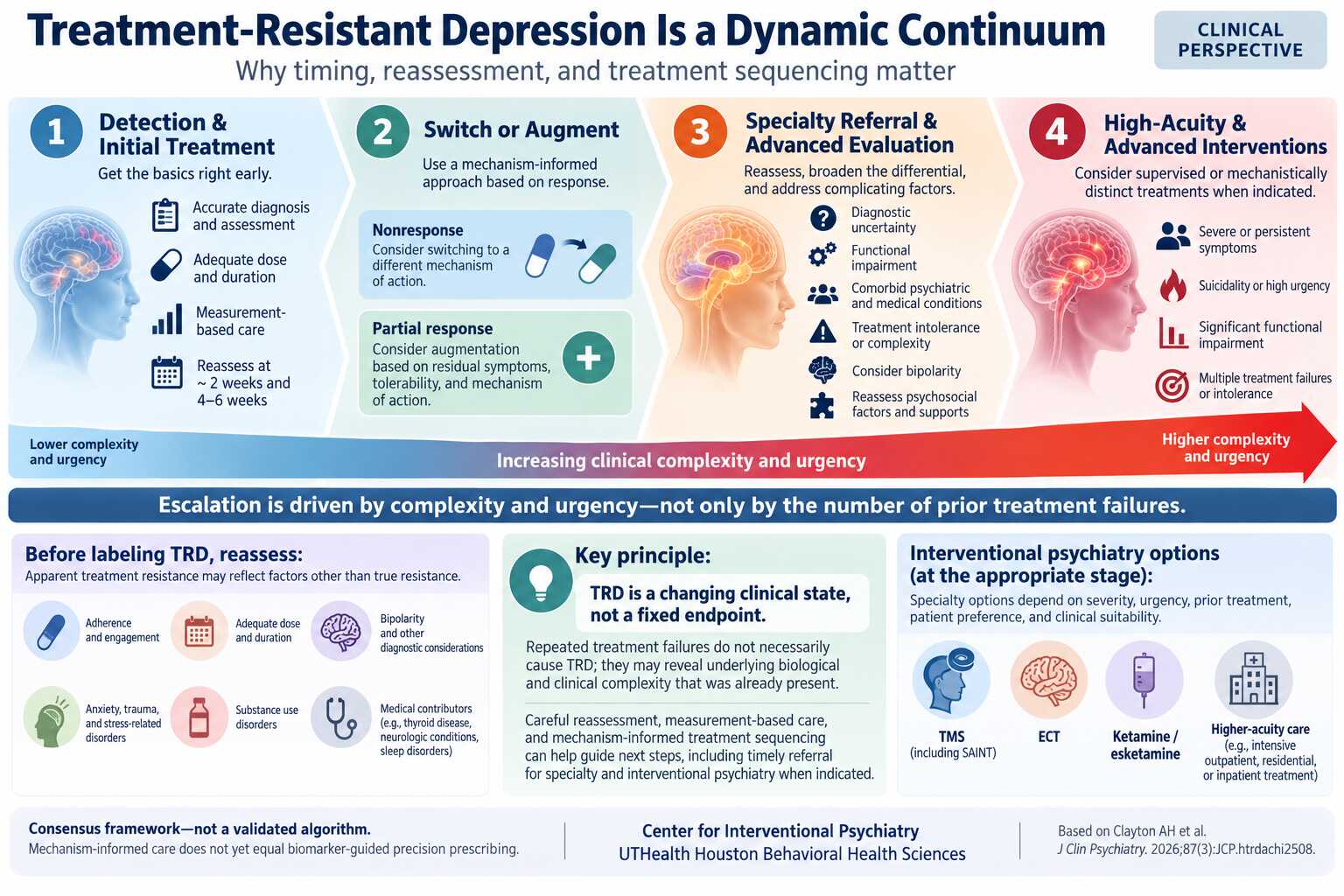 For decades, treatment-resistant depression (TRD) has often been described using a deceptively simple rule: major depressive disorder that has not responded adequately to at least two antidepressant trials of sufficient dose and duration. That definition remains useful for research, regulation, and access to certain treatments. But it can also create the impression that TRD suddenly appears only after a numerical threshold has been crossed.
A 2026 multidisciplinary consensus report in The Journal of Clinical Psychiatry proposes a more clinically useful way to think about the problem. Rather than viewing TRD as a fixed category reached after a predetermined number of failures, the panel argues that treatment resistance is better understood as a dynamic continuum shaped by illness biology, diagnostic complexity, comorbidity, treatment adequacy, patient preferences, and cumulative treatment history.
The practical implication is important: clinicians should not simply count failed medications. They should continuously ask whether the diagnosis is correct, whether a treatment was truly adequate, whether response is emerging early enough, whether residual symptoms represent partial response or true nonresponse, and whether the next intervention should engage a different therapeutic mechanism.
Why the Traditional Definition Is Not Enough
The usual operational definition of TRD—failure to respond adequately to two antidepressant trials—has value because it creates a common threshold. But real-world depression is more heterogeneous than that threshold suggests. A medication may appear to have “failed” because the dose was subtherapeutic, the trial was too short, adherence was inconsistent, adverse effects limited exposure, or the underlying diagnosis was incomplete.
The consensus panel highlights several causes of apparent or “pseudo-resistant” depression: unrecognized bipolar spectrum illness, trauma-related conditions, anxiety disorders, substance use, medical contributors, and other comorbidities. In such situations, adding another antidepressant without first clarifying the clinical picture can prolong ineffective care.
This is one reason the concept of difficult-to-treat depression has gained attention. It shifts the focus away from proving that a patient is biologically “resistant” and toward the practical task of reducing persistent illness burden. The 2026 panel retained the term TRD because it remains widely used, but its continuum model moves in the same direction: resistance is not a binary state.
Treatment Resistance Should Be Detected Early, Not Retrospectively
A central message of the report is that treatment response should be measured rather than assumed. The panel recommends measurement-based care from the start, with structured reassessment early in treatment rather than waiting passively for months.
The report defines meaningful early improvement as approximately 20% symptom reduction at two weeks and 25%–50% reduction by four to six weeks. These thresholds are not absolute biological cutoffs, but they provide clinically useful signals. When improvement is absent despite an adequate dose, the clinician should reconsider the diagnosis, dosing, adherence, tolerability, comorbidity, and treatment strategy.
The distinction between nonresponse and partial response is particularly important. The panel recommends that minimal or absent response should generally prompt a switch—preferably toward a mechanistically different treatment—whereas partial response may justify augmentation of the existing strategy.
A Four-Stage Framework for the TRD Continuum
Stage 1: Detection and Initial Treatment
The first stage emphasizes diagnostic accuracy, an adequately dosed initial treatment, tolerability, and early measurement of response. The choice of medication should reflect the patient’s symptom profile, comorbidities, prior history, and preferences rather than a one-size-fits-all sequence. Reassessment at roughly two weeks and again by four to six weeks is intended to identify nonresponse before therapeutic inertia becomes established.
Stage 2: Switch for Nonresponse, Augment for Partial Response
When a treatment has been adequate but improvement remains insufficient, the panel divides escalation into two paths. For patients with little or no response, a mechanistic switch is favored. For patients with partial improvement, augmentation may preserve an emerging benefit while engaging complementary pathways.
The broader principle is more important than any single medication choice: repeatedly cycling through treatments that operate in essentially the same way may offer diminishing value when meaningful response has not emerged. Sequencing should increasingly seek mechanistic diversity.
Stage 3: Specialty Referral and Advanced Evaluation
Referral should not be interpreted as evidence that routine psychiatric care has failed. It is a transition to a level of care with greater diagnostic depth, more treatment options, closer monitoring, and access to specialized infrastructure.
Although failure of two adequate antidepressant trials remains a common referral threshold, the panel argues that complexity and urgency can justify earlier specialty involvement. Diagnostic uncertainty, persistent functional impairment, substantial comorbidity, repeated intolerance, limited treatment options, or concern for bipolarity are examples.
Stage 4: High-Acuity and Advanced Interventions
The fourth stage includes patients with established TRD or high clinical acuity who require more specialized or mechanistically distinct interventions. The consensus report focuses mainly on pharmacologic care, including supervised or glutamatergic treatments, while also recognizing psychotherapy and neuromodulation such as repetitive transcranial magnetic stimulation as appropriate considerations.
Suicidality can accelerate movement through this framework. In a patient with acute or persistent suicidal thinking, the goal is no longer simply incremental symptom improvement. Risk reduction, rapid stabilization, and access to higher-acuity care may need to take priority.
Mechanism-Informed Care: Useful Concept, Important Limits
One of the report’s most forward-looking recommendations is to move beyond repeated treatment choices based only on conventional antidepressant classes. The panel emphasizes that depression involves multiple interacting systems—including monoaminergic signaling, glutamatergic and GABAergic pathways, neuroplasticity, stress-response systems, inflammation, and neural-network function.
This does not mean that clinicians can currently identify a single biological mechanism responsible for an individual patient’s depression and select a treatment with precision. Psychiatry does not yet have validated routine biomarkers that can reliably map a specific patient to a specific antidepressant mechanism. Mechanism-informed sequencing should therefore be understood as a rational diversification strategy, not as established biomarker-guided precision prescribing.
The same caution applies to pharmacogenomic testing. The panel notes that such testing can sometimes inform dosing, metabolism, tolerability, and drug–drug interaction risk, particularly in complex cases. But it should complement—not replace—clinical assessment, and current evidence is stronger for pharmacokinetic guidance than for predicting which antidepressant will produce remission.
Where Interventional Psychiatry Fits
This is where the continuum model becomes especially relevant to interventional psychiatry. The consensus panel intentionally limited its scope primarily to pharmacologic sequencing, so it should not be interpreted as a comprehensive algorithm for ECT, TMS, SAINT® TMS, ketamine, esketamine, vagus nerve stimulation, or other advanced interventions.
In contemporary specialty care, however, these treatments should not be conceptualized as a disconnected “last resort” category that becomes relevant only after an arbitrary number of medication failures. Their place depends on the entire clinical picture: severity, urgency, suicidality, psychosis, catatonia, functional decline, prior treatment adequacy, treatment burden, patient preference, medical suitability, and the need for speed of response.
For example, electroconvulsive therapy may appropriately enter much earlier in a severe depressive episode complicated by psychosis, catatonia, or urgent suicidality than it would in a stable outpatient with moderate symptoms. TMS or accelerated TMS may be appropriate for other patients who need a noninvasive intervention after inadequate response to standard treatments. Ketamine- and esketamine-based strategies may be considered when rapid or mechanistically distinct treatment is clinically appropriate. The central point is not that every patient should escalate quickly, but that escalation should be matched to need rather than delayed simply to satisfy a fixed sequence.
What This Consensus Does—and Does Not—Show
The report provides a clinically useful framework, but it is important to understand the type of evidence being discussed. This is a multidisciplinary expert consensus report, not a randomized clinical trial, systematic review, or formal treatment guideline. Its recommendations synthesize published evidence with expert interpretation and real-world clinical experience.
The panel meeting and publication support were funded by Janssen Scientific Affairs, LLC; the article also reports relevant author disclosures, including an author affiliated with Johnson & Johnson. The publication states that the sponsor performed a courtesy review for medical accuracy and that the opinions expressed were those of the faculty. These relationships do not invalidate the framework, but they are relevant when interpreting recommendations—particularly those involving pharmacologic sequencing and esketamine.
The report also does not establish that repeated treatment failures biologically create TRD, nor does it prove that mechanism switching is superior in every clinical situation. Rather, it argues that multiple failures often reveal a more complex illness and that prolonged therapeutic inertia should be avoided.
The UTHealth Houston Perspective
At the Center for Interventional Psychiatry, this continuum model is highly compatible with a matched-care approach to treatment-resistant depression. The key clinical question is not simply, “How many antidepressants has this patient failed?” It is, “What is maintaining the illness now, how urgent is the situation, what has truly been tried adequately, and what level and modality of care offer the best next opportunity for recovery?”
A comprehensive TRD evaluation should reconstruct treatment history, clarify diagnosis and comorbidities, quantify current symptom burden and functioning, assess suicide risk, and determine whether medication optimization, psychotherapy, interventional treatment, or a higher level of care is most appropriate. The objective is not escalation for its own sake. It is to reduce time spent in ineffective treatment while avoiding unnecessary treatment burden.
This is also why longitudinal documentation matters. A patient’s treatment history should function as clinical information, not simply as a list of failures. Each prior intervention can help clarify patterns of response, tolerability, adherence, mechanism exposure, and the trajectory of illness.
Looking Ahead
The future of TRD care will likely move further away from rigid medication counts and toward multidimensional staging. Better biomarkers, digital phenotyping, neuroimaging, pharmacogenomics, and structured treatment-history tools may eventually help clinicians identify earlier which patients are at greatest risk for persistent illness and which mechanisms are most promising for a given individual.
For now, one principle is already actionable: treatment-resistant depression should be managed as a changing clinical state, not a static label. Measure response early. Reassess the diagnosis. Distinguish partial response from nonresponse. Address comorbidity and adherence. Change mechanisms when appropriate. Refer when complexity or urgency demands it. And consider advanced treatments as part of a continuum of care rather than as an isolated endpoint.
Related Reading from the Center for Interventional Psychiatry
When Two Failed Antidepressants Are Not Enough: Rethinking Treatment-Resistant Depression
When Two Failed Antidepressants Are Not Enough: Rethinking Treatment-Resistant Depression
DATAd: A Common Language for Treatment-Resistant Depression
Treatment-Resistant Depression vs Difficult-to-Treat Depression: Why the Distinction Matters
Treatment-Resistant Depression vs Difficult-to-Treat Depression: Why the Distinction Matters
Advancing Care for Treatment-Resistant Depression: A Bold, Innovative TRD Program at UTHealth Houston
Clinical Resources
Treatment-Resistant Depression
Treatment-Resistant Depression (TRD) Program
Reference
Clayton AH, Asbach M, Cabrera P, et al. Treatment-Resistant Depression as a Dynamic Continuum: A Consensus Panel Report on Mechanism-Informed Pharmacologic Sequencing. J Clin Psychiatry. 2026;87(3):JCP.htrdachi2508. Published online September 4, 2026. doi:10.4088/JCP.htrdachi2508.
Contact
Center for Interventional Psychiatry
UTHealth Houston Behavioral Health Sciences
Request for Second Opinion: https://Go.uth.edu/CIPIntake (external link)
Phone: (713) 486-2621
Fax: (713) 500-2728
Email: [email protected]
Website: https://go.uth.edu/CIP
Disclaimer
This article is intended for educational and informational purposes only and should not be considered medical advice or a substitute for consultation with a qualified healthcare professional.
This content was developed with the assistance of artificial intelligence (AI) as a scientific writing support tool and was reviewed, substantially edited, and approved by João L. de Quevedo, MD, PhD. Every effort has been made to ensure the accuracy, scientific balance, and clinical relevance of the information presented; however, readers should consult the original publication and current clinical guidelines when making patient-care decisions.