The 2026 Nobel Prize in Medicine Honors Optogenetics: Why Controlling Brain Circuits With Light Changed Neuroscience
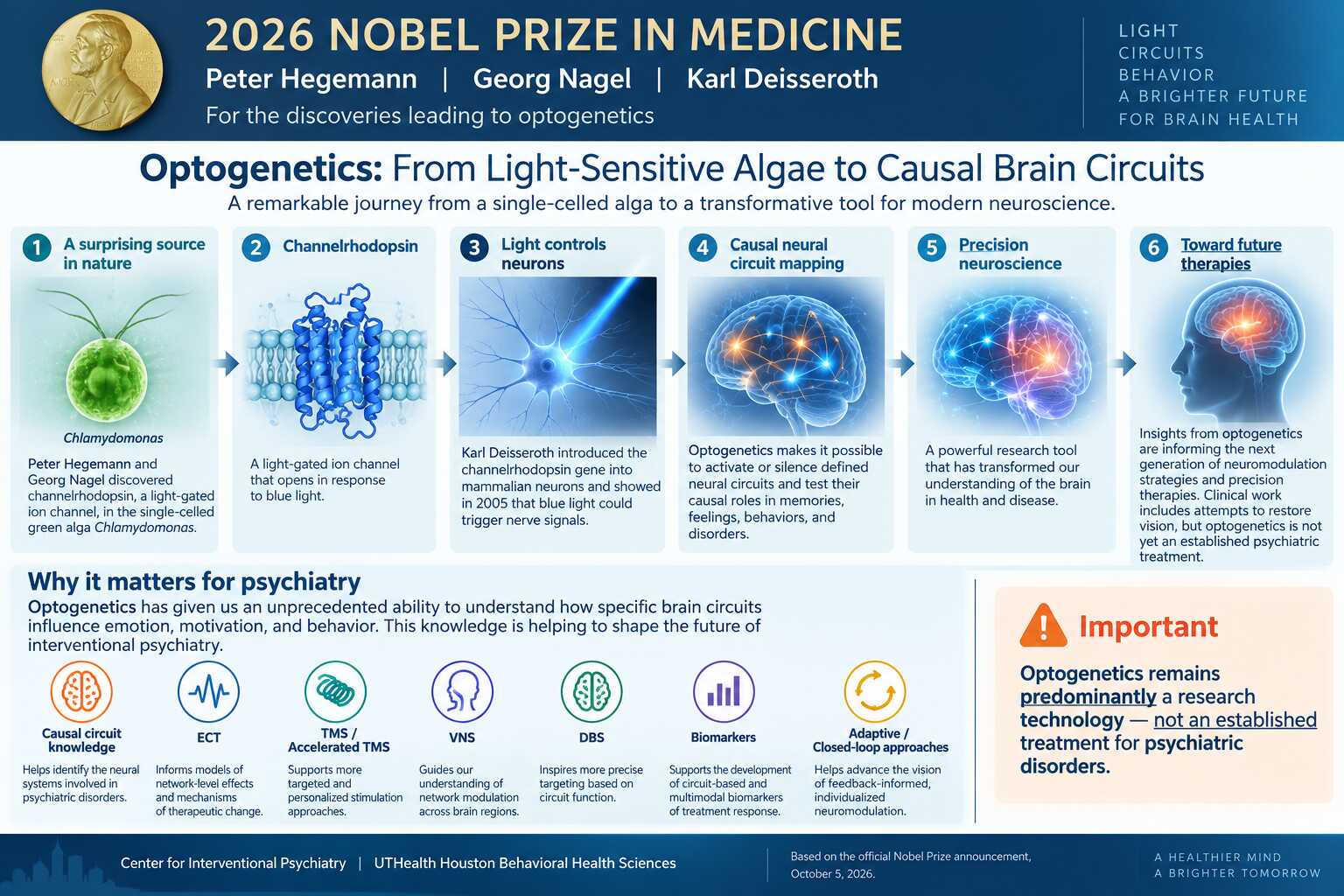 Today, the 2026 Nobel Prize in Physiology or Medicine was awarded to Karl Deisseroth, Peter Hegemann, and Georg Nagel for discoveries that led to optogenetics—a technology that allows scientists to control the activity of selected nerve cells with light.
For neuroscience, this is much more than recognition of an ingenious laboratory technique. Optogenetics helped transform one of the field’s most difficult questions: how do we move from observing that a brain region is active during a thought, feeling, or behavior to demonstrating that a specific neural circuit actually contributes to that function?
That distinction—between correlation and causation—is fundamental to psychiatry.
The Nobel-recognized work gave researchers a way to manipulate precisely defined populations of neurons on a millisecond timescale and observe what happens next. In doing so, it opened a new era in the study of memory, emotion, motivation, behavior, and brain disorders.
From a Single-Celled Alga to the Mammalian Brain
The story begins in an unexpected place: a single-celled green alga called Chlamydomonas.
Peter Hegemann and Georg Nagel studied how these organisms respond to light. Their work helped identify channelrhodopsin, a light-sensitive membrane protein. When exposed to blue light, the channel opens and allows charged ions to flow across the cell membrane, generating an electrical signal.
Karl Deisseroth then introduced the gene encoding channelrhodopsin into mammalian neurons. In 2005, his group showed that blue light could trigger electrical activity in genetically targeted nerve cells. The approach was subsequently extended to the brains of living animals.
The result was optogenetics: combining genetic targeting with optical control to switch selected neurons on—or, with other light-sensitive proteins, modulate or silence them—with extraordinary temporal precision.
Why Optogenetics Was a Conceptual Breakthrough
Before optogenetics, neuroscientists had many powerful ways to observe the brain. Neuroimaging could show which regions were active. Electrophysiology could record neural signals. Lesion studies could reveal what happened when particular structures were damaged.
But observation has limits. If a brain region becomes active when someone experiences fear, reward, or sadness, that does not prove that the activity is causing the experience. It may be downstream from the true mechanism, compensatory, or simply occurring at the same time.
Optogenetics made a different type of experiment possible. Researchers could identify a particular cell population, manipulate its activity with light, and determine whether behavior changed. That ability to test causal relationships between neural activity and behavior fundamentally altered systems neuroscience.
Why This Matters for Psychiatry
Psychiatry is especially dependent on understanding circuits.
Depression, bipolar disorder, obsessive-compulsive disorder, addiction, schizophrenia, post-traumatic stress disorder, and other psychiatric conditions cannot be reduced to one neurotransmitter or one anatomical location. They involve distributed networks of neurons interacting across multiple brain regions.
Optogenetic experiments have allowed researchers to dissect those networks with a level of specificity that would otherwise be extraordinarily difficult. Researchers can ask whether activating one pathway changes reward-seeking behavior, whether inhibiting another alters fear, or how specific neural populations influence stress responses, motivation, memory, and emotional regulation.
These experiments do not reproduce the full complexity of human psychiatric illness. But they allow investigators to test mechanistic hypotheses that can then inform human neuroscience.
From Brain Maps to Causal Circuit Maps
One of the most important consequences of optogenetics is the shift from anatomical maps toward functional and causal circuit maps.
The brain does not operate simply as a collection of isolated regions. The same anatomical structure may contain different neuronal populations with different projections and even opposing functions.
Knowing that the prefrontal cortex, amygdala, hippocampus, striatum, or another structure is involved in a psychiatric condition is therefore only a beginning. The more clinically meaningful questions are: Which cells? Connected to what? In which direction does information flow? At what time? Under what behavioral state? And what happens if that pathway is changed?
Optogenetics provided a powerful experimental language for asking those questions.
The Connection to Interventional Psychiatry
For interventional psychiatry, the Nobel Prize has particular resonance.
Treatments such as electroconvulsive therapy, transcranial magnetic stimulation, accelerated TMS protocols, vagus nerve stimulation, and deep brain stimulation all influence neural circuits. Yet the relationship between where we stimulate, which networks are affected, and why an individual patient improves remains incompletely understood.
Optogenetics cannot simply be transferred from a research animal into routine psychiatric care. In most experimental applications it requires genetic modification of selected cells and delivery of light into neural tissue—requirements that make direct clinical translation to psychiatric treatment challenging.
Its greatest impact on psychiatry today is therefore mechanistic. By helping researchers establish causal relationships within neural circuits, optogenetics contributes to the biological knowledge needed to make future neuromodulation more precise.
A Bridge Toward Precision Neuromodulation
The long-term vision of interventional psychiatry is increasingly moving away from treating the brain as though the same target and the same parameters should work equally well for everyone.
Modern TMS already uses anatomical and, increasingly, functional information to guide targeting. Deep brain stimulation research is exploring circuit-based and connectivity-informed targets. Closed-loop neuromodulation aims to adjust stimulation according to biological signals from the brain itself.
Optogenetics has been one of the experimental technologies that made this circuit-centered way of thinking possible. It allows researchers to ask not simply whether stimulation works, but which neural elements within a circuit are necessary or sufficient for a particular effect.
From Correlation to Mechanism—and Eventually Prediction
A recurring challenge in psychiatric neuroscience is distinguishing a biomarker that accompanies improvement from a biological mechanism that actually contributes to recovery.
Optogenetics provides one experimental way to test that distinction. If manipulating a defined neural population changes a relevant behavior, researchers gain stronger evidence that the circuit has a causal role rather than merely being correlated with the behavior.
This does not automatically create a clinical biomarker. But causal understanding can improve the biological models from which future biomarkers and treatment-selection strategies are developed.
The path toward precision psychiatry may therefore proceed through several stages: observation → association → causal testing → circuit model → human biomarker → treatment targeting → adaptive treatment. Optogenetics has been transformative particularly at the causal-testing stage.
Is Optogenetics a Treatment?
For most psychiatric disorders today, the answer is no.
Optogenetics remains predominantly a research technology. Applying it therapeutically in the human brain would require overcoming substantial challenges involving gene delivery, cell-type specificity, light delivery, invasiveness, long-term safety, immune responses, device engineering, ethics, and regulation.
There are, however, early clinical efforts using optogenetic principles in other areas of medicine. The Nobel announcement specifically notes attempts to restore vision in people with visual impairment.
The 2026 Nobel Prize should therefore not be interpreted as evidence that optogenetic treatment for depression or other psychiatric disorders is ready for clinical practice.
Three Laureates, One Translational Chain
The Nobel Prize also illustrates how transformative medical technologies often emerge through a chain of discoveries rather than from a single moment.
Peter Hegemann and Georg Nagel’s work on light-sensitive proteins in algae established the biological tool. Karl Deisseroth’s work transformed that tool into a method for controlling mammalian neurons and ultimately neural circuits in living animals.
The journey from basic biology to neuroscience exemplifies translational science at its best: curiosity-driven research in an organism far removed from human medicine ultimately changed how scientists investigate the human brain.
The UTHealth Houston Perspective
At the Center for Interventional Psychiatry at UTHealth Houston, the 2026 Nobel Prize is particularly meaningful because it recognizes a principle central to the future of our field: psychiatric treatments will increasingly be understood in terms of circuits, networks, and causal mechanisms.
Interventional psychiatry already works at the interface between clinical care and circuit neuroscience. ECT, TMS, SAINT®-type accelerated TMS, VNS, DBS, ketamine-based treatments, and emerging technologies differ substantially in how they are delivered, but all challenge us to understand why changing brain activity can change mood, cognition, behavior, and function.
The next generation of treatment will require more than demonstrating that an intervention works on average. We want to know which circuit is abnormal in a particular patient, which target should be engaged, how strongly and how often it should be modulated, whether the desired biological effect is occurring, and when treatment should be adjusted.
Optogenetics does not provide those clinical answers directly. What it has provided is something foundational: an experimental method for moving from maps of the brain toward causal models of neural circuits. That conceptual shift is one of the intellectual foundations of precision neuromodulation.
Looking Ahead
The Nobel Prize often recognizes discoveries whose deepest impact becomes clear only over decades. Optogenetics is a striking example.
What began with the question of how an alga senses light evolved into the ability to control defined neurons in the living brain. That ability has transformed neuroscience and provided researchers with unprecedented tools to investigate how neural circuits generate memory, emotion, motivation, and behavior.
For psychiatry, the next challenge is translation. Can causal circuit knowledge help us identify better biomarkers? Can it improve neuromodulation targets? Can treatments adapt to biological feedback during a course of therapy? Can we identify which circuit should be modulated in which patient?
Those questions remain open. But the 2026 Nobel Prize recognizes a discovery that fundamentally changed our ability to ask them. And for interventional psychiatry, that may be its most important legacy.
Reference
The Nobel Assembly at Karolinska Institutet. The Nobel Prize in Physiology or Medicine 2026: Peter Hegemann, Georg Nagel and Karl Deisseroth—for discoveries concerning light-gated ion channels and optogenetics. Announced October 5, 2026.
Official Nobel Prize summary: https://www.nobelprize.org/prizes/medicine/2026/summary/
Karolinska Institutet announcement: https://news.ki.se/the-2026-nobel-prize-in-physiology-or-medicine-to-peter-hegemann-georg-nagel-and-karl-deisseroth
Contact
Center for Interventional Psychiatry
UTHealth Houston Behavioral Health Sciences
Request for Second Opinion: https://Go.uth.edu/CIPIntake
Phone: (713) 486-2621
Fax: (713) 500-2728
Email: [email protected]
Website: https://go.uth.edu/CIP
Disclaimer
This article is intended for educational and informational purposes only and should not be considered medical advice or a substitute for consultation with a qualified healthcare professional.
Optogenetics is predominantly a research technology and is not an established clinical treatment for depression or other psychiatric disorders. Discussion of its potential relevance to precision neuromodulation and future psychiatric treatment is translational and forward-looking.
This content was developed with the assistance of artificial intelligence (AI) as a scientific writing support tool and was reviewed, substantially edited, and approved by João L. de Quevedo, MD, PhD. Every effort has been made to ensure the accuracy, scientific balance, and clinical relevance of the information presented; readers should consult the official Nobel Prize materials and primary scientific literature for additional detail.