TMS Versus Medication in Older Adults With Treatment-Resistant Depression: New Evidence Challenges the Traditional Treatment Sequence
For older adults living with treatment-resistant depression (TRD), choosing the next treatment can be particularly challenging. Persistent depression often coexists with medical illness, multiple medications, cognitive concerns, and increased vulnerability to adverse effects. Should clinicians add another medication, switch antidepressants, or consider transcranial magnetic stimulation (TMS)?
A new study published online October 14, 2026, in the American Journal of Psychiatry provides timely evidence to inform that decision. Adler and colleagues found that repetitive TMS (rTMS) was associated with greater improvement in depressive symptoms at 10 weeks than three commonly used medication strategies in adults aged 60 or older. The results strengthen the case for discussing TMS earlier in care—but the design requires careful interpretation.
 What Did the Researchers Study?
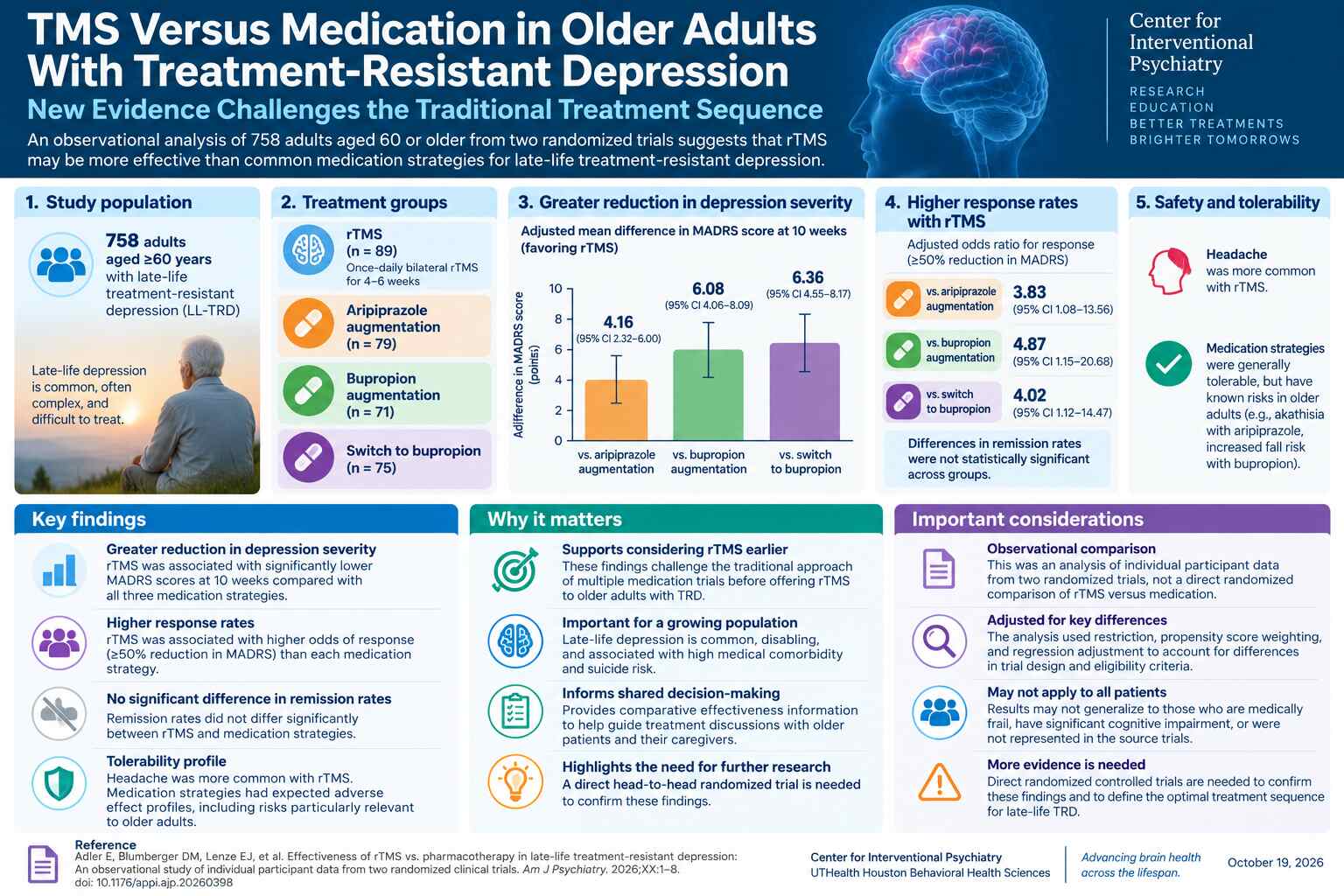
The investigators pooled individual participant data from two previously conducted randomized clinical trials: FOUR-D, which compared standard bilateral rTMS with bilateral theta-burst stimulation, and OPTIMUM, which compared aripiprazole augmentation, bupropion augmentation, and switching to bupropion. The current study analyzed 758 eligible participants: 160 from FOUR-D and 598 from OPTIMUM.
Importantly, participants were randomized within their original trials, not between TMS and medication. For the new comparison, investigators used eligibility restrictions, propensity-score overlap weighting, and regression adjustment to reduce measured differences between the two trial populations. The primary outcome was depression severity at 10 weeks, measured with the Montgomery–Åsberg Depression Rating Scale (MADRS).
What Were the Main Findings?
At week 10, rTMS was associated with lower (better) MADRS scores than each medication strategy. The adjusted differences favoring rTMS were 4.16 points compared with aripiprazole augmentation (95% CI, 2.32–6.00), 6.08 points compared with bupropion augmentation (95% CI, 4.06–8.09), and 6.36 points compared with switching to bupropion (95% CI, 4.55–8.17).
Response—defined as at least a 50% reduction in MADRS score—was also more likely with rTMS. Adjusted odds ratios were 3.83 versus aripiprazole augmentation, 4.87 versus bupropion augmentation, and 4.02 versus switching to bupropion. Although remission was numerically more frequent with rTMS, none of the remission comparisons reached statistical significance. Thus, the study supports a response and symptom-severity advantage, not a proven remission advantage.
At week 4, rTMS and aripiprazole augmentation did not differ significantly on depression severity, whereas rTMS was associated with better outcomes than either bupropion strategy. This suggests that the relative differences may evolve over the course of treatment rather than appearing immediately.
What About Safety and Tolerability?
Headache was significantly more common among participants receiving rTMS than among those receiving the medication strategies. The researchers found no statistically significant differences for the other adverse events measured consistently across trials: nausea or vomiting, dizziness, fatigue, and falls. These findings should not be interpreted as proving that all risks are equivalent: the analysis assessed only selected adverse events and was not a direct randomized safety comparison.
For older adults, treatment selection must also account for polypharmacy, movement-related adverse effects, fall risk, medical comorbidities, and the practical demands of repeated clinic visits. Conventional TMS generally requires in-person sessions on multiple days each week. Travel, caregiver availability, transportation, and insurance coverage can be decisive factors.
Why the Findings Matter for Interventional Psychiatry
In clinical practice, TMS is sometimes discussed only after numerous medication changes have failed. This study challenges the assumption that another medication trial must always precede a neuromodulation referral. For an older adult with persistent symptoms despite adequate treatment, TMS may deserve consideration alongside switching or augmentation—not merely after those options have been exhausted.
The key principle is shared decision-making. A patient who wishes to avoid additional medication burden may place greater value on a nonpharmacologic option. Another patient may prefer medication because travel for repeated TMS sessions is impractical. Treatment history, severity, prior tolerability, functional impairment, medical conditions, and patient preference all matter.
The findings are specifically about once-daily bilateral rTMS and theta-burst approaches studied in FOUR-D. They should not be generalized automatically to every TMS protocol, including newer accelerated or SAINT-type regimens. The authors note that accelerated approaches could reduce treatment-day burden, but their effectiveness relative to medication in older adults requires further study.
What the Study Cannot Establish
This is a sophisticated observational comparison, not a head-to-head randomized trial assigning older adults to TMS or pharmacotherapy. Statistical adjustment balanced measured baseline characteristics, but unmeasured differences between trials could still influence the results. The effective sample sizes after weighting were smaller than the nominal 758 participants, reducing precision—especially for response and remission estimates. Week-10 outcomes were missing for some participants and handled using multiple imputation.
The comparison also covered three specific medication strategies; it did not compare rTMS with all antidepressants, other augmentation approaches, psychotherapy, ketamine or esketamine, or electroconvulsive therapy. The results are therefore clinically informative, but not a universal ranking of available treatments.
The UTHealth Houston Perspective
At the Center for Interventional Psychiatry, the most useful question is not simply how many medications a patient has tried. It is whether the current strategy is producing meaningful recovery, whether the treatment burden is acceptable, and whether another mechanism of action may offer a better next step. This is particularly important in late-life depression, when prolonged symptoms can undermine independence, cognition, relationships, and quality of life.
The Adler study adds evidence supporting timely specialty evaluation and thoughtful consideration of TMS for older adults with TRD. It does not mean that every older patient should receive TMS, or that medication augmentation has no role. Rather, it supports making neuromodulation part of the conversation sooner when standard treatment is not delivering adequate improvement.
Looking Ahead
Prospective randomized trials directly comparing TMS with medication strategies in older adults are still needed. Future research should also examine durability of benefit, cognition, functional outcomes, patient-centered burden, cost-effectiveness, and the performance of accelerated stimulation protocols in late-life TRD.
For now, the clinical takeaway is clear: older adults with persistent depression deserve an individualized discussion of evidence-based options, including TMS, before repeated medication changes become the default pathway.
Reference
Adler E, Blumberger DM, Lenze EJ, et al. Effectiveness of rTMS vs. Pharmacotherapy in Late-Life Treatment-Resistant Depression: An Observational Study of Individual Participant Data From Two Randomized Clinical Trials. American Journal of Psychiatry. Published online October 14, 2026. doi:10.1176/appi.ajp.20260398. https://doi.org/10.1176/appi.ajp.20260398
Contact
Center for Interventional Psychiatry
UTHealth Houston Behavioral Health Sciences
Request for Second Opinion: https://Go.uth.edu/CIPIntake
Phone: (713) 486-2621
Fax: (713) 500-2728
Email: [email protected]
Website: https://go.uth.edu/CIP
Disclaimer
This article is intended for education and does not constitute individualized medical advice. Treatment decisions should be made with qualified healthcare professionals based on clinical circumstances and patient preferences.
Artificial intelligence was used as a scientific writing support tool. The final text has been reviewed and approved by João L. de Quevedo, MD, PhD.