Vagus Nerve Stimulation for Treatment-Resistant Depression: What the RECOVER Trial Teaches Us About Meaningful and Lasting Recovery
For people living with profoundly treatment-resistant depression, progress does not always follow the timeline—or meet the thresholds—used in conventional antidepressant trials. A new review of the RECOVER trial, published in the American Journal of Psychiatry, raises an important question: how should we recognize meaningful treatment benefit when illness has persisted for years despite extensive treatment?
The answer may require looking beyond a single symptom score. The RECOVER findings suggest that adjunctive vagus nerve stimulation (VNS) can provide benefits in depressive symptoms, everyday function, and quality of life for some people with exceptionally difficult-to-treat depression. Yet the results also demand careful interpretation: the trial did not meet its prespecified primary efficacy outcome.
What is VNS—and who was studied?
VNS uses a surgically implanted pulse generator and lead to deliver electrical stimulation to the left cervical vagus nerve. In the United States, VNS received FDA approval for treatment-resistant depression in 2005, but coverage restrictions have limited access. RECOVER was developed in the context of Medicare’s coverage-with-evidence-development process.
The multicenter RECOVER study enrolled 493 adults with nonpsychotic major depressive disorder and at least four verified adequate antidepressant treatment failures during the current episode. Participants had unusually severe and persistent illness: the current depressive episode averaged 17.8 years, and the group had received an average of 13.3 lifetime antidepressant treatments. About 75% were unemployed; approximately two-thirds had previously not benefited sufficiently from an interventional treatment such as ECT, TMS, or ketamine.
All participants underwent implantation and continued usual care. During the first 12 months, they were randomized to active or sham VNS, with monthly symptom assessments and periodic measures of function and quality of life. The sham group’s devices were activated after the blinded year, and longer-term follow-up continued.
The primary outcome was negative
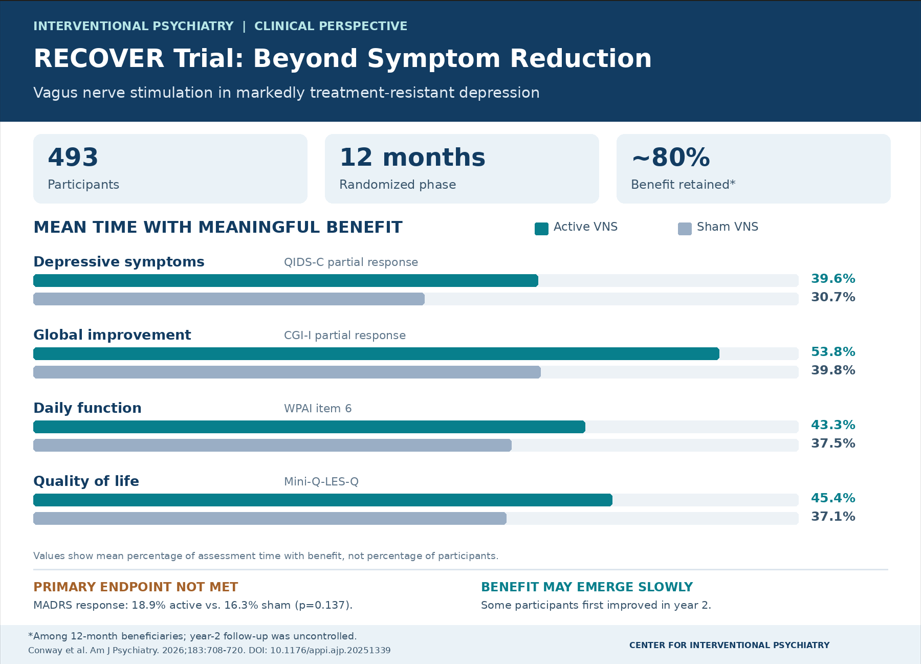
The trial’s prespecified primary outcome was the percentage of time participants spent in MADRS-defined response across months 3 through 12. Active VNS and sham VNS did not differ significantly: 18.9% versus 16.3% (p=0.137). This is a central result, not a technical footnote. It prevents us from describing RECOVER as an unequivocally positive trial on its primary endpoint.
Other prespecified and exploratory measures told a more encouraging—but more complex—story. For example, the percentage of time in partial response on the clinician-rated QIDS was 39.6% with active VNS versus 30.7% with sham (p=0.006). On the Clinical Global Impressions improvement measure, time in partial response was 53.8% versus 39.8% (p<0.001). Some other symptom measures, including MADRS partial response across the full interval, did not reach statistical significance. Analyses of multiple secondary outcomes were exploratory and were not adjusted for multiple comparisons.
Why functioning and quality of life matter
Depression is not experienced only as a numerical symptom score. For patients who have been ill for many years, being able to participate in daily activities, reconnect with family, or experience greater satisfaction in life can represent a meaningful change—even without full remission.
In RECOVER, active VNS was associated with more time showing meaningful improvement in daily function (43.3% versus 37.5% on the WPAI activity-impairment item) and in quality of life (45.4% versus 37.1% on the Mini-Q-LES-Q). A composite approach that considered symptoms, function, and quality of life also favored active VNS. These domains did not always improve together: a patient could benefit in one without crossing a threshold in another.
This does not mean that partial improvement should replace remission as the goal. It means that in markedly resistant illness, a multidimensional assessment may better reflect what patients and families value—and may detect gains that a single conventional response threshold misses.
A treatment whose benefits may emerge slowly
One of the most consequential RECOVER observations concerns timing. VNS is not generally a rapid-acting intervention. The separation between active and sham stimulation tended to be greatest late in the blinded year, particularly during months 10–12. Averaging response across months 3–12 may therefore have diluted a delayed treatment effect.
In the subsequent, uncontrolled follow-up of participants who received active VNS in the first year, the median retention of at least meaningful benefit across seven outcome measures was 83.1% at 18 months and 81.3% at 24 months among those who had benefited at month 12. Some participants who had not benefited at 12 months first showed meaningful gains during the second year. The overall MADRS remission rate at 24 months was approximately 21.5%.
These are encouraging observations, especially in such a severely ill population. But because the second-year analysis was naturalistic rather than sham-controlled, the persistence and later emergence of benefit cannot be attributed with certainty to VNS alone.
What about patients who have already tried ECT or TMS?
Prior failure of interventional treatments was associated with a poorer overall prognosis. Nevertheless, subgroup analyses generally favored active over sham VNS even among participants with prior ECT or TMS exposure. The authors suggest that VNS might be considered earlier in an appropriate treatment sequence, while remaining a potential option after other interventions have not provided sustained benefit.
These subgroup findings are hypothesis-generating. They do not establish an optimal sequence of VNS, ECT, TMS, or ketamine, and should not be interpreted as a reason to delay treatments needed urgently for severe suicidality, psychosis, or catatonia.
Safety, burden, and the limits of the evidence
VNS requires surgery, programming, ongoing monitoring, and a willingness to wait months for potential benefit. The review reports no new safety signals in RECOVER; reported adverse events included voice changes, implant-site pain, breathing discomfort, and worsening depression or suicidal ideation, requiring careful monitoring. The trial excluded participants with active suicidal intent or recent suicide attempts, among other exclusions, so its findings should not be generalized uncritically to those clinical situations.
The publication is a review and interpretation of multiple RECOVER reports, not a new independently randomized trial. The study and article involved support from LivaNova, the device manufacturer; relevant author relationships are disclosed in the paper. The negative primary endpoint, secondary-outcome multiplicity, delayed response, and uncontrolled durability data all matter when evaluating the strength of the evidence.
The Center for Interventional Psychiatry perspective
For interventional psychiatry, RECOVER reinforces the need for matched, longitudinal care. Different treatments serve different clinical needs. ECT may be appropriate when rapid and robust intervention is necessary; TMS and accelerated TMS offer noninvasive approaches; ketamine-based treatments may be considered in selected patients; and implanted VNS may be relevant for carefully evaluated patients with longstanding, highly treatment-resistant depression who can commit to a longer therapeutic horizon.
A comprehensive evaluation should establish the accuracy of the diagnosis, adequacy of previous treatments, current symptom burden, suicidality, functional impairment, patient preferences, and practical access to care. Outcomes should then be tracked across symptoms, function, and quality of life—not merely counted as “response” or “nonresponse.”
Looking ahead
The most important lesson from RECOVER may be methodological as well as clinical: a treatment with delayed and potentially durable effects cannot necessarily be evaluated using the same timing and endpoints as a six-week antidepressant trial. Future research must determine which patients benefit most, when benefit becomes clinically meaningful, how it persists, and how VNS compares with other interventional strategies.
For patients who have endured years of depression, recovery may begin with a modest but sustained improvement in the ability to live. Recognizing that progress—without overstating what the evidence proves—is an important part of responsible, patient-centered care.
Reference
Conway CR, Sackeim HA, Rush AJ, et al. The RECOVER Trial of Vagus Nerve Stimulation in Markedly Treatment-Resistant Depression: Critical Findings, Lessons Learned, and Future Directions. American Journal of Psychiatry. 2026;183(10):708–720. doi:10.1176/appi.ajp.20251339.
Contact
Center for Interventional Psychiatry
UTHealth Houston Behavioral Health Sciences
Request for Second Opinion: https://Go.uth.edu/CIPIntake
Phone: (713) 486-2621
Fax: (713) 500-2728
Email: [email protected]
Website: https://go.uth.edu/CIP
https://redcap.uth.tmc.edu/surveys/?s=MTJFFCANLREC8CML (external link)
Disclaimer
This post is educational and is not individualized medical advice. Treatment selection requires evaluation by qualified healthcare professionals. Artificial intelligence was used as a scientific writing support tool; the final text has been reviewed and approved by João L. de Quevedo, MD, PhD.