Innovations in cardiology take center stage
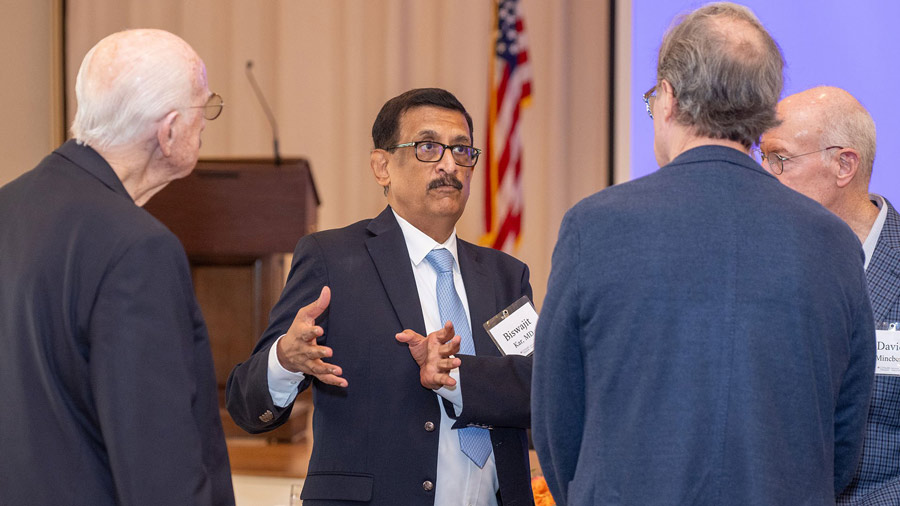
Breakthroughs in artificial intelligence, advanced imaging, and next-generation therapies are reshaping the future of cardiology, and UTHealth Houston is at the forefront.
At the Junior League of Houston’s “Bite-Sized Medicine: How to Keep Your Heart Healthy” lunch-and-learn Feb. 12, university leaders highlighted how research, innovation, and prevention are transforming the fight against the world’s leading cause of death.
A shared commitment to heart health
“Cardiovascular disease remains the leading cause of death worldwide. It’s likely many of us here know somebody who has been impacted,” said Chris Kasavich, MBA, assistant vice president in the Office of Development. “At UTHealth Houston we’re committed not to just advancing the prevention and limiting the trauma of this disease, but also to help patients and families navigate the path to better health.”
Kasavich welcomed and honored members of the Patient Navigator Program, who were in attendance at the event. The Patient Navigator Program is a dedicated team of nurses, available by phone, who assess symptoms and connect patients with the most appropriate clinical provider.
LaTanya J. Love, MD, dean and H. Wayne Hightower Distinguished Professor in the Medical Sciences at McGovern Medical School at UTHealth Houston, introduced the keynote speaker for the event, Biswajit Kar, MD. Kar is a professor and Memorial Hermann Chair in the Department of Internal Medicine and vice president for Strategy and Development for UTHealth Houston Heart and Vascular.
“Each one of us knows somebody that has been impacted by cardiovascular disease, or maybe we have personally been impacted,” Love said. “However, we are so excited that we continue to have new developments in cardiovascular research and artificial intelligence that are making it more possible to quickly diagnose and effectively treat heart disease than at any point in history.”
From decades of discovery to rapid innovation
Kar expanded on this theme, mentioning that when he first started in the field of cardiology, research could take decades. With advances in technology, and the introduction of artificial intelligence in the field, what once took years is now being achieved in weeks.
“This is an extraordinarily exciting era in cardiovascular medicine,” Kar said. “Discoveries that once required decades now unfold in years or even months. For students and trainees, the opportunity to shape the future of heart care has never been greater.”
Targeting the world’s leading killer
However, despite all of the progress made in the field, coronary artery disease remains the leading cause of death in the world.
He shared that by age 40, lifetime risk of coronary artery disease approaches 40% to 50% and that it accounts for roughly 20% of deaths in the United States and up to one-third of deaths globally.
“If we could eliminate coronary artery disease, we would remove the single greatest cause of mortality worldwide,” Kar said.
Kar mentioned that currently cardiology often focuses on patients who are already experiencing chest pain, heart attacks, or a form of obstructive disease. However, he said that true population impact will require diagnosis before obstruction and ideally have prevention before diseases even develop.
Preventing disease before it starts
According to Kar, the six major risk factors that drive most coronary artery disease are abnormal lipids, smoking, high blood pressure, diabetes, abdominal obesity, and poor diet and inactivity. He said that by aggressively treating lipids, adding smoking cessation and blood pressure control, we can eliminate nearly two-thirds of coronary artery disease risk.
Kar shared research on the Tsimane, a group of nearly 10,000 Amazonians living in northeastern Bolivia. The Tsimane live a lifestyle fully based on hunting, foraging, and farming, and in turn live virtually free of the major risk factors found in coronary artery disease.
“With healthy diet, limited alcohol, and regular physical activity, as much as 90% of disease risk could be reduced,” Kar said. “The remaining portion reflects genetic factors, which are now an emerging research focus.”
Emerging technologies in cardiac care
Kar then shared new therapies and technology that will help curb the risk of coronary artery disease and take important steps to possibly eliminating the disease altogether in the future.
He mentioned new long-acting lipid-lowering treatments, such as twice-yearly injectable medication, that can significantly reduce lifetime cholesterol burdens as well as advanced imaging and inflammatory biomarkers that allow earlier detection and targeted treatment before heart attacks occur.
Another area of focus for cardiology research is in sudden cardiac death, which accounts for one-fifth of deaths in the United States. Kar showed examples of emerging technologies like AI-enabled electrocardiographic analysis and wearable detection systems, which may identify dangerous signals before an attack and enable lifesaving intervention and prevention.
The next frontier: Heart failure and regeneration
Heart failure and cardiogenic shock represent the third frontier of cardiovascular research according to Kar. He mentioned that while mechanical circulatory devices and transplantation save lives, there is a scarcity of donor organs available. Through new technologies using advanced imaging, AI-guided device optimization, and next-generation artificial hearts, cardiologists can improve survival and reduce complications such as stroke, bleeding, and infection.
Many transformative possibilities are becoming reality in the field of cardiology. Treatments like the regeneration of heart muscle after injury, biologic or leadless pacemakers, AI-driven continuous cardiac monitoring, gene-editing therapies, and possibly even bioengineered replacement hearts may soon be available. Many are already in early clinical testing.
“If the future feels unimaginable, it will always remain distant,” Kar said. “But when we can clearly envision it, progress accelerates, and that future quickly becomes the present.”