Vigilance and Multidisciplinary Surgical Expertise Give a Two-Time Cancer Survivor a Fresh Start
 In 2024, while using a magnifying mirror to put on makeup, Meredith Young spotted a slightly thicker area on her neck near her right earlobe. “It was very subtle – nothing to set off alarm bells,” she says. “One of my regularly scheduled doctor appointments was coming up, and after examination, we thought it might be a swollen muscle from clenching and grinding my teeth at night. Shortly afterwards, I was scratching behind my right ear and felt a swollen lymph node about the size of a BB.”
Young had been diagnosed with breast cancer 15 years earlier, and her follow-up appointment with her breast oncologist was scheduled for three days later. “I was supposed to graduate from seeing her, but instead, it was the beginning of my second cancer journey,” Young says. “The biopsy was positive for cancer, and obviously surgery was the next step, but where to go with a rare salivary gland cancer? I remembered I’d met a young medical student who planned to become an ENT years earlier in my Bible study class – Dr. Douglas Stanley. Because he’s in the UTHealth Houston system, he could access my imaging and biopsy results online. He recommended that I see a doctor in his practice who specializes in head and neck cancer.”
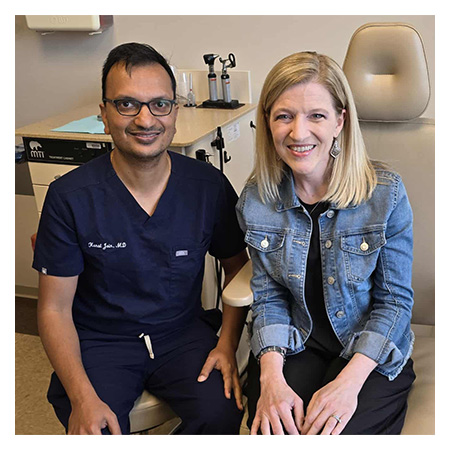
She scheduled an appointment with Kunal Jain, MD, an associate professor in the Department of Otorhinolaryngology at McGovern Medical School at UTHealth Houston. Dr. Jain treats patients with benign and malignant tumors of the head and neck, including throat cancer, oral cancer, larynx cancer, locally advanced skin cancer, salivary gland tumors, and thyroid and parathyroid disease, and he also performs reconstructive surgery. “I felt comfortable with him immediately. He was knowledgeable and patient and took time to answer all my questions,” Young says. “By the time I left his office, I had complete confidence in him.”
Although salivary gland cancer is uncommon, Dr. Jain treats a number of these patients each year. “For Meredith, unfortunately, the pathology report from the fine-needle biopsy revealed mucoepidermoid carcinoma,” he says. “The MRI showed that the cancer was located exactly where the facial nerve exits the skull.”
Because of the complexity of Young’s case, he consulted with two other faculty in the Department of Otorhinolaryngology: Tang Ho, MD, chief of facial plastic and reconstructive surgery and director of the Texas Center for Facial Plastic Surgery, and Vivian Kaul, MD, chief of otology, neurotology, and lateral skull base. “We discussed whether we would have to sacrifice her facial nerve to remove all the cancer,” Dr. Jain says. “Dr. Kaul has the skill to drill out the temporal bone, which would give us good access to the nerve, allow us to clear out the cancer, and hopefully, save the nerve. If she needed reconstructive surgery, Dr. Ho has the expertise.”
Dr. Jain took her to the OR on Oct. 30, 2024, as her primary surgeon. “Thankfully, we didn’t need to remove the facial nerve but because of the size of the cancer, we removed the right parotid gland, which left her with a sizeable defect,” he says. “Dr. Ho was able to fill it with tissue from other locations to give her face a better contour.”
The surgical team felt confident they had removed all the cancer except on the facial nerve. “We cleared that margin but there’s a difference between pathological clearance and what we can see with our eyes,” Dr. Jain says. “Intraoperatively, we decided that the nerve looked good, so we opted to treat her with postop radiation therapy rather than remove it.”
Young came out of anesthesia with facial paresis – weakness of the facial muscles. “I was grateful they didn’t take the nerve, but recovery was a waiting game,” she says. “Will I remain unable to blink? Will I be able to smile? Will I be able to interact with people I pass in the hallway? I had to decide whether I’d stay in my house and hide from the world or go out and try to live normally. Social media allowed me to tell my story once instead of again and again. I could update everyone, and the outpouring of support and love was therapeutic for me.”
Five weeks after the surgery, Young started radiation therapy and went on to complete 33 sessions. A PET scan done three months after her treatment showed no evidence of cancer.
Seven weeks after the surgery, during speech therapy at TIRR Memorial Hermann, the right side of her bottom lip moved slightly. “Today, people say I look like I always did,” she says. “You never want to have this kind of surgery, but I had a fantastic team, from the surgeons to the anesthesiologist to the nurses who cared for me. I’m so grateful that Dr. Jain had the skill to spare my facial nerve.”
“Paresis is standard for about two months after any surgery that disrupts the facial nerve,” Dr. Jain says. “Meredith has made great progress. Before moving forward, she talked with doctors at other institutions but gravitated back to us because she felt we offered the most personalized care. We’re all in the same building and try to make sure our patients don’t feel like they’re plugged into a health care machine. At 51, she’s a young, highly functional person who had concerns about her appearance after surgery. We took all those things into consideration.
“The fact that all her doctors are at Memorial Hermann and UTHealth Houston helped streamline her care,” he adds. “All imaging results and doctor’s notes are in the electronic health record so we’re all on the same page. It helps us make good decisions and allows the patient to focus on healing.”
Young knows firsthand how well this system works. “I had no symptoms, but cancer survivors tend to know when something has changed,” she says. “Things can happen quickly and it’s important to talk with a doctor who hears you. With a cancer diagnosis, anything your health care providers can do to make your journey easier allows you to focus your energy on battling cancer. I’m fortunate to have a great team. All three surgeons are skilled, but Dr. Jain is particularly amazing. Surgeons can’t make promises, and he did a great job of presenting me with the facts and my treatment options. Plus, I could tell that he genuinely cares.”