Champions of Clinical Learning Environment: Atai and Stafford
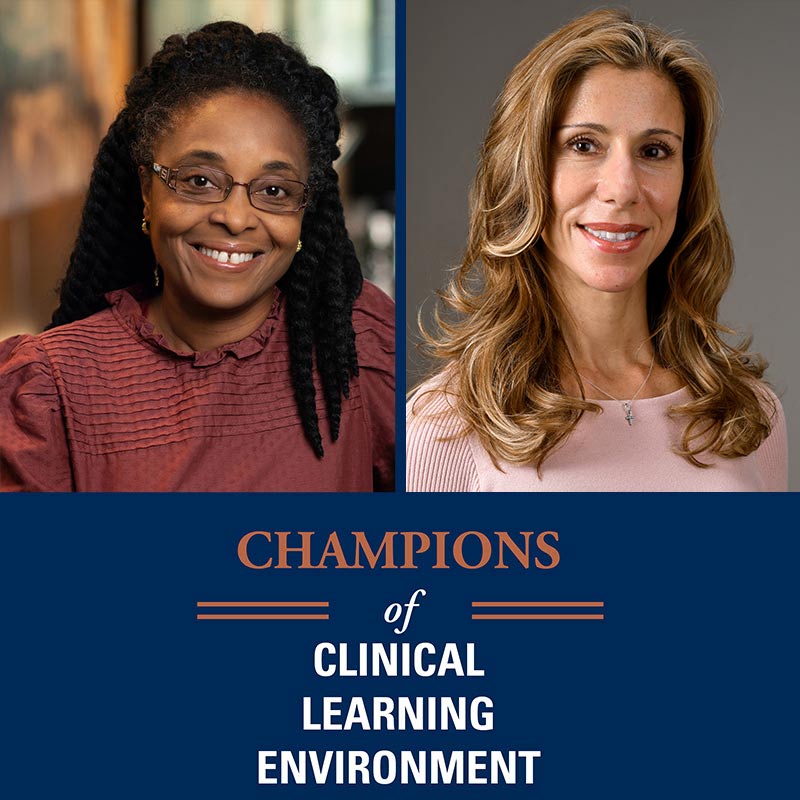
The Office of Professionalism at McGovern Medical School at UTHealth Houston congratulates Faith Atai, MD, and Irene Stafford, MD, MPH, MS, on being honored as Champions of the Clinical Learning Environment.
Champions are identified through the Learning Environment Surveys, which are sent to students and provide an opportunity to recognize faculty whose everyday actions have meaningfully shaped their clinical education.
This series spotlights Champions of the Clinical Learning Environment. Each issue highlights educators who have made a lasting impression on third-year medical students during clerkship rotations by fostering clinical learning environments rooted in professionalism, compassion, and academic rigor.
Faith Atai, MD
Associate professor in the Department of Internal Medicine
How would you describe your teaching philosophy?
My teaching philosophy is to generate interest in my learners by making what I have to teach relevant to their interests and goals. Anyone can learn with the right amount of interest and motivation.
What do you enjoy most about working with medical students during their training?
What I enjoy most about working with medical students is learning from them and watching them grow. They also keep me grounded in the basics and current on which, if any, classroom teachings have changed. It is always rewarding to meet a student in their first or second year (like problem-based learning) and then later in their training (late third or fourth year). I always find it fascinating how much difference even a year of training can make.
What is a memorable moment or teaching success story from working with third-year medical students?
There are several instances I can think of where students have incorporated what they have learned in my clinic into their handling of situations in their own families. In one case, a student left straight after clinic to visit her grandmother at the long-term care facility because a case in clinic alerted her to some possible red flags going on around her grandmother. Her deductions had been correct—there was some bullying going on at the facility among the residents, and she was able to address it. Like in most such instances, she told me about it after the fact. It was extremely rewarding to see how relevant her geriatrics rotation had become, even on a personal level.
Irene Stafford, MD, MPH, MS
Associate professor in the Department of Obstetrics, Gynecology, and Reproductive Sciences
How would you describe your teaching philosophy?
I would say my teaching philosophy emphasizes hands-on, full immersion with enthusiastic support. The experience of practicing medicine during each valuable rotation far outweighs any book or lecture.
Do you have a particular practice that has proved effective in your clinical teaching?
I like incorporating an element of surprise in my approach to teaching. For me, the best method involves spontaneity and adventure with each student. Every patient and clinical scenario presents a teaching moment that makes learning real and fun.
What do you enjoy most about working with medical students during their training?
Seeing their joy and self-confidence grow as they successfully implement skills that they were taught.