Improving Diagnostics for Deep Space Missions
Expanding Imaging Strategies in Space Medicine

A recent study (external link) indexed in PubMed evaluated the diagnostic utility of ultrasound and X-ray across 119 high-risk medical conditions identified by NASA (external link)for deep space missions.
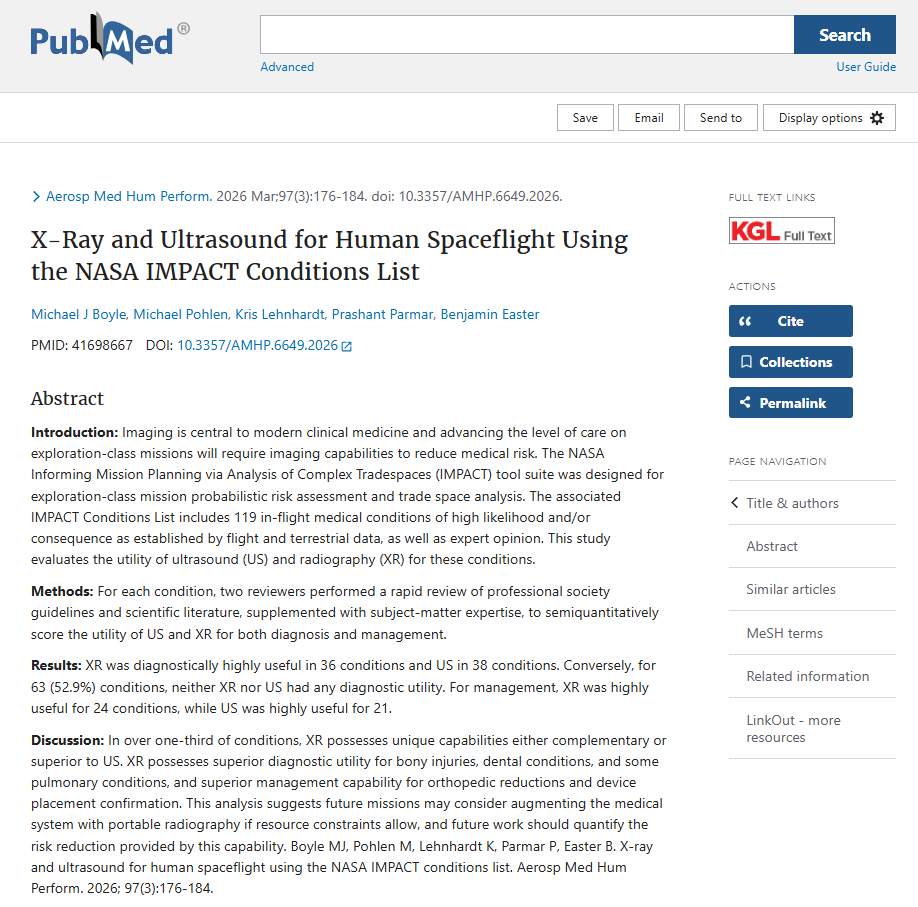
The study found that while both imaging modalities are useful in roughly 1/3 of these conditions, each has limited value in more than half.
Although ultrasound is often emphasized in spaceflight due to its portability, X-ray provides important complementary value in a number of scenarios, particularly for both diagnosis and management.
These findings suggest that relying on ultrasound alone for exploration-class missions may leave gaps in care. Incorporating X-ray capability could help improve clinical decision-making and reduce medical risk during long-duration spaceflight. This work highlights ongoing efforts in space medicine, including contributions from Kris R. Lehnhardt, MD, FACEP.
Nice work to Dr. Lehnhardt!