Welcome from the Chiefs
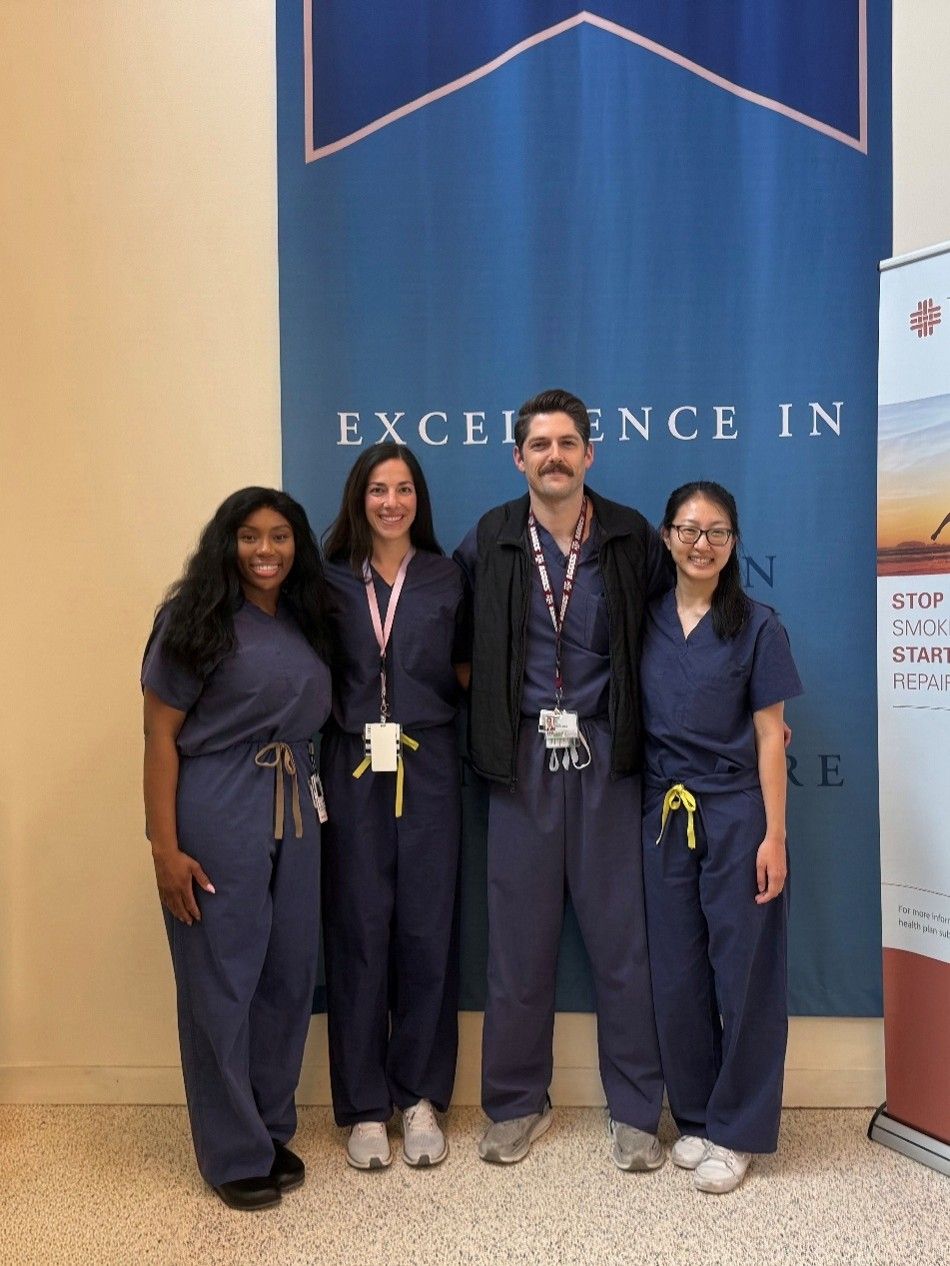
2026-2027 Chief Residents. Left to right, Stephanie Assimonye, Sydney Cooper (IR chief), Joe Wilder, and Lorna Min
Welcome to the UT Houston Diagnostic Radiology residency program! We are delighted that you chose to pursue a career in radiology. As chief residents, we are very excited to share why we chose UT Houston and what makes this residency one of the top programs to train in the country.
Our Residents: UTHealth Houston is home to one of the nation’s largest radiology residency programs, with 62 total residents representing diverse backgrounds from across the country and around the world. Our residents are truly exceptional. We support one another, learn from each other, and take pride in the collegial environment that defines our program. During our time at UTHealth Houston, we develop not only into skilled radiologists and professional colleagues but also lifelong friends.
Our Faculty: Our faculty are deeply committed to resident education and are recognized experts in their respective fields. Many are nationally and internationally renowned and hold active roles in leading professional organizations, including the RSNA, ARRS, AUR, and others. Faculty lead a wide range of projects in research, quality improvement, and medical education, providing residents with numerous opportunities to get involved. Residents can readily find mentors who will support their professional development and help them pursue their individual interests and career goals.
Clinical Experience and Education:
Training at Nationally and Internationally Recognized Institutions
Our residents train at several nationally and internationally recognized institutions, including Memorial Hermann Hospital (one of the nation’s busiest Level I trauma centers), Lyndon B. Johnson Hospital (Greater Houston county hospital), MD Anderson Cancer Center (world-renowned cancer hospital), and Texas Children’s Hospital (one of the country’s top pediatrics hospitals). Training across these diverse institutions provides residents with exceptional exposure to high-acuity trauma, complex oncologic imaging, advanced pediatric care, and a remarkable breadth of uncommon pathology.
Learning at the Workstation and Beyond
Our daily workstation experience is generally organized into morning and afternoon sessions. Residents interpret and dictate studies independently before reviewing cases one-on-one with attending radiologists. These readouts provide dedicated time to discuss imaging findings, refine diagnostic reasoning, and explore important pearls and potential pitfalls.
Residents also gain hands-on experience with a broad range of image-guided procedures across interventional radiology, abdominal imaging, musculoskeletal imaging, breast imaging, pediatric radiology, and neuroradiology. Beyond the reading room, residents work closely with technologists and clinical teams, serving as imaging consultants and helping to answer questions, troubleshoot examinations, and guide patient care.
Progressive Call Experience
Our call curriculum progressively builds confidence, efficiency, and independence through increasing responsibility and case complexity. R1 residents begin with several supervised “baby call” shifts in the spring, working alongside upper-level residents to learn the evening workflow.
During the R2 year, residents primarily take call at Lyndon B. Johnson Hospital and MD Anderson Cancer Center. At LBJ, residents work alongside an in-house emergency radiology attending to cover the emergency department list while independently providing preliminary interpretations of urgent inpatient body, neuroradiology, and musculoskeletal examinations. At MD Anderson, an in-house body imaging attending is available while residents independently interpret oncologic emergencies and STAT inpatient chest, neuroradiology, and musculoskeletal examinations. These studies are reviewed by the appropriate subspecialty attending the following day, providing meaningful autonomy within a structured learning environment.
In the R3 year, residents transition to Memorial Hermann Hospital, where they apply the independence developed during R2 call to a greater volume of complex, high-acuity emergency and trauma imaging at one of the nation’s busiest Level I trauma centers. In the spring, R4 residents assume Memorial Hermann call responsibilities to support R3 ABR Core preparation.
Conferences and Didactic Education
An hour is set aside each weekday for dedicated academic time, generally between 12pm-1pm. This protected academic time is split between more formal lectures, including didactics and case-based conferences, and asynchronous online lecture material that can be completed by each individual resident in a way that best suits them. There is also a dedicated Fundamentals lecture series for R1s every Wednesday afternoon for the entire year that is meant to assist in learning radiology basics and gradually prepare them for call. In addition, all residents may attend subspecialty-specific conferences on each rotation. During the months before the Core Exam, R3s may elect to attend Board Review sessions.
Leadership
Our program cultivates resident leaders. Our residents are actively involved in the House Staff Senate and various program committees, such as our Program Evaluation Committee, Resident Discrepancy Review Committee, and Mentorship Committee. We also have resident leaders involved on a state and national level in organizations, such as the Texas Radiological Society (TRS), RSNA, SIR, ARRS, and AUR. Our leaders continue to advocate for fellow trainees and make a lasting impact in various ways.
Specialized Education Tracks
Our program offers various opportunities for residents to learn and expand on special interests. Examples include our Clinician-Educator Track, combined Diagnostic Radiology/Nuclear Medicine pathway, combined Diagnostic Radiology/Pediatrics pathway, ESIR, and a dedicated Research Track.
Scholarly Opportunities
We encourage all residents to participate in scholarly projects, such as those in research, quality improvement, and medical education. Many faculty members in the Texas Medical Center are involved in clinical projects, and we offer a dedicated faculty mentor database for trainees to easily identify mentors with similar interests and projects. We encourage residents to present at national or international conferences, which is generously supported by our department funds.
Moonlighting
Residents have access to numerous moonlighting opportunities throughout the Texas Medical Center, including Memorial Hermann Hospital, its satellite locations, and MD Anderson Cancer Center. These after-hours experiences include managing contrast reactions, protocoling examinations, and providing preliminary interpretations of imaging studies. Eligible residents may begin moonlighting at the beginning of R1 year.
Life in Houston
Houston is one of the largest metropolitan areas in the country. The city is home to over 2.4 million people and offers a rich spectrum of cultural enrichment opportunities, consistently ranking as one of the most diverse cities in the nation. Aside from the endless eclectic dining options Houston has to offer, there are many fun things to do in Houston – professional sporting events (NFL, NBA, MLB, MLS), NASA Johnson Space Center, Houston Rodeo, Theater District, Museum District, etc. Beyond the city, you can easily go on a weekend trip to Galveston, Austin, San Antonio, or Dallas. Houston also has two major airports (Hobby and IAH) and serves as a domestic and international hub for many cheap flights around the country and world.
Ultimately, our program provides the exceptional clinical training, graduated autonomy, mentorship, and diverse experiences residents need to become confident, well-rounded radiologists. Whether you envision a career in private practice, academic medicine, or another specialized path, UTHealth Houston will prepare you to succeed.
We look forward to meeting you during interview season and sharing more about our program. Please do not hesitate to contact us with any questions!
Warm Regards,
Stephanie Assimonye, MD
Lorna Min, MD
Joe Wilder, MD
Chief Residents, 2026-2027