Research Newsletter Archive
Spotlight on Akshitha Yarrabothula, MD
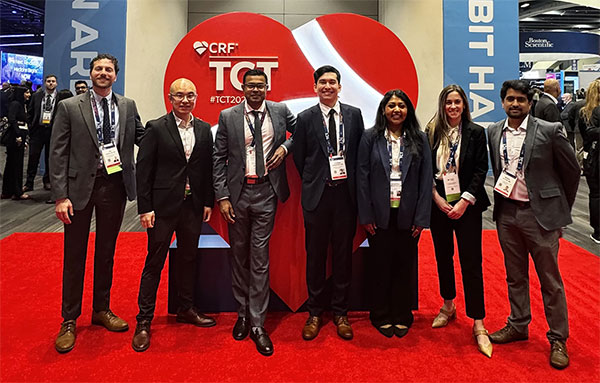 (2025-2026 Chief Cardiology Fellow)
TCT 2025 in San Francisco, CA
HydroDynamic Contrast Recanalization (HDR): 2-Year All-Comers Experience With a New Crossing Technique for Coronary Chronic Total Occlusions
Research mentors: Dr. Salman Arain and Dr. Angelo Nascimbene.
Co-authors are Dr. Goutham Ravipati and Dr. Mauro Carlino.
The objective of Dr Yarrabothula’s study, under mentorship from Dr. Arain and Dr. Nascimbene, was to evaluate the effectiveness and safety of hydrodynamic contrast recanalization (HDR) as a primary crossing strategy for chronic total occlusion (CTO) PCI in an all-comers cohort. In a consecutive series of 100 CTO PCI cases with heterogeneous lesion characteristics performed at a single institution, a contrast-first HDR strategy achieved a technical success rate of 76%. Importantly, there were no clinically significant perforations, myocardial infarctions, strokes, or deaths.
This study is among the first reporting the outcomes of the new crossing technique used to tackle chronic total occlusions, well known to be a technically challenging subset of coronary artery disease, with this expertise available only at some very specialized centers in the world.
Spotlight on PGY6 Dr. Andrew Kim
Heart failure with preserved ejection fraction (HFpEF) is increasingly being recognized as a leading cause of heart failure-related hospitalization and death, with its impact projected to exceed that of heart failure with reduced ejection fraction (HFrEF) over the coming years in part due to an aging population. The treatment has been challenging by a dearth of proven therapies and its overlap with other clinical syndromes, as well as a historical lack of diagnostic criteria. Existing research on heart failure among Hispanics have shown a rather high prevalence of cardiac dysfunction on echocardiography with only a minority of such cases resulting in overt clinical heart failure, as well as a younger median age of hospitalization for HFpEF compared to their non-Hispanic white counterparts.
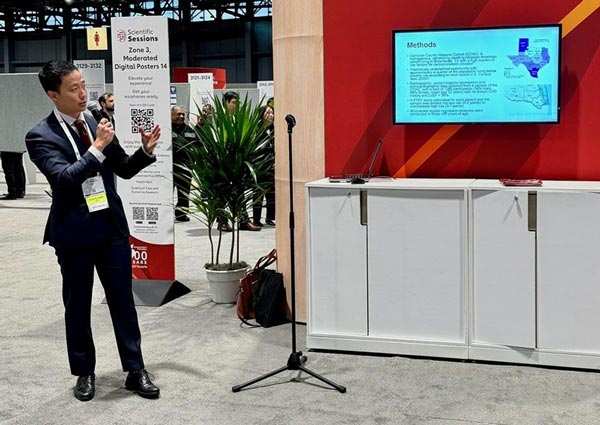
Dr. Kim presenting his work at the AHA Scientific session, held in November 2024 in Chicago, Illinois.
Mentors:Dr. Susan Laing and Dr. Soumya Patnaik
This project undertaken by Dr. Kim and his team is a sub-study of the Cameron County Hispanic Cohort (CCHC) study, a result of collaboration between the McGovern School of Medicine at UT Health Sciences Center in Houston and the UT School of Public Health in Brownsville. The study involves a multi-generational and ethnically homogenous population. Prior studies have noted a high prevalence of cardiometabolic disease compared to the US population at large, placing this cohort at increased lifetime risk for the development of HFpEF. The aim was to assess the prevalence of and identify risk factors for the development of HFpEF in this minority population.
The study included over 1200 patients who underwent routine echocardiography over a decade, excluding those with reduced left ventricular ejection fraction (<50%) as well as co-morbid cardiovascular disease. Using the H2FPEF score, both echocardiographic parameters and clinical data were utilized to quantify the prevalence of sub-clinical HFpEF among the participants. Subjects were then stratified based on score into categories of low and intermediate-high risk, as well as by age. Several key findings were identified. Approximately half the patients in the study cohort were found to be at increased risk for HFpEF based on the H2FPEF score. Among young patients (<60 years old), the metabolic syndrome (as determined by the standard criteria for hypertension, dyslipidemia, waist circumference, and hyperglycemia) was found to be a significant risk factor for the development of HFpEF in this population, even after adjusting for co-variates such as body mass index. Based on these findings, Dr. Kim et al concluded that the previously clinically validated H2FPEF score is a simple and useful tool to help identify those in this ethnic group at risk for HFpEF.
Since Hispanics represent a rapidly growing ethnic group in the United States, with most recent US Census data projecting representation of over 20% of the US population by the year 2030, this is a very important study to help identify high-risk groups for early initiation of preventive and life-saving therapies before transition to symptomatic HF.
Spotlight on Nicholas King, MD
Posters: Immune Checkpoint Inhibitor-associated Myocarditis Complicated By Conduction System Disease Needing Pacemaker Implantation: A Single Center Experience Of Pacing Outcomes
A Single Center Analysis Of Immune Checkpoint Inhibitor-associated Myocarditis And The Association Of Electrocardiographic Changes And Arrhythmias
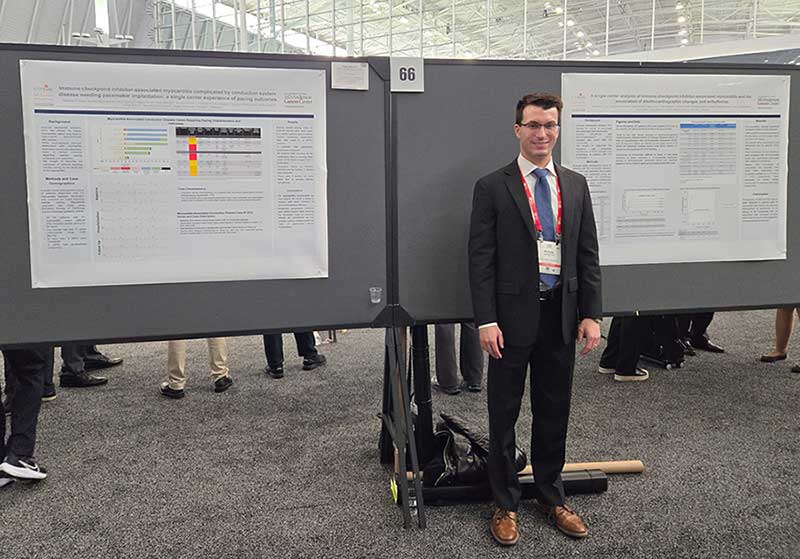
Dr. King presenting his posters simultaneously at HRS 2024
Posters Presented at: Research Retreat UT 2025, and Heart Rhythm Society (HRS) National Conference 2024
Publication: JACC case reports: https://www.jacc.org/doi/10.1016/j.jaccas.2024.103187 (external link)
Mentor: Dr. Nicolas Palaskas (external link)
Summary: Dr. King’s research focused on changes in the cardiac conduction system caused by immune checkpoint inhibitor (ICI) induced myocarditis. ICI’s represent a paradigm shift in cancer therapy by unleashing the immune system to fight malignancies. However, the complication of the immune activation can be severe bystander organ dysfunction including the heart. ICI induced myocarditis is rare but caries a high mortality. While conduction system disease is frequently associated with ICI myocarditis, the risk and outcomes of severe ICI myocarditis associated conduction disease is unknown. Dr. King and his team looked at the cohort of patients at MD Anderson cancer center who had confirmed ICI myocarditis to see what EKG changes they had and specifically what the long-term outcomes were and identified those with severe conduction disease requiring pacing. They found that ICI myocarditis increased the risk of arrhythmias and AV block, and that for patients who developed complete heart block, the pacing need was minimal after the acute myocarditis period. Therefore, they concluded that conduction disease associated with ICI myocarditis can be treated with temporary supportive pacing while the myocarditis is treated and is likely to resolve as the myocarditis resolves.
Spotlight on Jong Kun Park, MD
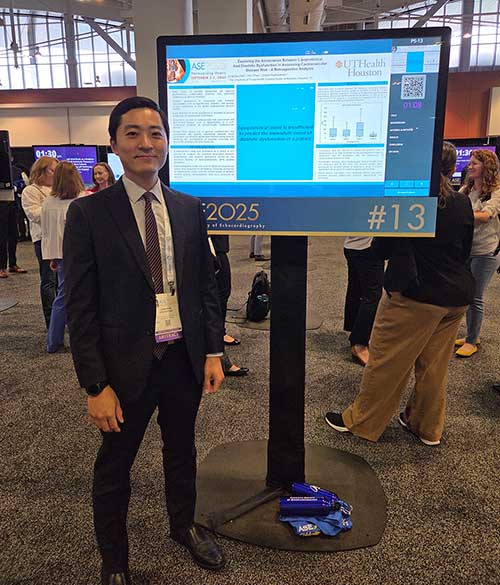 American Society of Echocardiography 2025
Exploring the Association Between Lipoprotein(a) and Diastolic Dysfunction in Assessing Cardiovascular Disease Risk – A Retrospective Analysis
Research Mentor: Dr. Deepa Raghunathan
Dr. Park’s research focused on investigating an association between lipoprotein(a) and diastolic dysfunction found on echocardiography. Dr. Park and his team conducted a single-center retrospective analysis and found that lipoprotein(a) alone is insufficient to predict the immediate onset of diastolic dysfunction in patients. A deeper analysis revealed that several factors, including a homogeneous cohort with predominantly healthy subjects and a lack of longitudinal temporal data between the variables, likely contributed to the statistical insignificance. Dr. Park is planning on organizing a larger-scale prospective trial, including global longitudinal strain along with advanced lipid profile tests, to provide a more robust analysis between lipidology and various echocardiographic parameters.